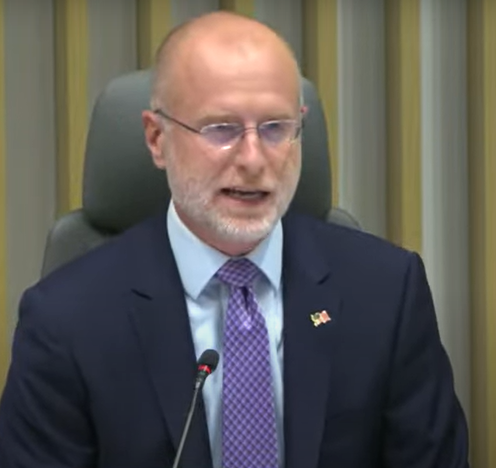
WASHINGTON, D.C. — Yes, the FCC is effectively shuttered due to the federal government shutdown due to lack of funding amid Capitol Hill squabbling between Republicans and Democrats. But that didn’t stop Chairman Brendan Carr from circulating a proposal on Friday to set interim rate caps and to review the IPCS framework.
The FCC head has circulated an item that would revisit the framework established by the FCC’s 2024 Incarcerated People’s Communications Services (IPCS) Report and Order. The item “aims to ensure that the FCC is achieving the statutory goals” Congress codified in the Martha Wright-Reed Act, while also addressing what the GOP-controlled Commission terms “the negative, unintended consequences that have flowed from the prior FCC’s approach—namely, unacceptable risks to safety and security as well as reductions in the availability of calling services.”
That’s a swipe at Jessica Rosenworcel’s tenure as FCC Chairwoman during the Biden Administration. Now, Carr wishes to erase that with an item that would set, on an interim basis, rate caps for IPCS that allow for the full inclusion of safety and security costs to correctional facilities and IPCS providers, consistent with the statute.
The item would also seek comment on other changes to the IPCS framework to ensure the continued availability of IPCS for incarcerated people at rates that are just and reasonable as required by the Martha Wright-Reed Act.
“For years, the FCC has been trying to adopt rates for inmate calling services that are at once just and reasonable for consumers and fair for providers and law enforcement agencies,” Carr said. “After all, when it comes to inmate calling services, public safety officials must account for unique safety and security risks as well as their attendant costs. The FCC has yet to find a path forward that is both lawful and sustainable over the long run. The FCC’s latest 2024 effort at rate setting is one such example. In aiming to significantly drop rates for consumers, the agency’s decision generated negative, unintended consequences.”
Carr added that dropping the rate caps too low made the cost of doing business too high for service providers and law enforcement alike, risking public safety and requiring calling services for inmates to be reduced or cut—the opposite of what the FCC intended.
“Today’s proposal aims to address these and other implementation challenges, helping to ensure that communications are more readily available and that the interim rate caps account for the costs of all safety and security measures that are necessary to providing inmate calling services, including the monitoring and recording of calls,” Carr said.
The proposed Report and Order, Order on Reconsideration, and Further Notice of Proposed Rulemaking will be voted on by the Commission at its October Open Meeting.
And, as the Carr Commission sees it, the action “will mitigate the demonstrated negative, unintended consequences of the FCC’s 2024 IPCS rules that expanded the Commission’s regulation of IPCS in response to the Martha Wright-Reed Just and Reasonable Communications Act of 2022.”
Specifically, this action would supersede the Commission’s previous rate cap calculations by using only billed minutes to determine the Commission’s rate caps, incorporating all of the safety and security measure expenses that IPCS providers reported incurring, and creating an additional rate cap tier for extremely small jails.
It would also create a separate uniform $0.02 rate additive above the revised caps to ensure recovery of correctional facilities’ costs of administering service. Additionally, it would set a new uniform compliance date for providers, including for the Commission’s ban on site commissions, while seeking further comment on these issues in the FNPRM portion of the item.
In July, the FCC’s Wireline Competition Order temporarily waived the deadlines for complying with the rate cap, site commission, and per-minute pricing rules adopted in the 2024 Order. This effort allowed IPCS providers and facilities time to address implementation challenges and preserved the status quo while the Commission assesses potential changes to its IPCS rules based on the record that has developed.