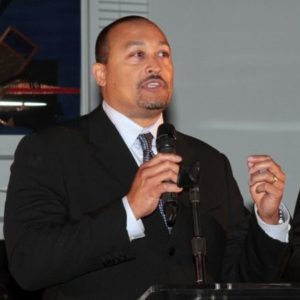
Pluria Marshall Ends His Nexstar Battle With Station Sales

0

In April 2019, minority broadcast media owner Pluria Marshall Jr. filed a lawsuit against an entity it acquired three stations from for what it says are this company’s active efforts “to undermine” its TV trio.


The company his Marshall Broadcasting Group acquired the three TV stations from in June 2014 is Nexstar Media Group.

In December, Marshall Broadcasting voluntary filed for Chapter 11 in a Houston-based U.S. Bankruptcy Court. Now, Marshall is selling the stations.

The buyer will certainly raise some eyebrows.

An asset purchase agreement dated March 30, filed with the FCC on April 8, shows that Marshall is selling KMSS-33 in Shreveport, La.; KPEJ-24 in Odessa-Midland, Tex.; and KLJB-18 in Quad Cities, Ia.-Ill.

Marshall acquired the stations from Nexstar for $58.5 million.

Now, it is selling them — with the bankruptcy court authorizing the buyer to credit bid on a dollar-for-dollar basis up to the full amount of the outstanding obligations in any sale of Marshall’s assets, pursuant to Section 363 of the Bankruptcy Code.

As a result, the aggregate consideration for the three stations comes in a $49,013,808.90.

The buyer, which has made a 10% escrow deposit? Mission Broadcasting.

That’s the entity founded by the late David Smith that originally intended to purchase KMSS-33, KPEJ-24, and KLJB-18, in June 2014, but was thwarted in doing so by the FCC.

With Smith’s untimely death of a massive heart attack on March 28, 2011, while attending a friend’s wedding, ownership of Mission transferred to his wife, Nancie Smith. She continues to lead Mission today. However, all of Mission’s stations are operated by Nexstar, via a joint sales agreement and shared services agreement.

Mission’s cozy relationship with Nexstar led the FCC to reject a spin of three stations by Nexstar to Mission, a transfer intended to win regulatory approval of Nexstar’s June 2014 acquisition of licensees Grant Broadcasting, Communications Corporation of America and White Knight Broadcasting.

Enter Marshall, an African American broadcaster who agreed to fund the station acquisitions via credit, which Nexstar had agreed to guarantee.

Marshall’s deal was structured so that it would be acquiring the stations’ program contracts, equipment, and real estate interests in connection with studio and tower sites. Nexstar would provide sales and other non-programming services to MBG, allowing Marshall’s stations to use Nexstar personnel for engineering support, master control, traffic and billing and other administrative functions that do not relate to control of the stations or their programming.

This is likely where Marshall’s fight against Nexstar began. Per the original terms of the deal, MBG would be entitled to 70% of the revenue from advertising sold by Nexstar on the stations. It would not provide for any bonus payments to Nexstar for achieving revenue goals. Further, it would not be a fixed-fee payment; as total revenues increased, so would MBG’s share. The FCC required a modification, upping MBG’s ad revenue percentage to 85%.

This transaction structure was designed to provide Marshall with incentive to seek the best programming and, thus, maximize station advertising revenue while providing significant cost savings benefits.

The deal attracted the attention of both the Minority Media and Telecom Council (MMTC) and the National Association of Black Owned Broadcasters (NABOB).

MMTC’s “critical question”: Is this transaction designed to produce a free-standing, independent broadcast operation at the conclusion of the JSA agreement?

The question is central to Marshall’s April 2019 fight, which also takes Nexstar to task for the $58.5 million price it agreed to in selling the three TV stations. Marshall says it was overcharged, as Nexstar intended to sell the trio to “another potential buyer” for $42.3 million.

The 53-page APA filed with the FCC notes PVB Advisors LLC as the broker of record in this transaction, representing Marshall.

Mission Broadcasting is today led on a day-to-day basis by President Dennis Thatcher. 

It’s now up to the FCC, under Republican control compared to 2014, to approve or deny a deal Nexstar sought to complete nearly six years ago.