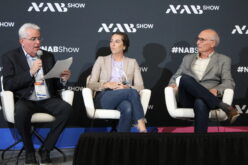
LAS VEGAS — Radio’s digital revenue hit $2.3 billion in 2025 and is helping to stabilize the industry, but sellers might still not be dreaming big enough, Borrell Associates CEO Gordon Borrell told 2026 NAB Show attendees during the digital benchmarking session held with the RAB.
The panel, with RAB President/CEO Mike Hulvey and Bonneville International VP of Digital Sales Aleece Southern, centered on findings from the 14th Annual Digital Benchmarking Report, sponsored by Marketron and drawn from analysis of 3,763 radio stations across 852 market clusters, with surveys of 406 local radio advertisers and 242 radio managers.
Digital now represents 24.4% of the average station’s total advertising revenue, with streaming audio ranking as the largest single revenue source and targeted banners second. The forecast for 2026: $2.5 billion.
Borrell laid out how total radio ad revenue declined steadily from 2016 through 2020. What arrested that slide is Digital, which has grown from a $600 million supplement in 2016 to a $2.3 billion engine in 2025.
Traditional broadcast revenue continues its gradual decline, but the combined total has effectively flatlined and is now trending slightly upward.
The figure Borrell kept returning to was the 74% share of existing radio customers not buying a station’s digital products. “You have a billing relationship with them. They have trust in you. You have brand awareness among them,” he said. “It’s much easier to sell that digital than it would be to someone that doesn’t have a relationship with you.”
Southern confirmed the finding matched what she sees daily. “It’s in every market. It doesn’t even matter the size.” She spent five years helping build Townsquare Media’s digital business before moving to Bonneville last August.
Borrell’s data showed that top-performing clusters in every market tier generate three to four times the digital revenue of the average cluster in the same peer group. The difference, he said, isn’t luck; it’s a deliberate market share strategy. Top performers don’t target category share over year-over-year growth, becoming experts in areas like auto, HVAC, or restaurants before expanding. “It’s not how much revenue you make,” he said. “It’s how much you make relative to what’s available in your market.”
On AI, Borrell went to the data on an industry concern that has circulated for the past year. Of 175 radio managers surveyed, 35% were aware of clients using AI to recommend marketing mixes. Of that group, 44% said those recommendations had negatively impacted radio, translating to roughly 15% of managers industry-wide who have directly encountered AI working against the medium.
Borrell’s team tested the platforms themselves, asking ChatGPT, Perplexity, Gemini, and Claude whether radio was a good place to advertise for a clothing store in Tucson. All four recommended radio, with qualifications. The nuance, he said, is in the framing: ask AI directly about radio, and it endorses the medium; ask broadly where to advertise without mentioning radio, and the medium may not surface at all.
Training data added urgency to that point. In 2018, 71% of local radio ad buyers qualified as novice marketers. By 2025, that figure had dropped to 41%, while the share classified as master marketers had risen to 34%. Radio’s ad sales force, meanwhile, has contracted 55% over the past decade, from 16,400 reps in 2014 to 7,300 in 2024. High-growth stations projecting 30% or more in digital revenue increases were four times more likely to be training their sales teams at least once a week, and the best programs weren’t just teaching radio sales — they were training reps on direct mail, SEO, search, and AI.
Southern advocated for field work and role-playing over formal instruction. “Training is overcomplicated a lot of times,” she said.
Hulvey closed by pointing to a consistent finding from prior years: radio sellers rank among the highest of any local media category in perceived marketing savvy. “If you can find a way to bottle that, and then train the living hell out of them,” Borrell said, “I think you have a real opportunity.”
IN OTHER 2026 NAB SHOW HEADLINES:
- With America’s 250th anniversary nearing, broadcasters are ready to own the moment. Those strategies came into focus on Tuesday at the NAB Show as executives from radio and television shared ideas and plans for this once-in-a-generation national moment.
- The 2026 NAB Show had plenty of industry business on the agenda on Tuesday, but the We Are Broadcasters program made room for reminders of why the work matters from Mo Rocca and Nate Bargatze, who were both honored and shared stories on the Main Stage.
- The newest voice in the NAB’s Radio Hall of Fame hasn’t just been on the air for more than 25 years; he’s also created one of the most memorable themes in sports. John Tesh was inducted into the NAB Hall of Fame on Tuesday night as part of the annual Awards Dinner.
- Nexstar Media Group CEO Perry Sook was in attendance at Tuesday evening’s Kalil & Co. cocktail reception, and earlier in the day opined during a 2026 NAB Show discussion with Deborah Norville that some of the linear broadcasting companies Nexstar competes with harbor a liberal bias. Despite Norville’s attempts, Sook did not offer any commentary on FCC Brendan Carr, or the preliminary injunction prohibiting Nexstar from fully integrating its acquired assets from TEGNA. The injunction took event less than one hour after Sook’s onstage NAB Show appearance.
- Speaking of Nexstar Media Group, Tuesday saw the company — as expected — file an appeal of the preliminary injunction with the Ninth Circuit federal appeals court. That action led Nexstar to vehemently criticize plaintiff DirecTV, which has spun a narrative that industry consolidation of broadcast TV companies will automatically lead to higher retransmission consent fees.