NEW ORLEANS — For radio industry professionals, the subject of royalty payments and acronyms such as the RMLC, SESAG, GMR, BMI and ASCAP has been much discussed and covered by trade journals.
But, there’s also a need for broadcast television stations to fork over payments to music rights organizations for their use in everything from syndicated programming to live broadcasts originating from the station itself.
A Media Finance Focus session provided attendees with keen insight as to what’s expected of every over-the-air TV station.

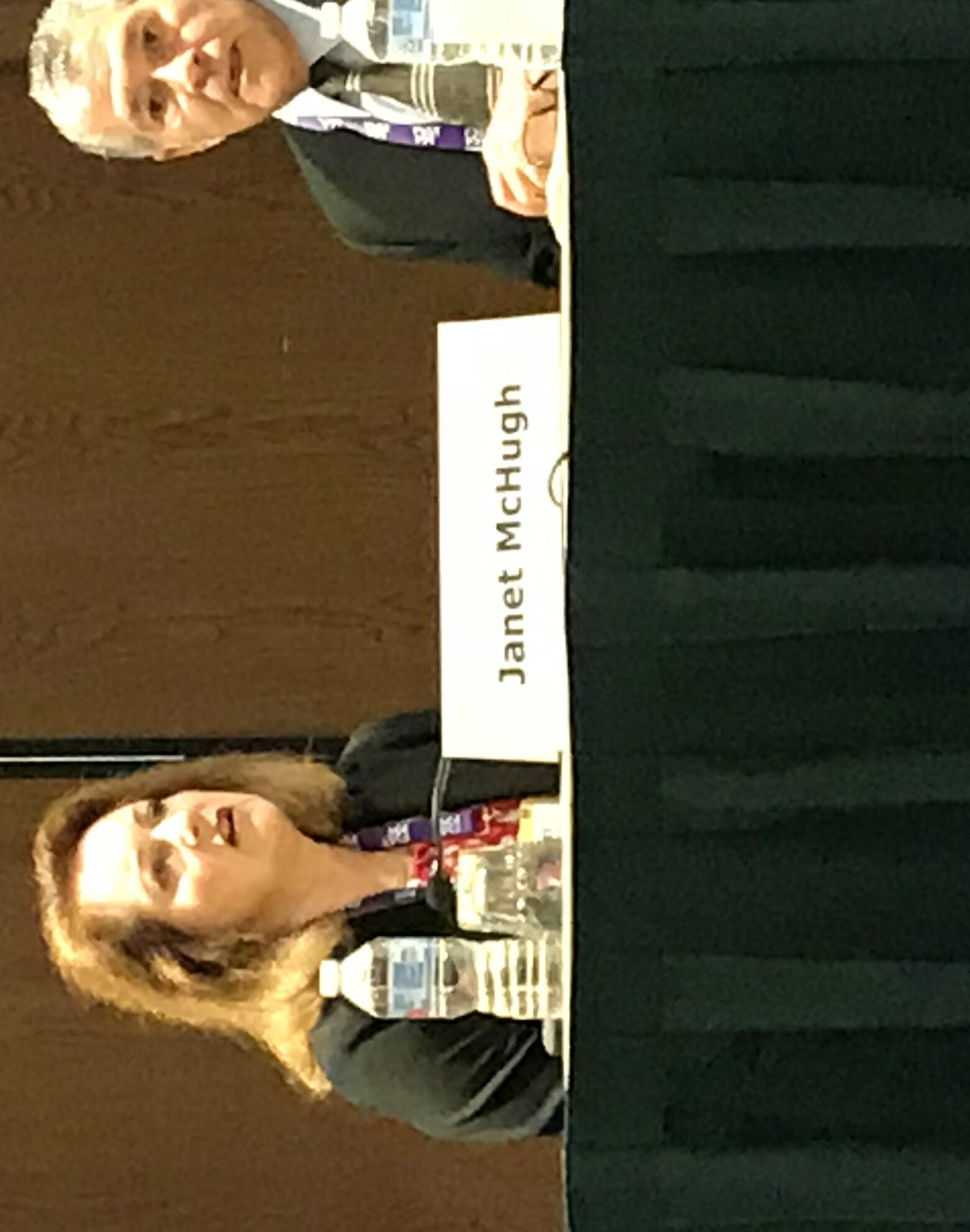
Providing those in attendance on the second day of the three-day Media Finance Focus Conference, presented by MFM and BCCA, a full rundown of music rights for VHF and UHF properties was Janet McHugh, the Baltimore-based Executive Director of the Television Music License Committee (TVMLC).
Her first revelation for those mainly familiar with radio industry royalty pains: If you own a FOX affiliate or a station airing programming from The CW Network, your network programming’s music is not cleared.
This differs from affiliate management of network recorded music at The Walt Disney Co.’s ABC, CBS Corp., and NBCUniversal. As such, the owners of any FOX or CW affiliate owe music rights payments to ASCAP, BMI and SESAC.
For all stations with music in their local programming and in their syndicated shows, payment for rights and use is necessary. That’s where the TVMLC comes in, as the group will negotiate music rights license agreements on behalf of local TV with the “PROs.”
“We resolve problems between the stations and the programming rights organizations,” says McHugh, who appeared alongside her Nashville-based Radio Music License Committee (RMLC) counterpart, Bill Velez.
The TVMLC will fund and manage all potential litigation, McHugh notes, working on behalf of 1,200 TV stations. The group is funded through voluntary contributions and is not a member organization.
“We represent stations whether or not they contribute to us,” McHugh says.
The TVMLC includes representatives from TEGNA, Gray Television, The E.W. Scripps Co., Hubbard Broadcasting, Meredith Corp., Graham Media Group, Morgan Murphy Media, Manship’s WBRZ-2 in Baton Rouge, Nexstar Media Group, Tribune Broadcasting, and Sinclair Broadcast Group.
What sort of dollars are TV stations paying performance rights organizations?
For ASCAP, the total industry blanket fee is $88.96 million — an amount McHugh says has been frozen since 2016. “We’re getting close to some kind of conclusion,” she says.
The BMI license expired at the end of 2017. With an interim license in place, the TVMLC has a blanket fee of $76 million going to Broadcast Music, Inc.
SESAC’s fee in 2019 is $36 million. It’s up from $25 million in 2016, but McHugh explains that the numbers are based on music share. Thus, there is a fee increase due to SESAC share increase.
What’s to come between the TVMLC and ASCAP and BMI? Negotiations “are ongoing,” McHugh notes.
And, for companies with digital multicast channels, website-based content and streaming video, and digital delivery of video content via wireless/mobile platforms, the rights payments are all inclusive, McHugh says.
A TV station owner has two common payment options. A blanket license can be obtained, or a station can obtain a license on a per-program basis. The former is recommended by McHugh for affiliates of The CW Network, given their heavy reliance of network shows and few locally produced programs.
The comments came as fresh for many in attendance, while Velez offered a limited recap on RMLC’s struggles with nearly every PRO in the U.S. The RMLC and SESAC squabbled in October 2012, when the RMLC filed an antitrust complaint on behalf of radio industry operators. Litigation was settled in Summer 2015. The settlement called for binding rate arbitration, if no voluntary license agreed upon. Arbitration was seen in July 2017, and this led to the use by SESAC of a percentage of revenue formula similar to that seen with ASCAP and BMI.
However, SESAC is collecting based on 0.2557% of revenue, compared to 1.7% at BMI.