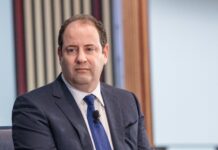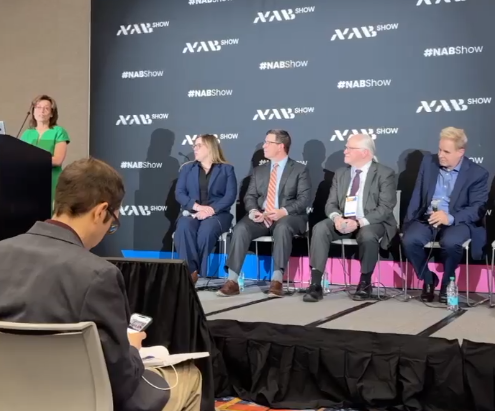
LAS VEGAS — As the lone Democrat serving as an FCC Commissioner, Anna M. Gómez has been outspoken in her ongoing defense of the First Amendment and Freedom of the Press concerns seen under the leadership of Chairman Brendan Carr. On Monday, this battle continued in a 2026 NAB Show session focused on “the vital role that the news media plays in our democracy.”
Introduced by NAB Chief Legal Officer and Executive VP of Legal and Regulatory Affairs Rick Kaplan, Gómez served as the moderator of a mid-morning discussion in which she said, “Put simply, broadcast journalism has a profound impact on informing the public and fostering civic engagement.”
It is a topic that is both timely and essential for Gómez, with praise and criticism of news organizations from across the political spectrum coming even as broadcasters each day demonstrate their commitment to the communities they serve.
At the heart of the conversation is what role, if any, the government should play in addressing concerns about bias or misinformation in news content. “Where do we draw the line between necessary oversight that protects the public interest and overreach that threatens editorial independence?,” Gómez asked. She also wonders how changes to the media ecosystem impact constitutional limits on government restrictions over content. “Some argue that the best remedy for perceived bias is less speech, not more,” Gómez added. Thus, encouraging debate through diverse perspectives — language used to challenge media ownership rule changes that would lead to television industry consolidation and fewer independent voices — is something Gómez wants to flourish.
Who are the ones making the decisions? That is something of concern to Gómez, who then conducted a lengthy discussion as part of the breakout Broadcast Management and Monetization Conference within the NAB Show featuring Mara Gassman, Senior Staff Attorney for Reporters Committee for Freedom of the Press; Casey Maddox, VP of Legal Strategy for Stand Together; Foundation for Individual Rights and Expression Chief Counsel Robert Corn-Revere; American Enterprise Institute Nonresident Senior Fellow Clay Calvert; and reporter Joe Flint, of The Wall Street Journal.
The discussion, of which the first 40 minutes was livestreamed on RBR+TVBR’s X stream, was largely one-sided, with little in the way of rebuttal or topics that challenged Gómez’s viewpoints. The appearance of Corn-Revere in particular is noteworthy for his calls for the resignation of Brendan Carr as FCC Chairman, based on his arguments that his leadership has been one of excessive overreach and “jawboning.”
Stand Together Vice President of Legal Strategy Casey Mattox pointed to Moody v. NetChoice and NRA v. Vullo as the most directly applicable recent precedents. Both, he said, reinforce that the government cannot use regulatory leverage to coerce private speakers into changing their content. “If you allow the accumulation of large amount of government power and a lot of discretion and how that government power is exercised by the executive branch, you’re going to have a lot of First Amendment problems,” Mattox said. He also encouraged broadcasters to think beyond their own immediate interests, arguing that protecting anonymous speech, associational rights, and the First Amendment rights of corporations broadly would ultimately serve the industry’s own legal standing.
American Enterprise Institute Nonresident Senior Fellow Clay Calvert focused on the Moody majority opinion authored by Justice Elena Kagan, reading aloud the court’s declaration that “it is not the job for the government to decide what counts as the right balance of private expression” and that “the state has no right to interfere with private actors’ speech to advance its own vision of ideological balance.” He connected that standard directly to Carr’s stated rationale for pursuing bias-based proceedings, calling it a textbook example of the conduct Moody forbids.
Wall Street Journal Staff Reporter Joe Flint offered the panel’s most practical framing of the evidentiary challenge. Broadcasters and reporters who want to build a jawboning case, he said, face the same problem as any journalist working a story: witnessing effects without having seen the cause. “I wake up in the morning, there’s snow on the ground. I know it’s snow, but did I prove it? I was asleep. I missed the snowfall,” Flint said.
— Additional reporting by Cameron Coats