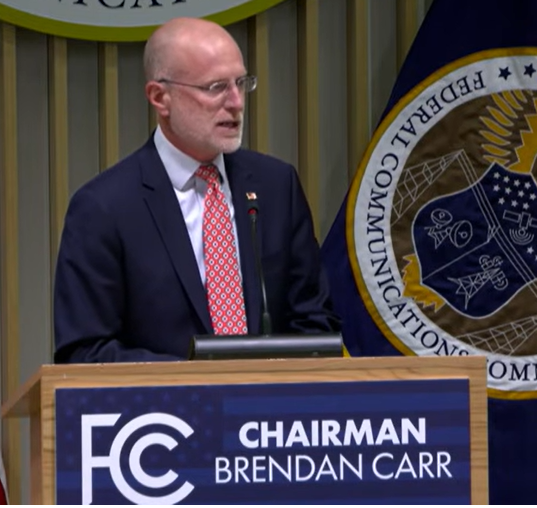
WASHINGTON, D.C. — FCC Chairman Brendan Carr has proposed an Order the three vote-makers at the Commission will consider at its July Open Meeting that would allow the agency to hold an auction of 160 MHz of spectrum in the Upper C-Band in 2027.
That’s above the 100 MHz clearing proposal of the NAB, and puts into question how broadcasters will be effected by Carr’s pending auction.
For Carr, the proposed order tees up “a large swath of prime, mid-band spectrum” in the 3.98 GHz-4.14 GHz range for auction. The vote would come on July 22, and also establish rules that would also “effectively harmonize” terrestrial wireless operations across the entire C-Band by creating a single “super-band” spanning 440 megahertz (3.70-4.14 GHz).
Federal Aviation Administration coordination was conducted, and rebates for any airlines impacted by the auction are being put into the plans, a FCC representative shared in a press conference held on Tuesday afternoon.
What this means for radio and TV stations could be the bigger question.
In November 2025, the NAB shared its thoughts on how the Commission could best free up additional mid-band spectrum for new services in the Upper C-band. NAB representatives met with individuals within the offices of FCC Commissioners Anna Gómez and Olivia Trusty and Chairman Carr to emphasize “the crucial role” that satellite operation in the Upper C-band plays in the contribution, distribution, and delivery of both television and radio programming.
In doing so, the FCC urged that the Commission account for this when determining whether to exceed the statutorily mandated 100 MHz clearing target and how to ensure incumbents are not unduly burdened during the subsequent transition.
The decision to auction 160 MHz of spectrum in the upper C-Band clearly exceeds this “floor,” as a FCC representative described it during the press conference.
Many broadcasters rely on C-band as the most dependable platform for content distribution, such as national news and emergency information, to affiliate stations spread across the United States and beyond. In recent months, however, secure and high-latency internet distribution service companies have vigorously stepped up their marketing and PR in a bid to woo impacted media entitles as customers.
Cost is a factor, and with the largest radio companies in fiscal malaise, the NAB’s failure to sway the FCC to keep the auction at the floor of 100 MHz of spectrum could prove challenging for some.
“The reallocation of a portion of the Upper C-band will require many incumbents to move to other platforms,” the NAB explained to FCC staff in November, adding that the association believes incumbent relocations out of the C-band “will be dramatically more expensive and lengthier than was required following Auction 107 — a process that took nearly three years.”
Congress required the FCC to auction at least 100 megahertz of Upper C-Band spectrum no later than July 2027. “The FCC has moved quickly,” the agency said in a statement. “We are on track for an on-time auction that clears significantly more spectrum than the minimum required under law. This auction is expected to raise many billions of dollars for the U.S. Treasury as well.”
Carr added, “While more complex than your average spectrum auction, the FCC moved from NPRM to Order in record time. We have also coordinated with aviation and satellite stakeholders so that wireless providers can light up the Upper C-Band and provide service to most Americans by the end of 2030—ahead of many expectations … The steps the FAA will be undertaking in parallel with this FCC decision will ensure that C-Band services successfully coexist with critical aviation safety tools in the adjacent band. Indeed, the FCC and FAA processes will together provide for the upgrade radio altimeters and provide rebates to support eligible domestic aircraft operators and owners in this effort.”
There was scant discussion during the press conference on potential impacts to broadcast media, with one reporter asking about it and receiving little in response from those on the call, including Chairman Carr.