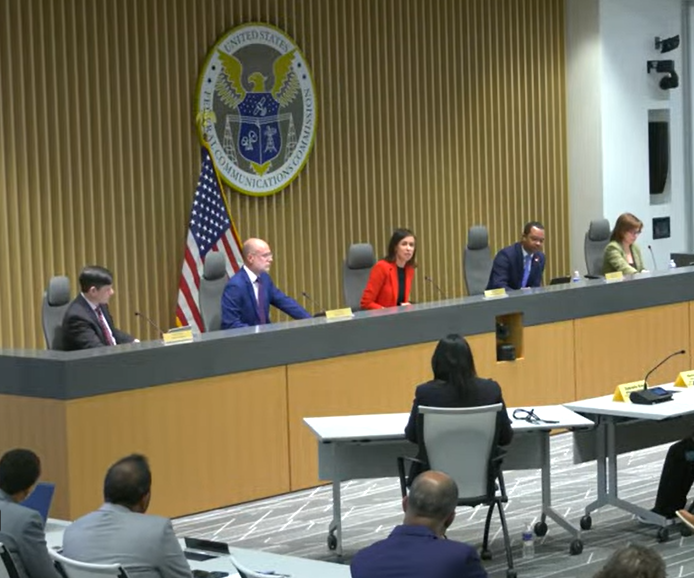
The Chris Devine-founded GeoBroadcast Solutions has been given the FCC’s unanimous nod to fully move ahead with the implementation of its “ZoneCasting” technology by expanding the opportunity to use FM boosters for program origination.
The 5-0 vote, which saw Democratic-aligned Commissioner Geoffrey Starks work in a non-partisan way with senior Republican and forthcoming FCC Chairman Brendan Carr, puts final rules in motion allowing FM stations to customize and differentiate content based on microgeography.
For operators such as Roberts Broadcasting, which owns WRBJ-FM in the Jackson, Miss., market, this will give it an opportunity to use the station’s rimshot signal to better market to listeners in the state capital in addition to its city of license to the southeast of the city. Localized programming has been the focal point for supporters; addressable advertising solutions, which today’s CMOs and advertising professionals desire, is one key delivery vehicle from “ZoneCasting.”
The unanimous approval of “ZoneCasting” comes despite widespread opposition to the plan from radio broadcasting companies and its chief advocates Inside the Beltway, as micro-sized advertising could negatively impact an already wounded core advertising environment for broadcast radio.
With MB Docket Nos. 20-401 and 17-105 now affirmed, both FM and low-power FM broadcasters can each turn to GBS to use “ZoneCasting.”
That said, a cacophony of competing broadcasting signals that could create an abundance of interference is not likely, with “ZoneCasting” likely used for select stations with signals that can’t fully reach a market. Basic physics suggest a 100kw or 50kw signal cannot be “split” within its main contour. As such, a market such as Miami may only see “ZoneCasting” from signals with towers in rural areas that don’t use the centralized Miami Gardens antenna farm adjacent to Hard Rock Stadium.
Making “ZoneCasting” happen, in the eyes of the FCC, is up to the broadcasters. If they choose to work with GBS, the exclusive company offering “ZoneCasting,” no more than three minutes per hour will see unique programming coming from a FM booster. This is the lynchpin of “ZoneCasting” and, as the Commission sees it, will “better meet the needs and interest of local listeners.”
Use of FM boosters, which were exclusive to the use of main signal rebroadcasting until temporary, experimental program origination came to light in April, “would provide broadcasters with an option to provide listeners with more targeted content such as hyper-local news and weather reports and advertisements from small local businesses.”
The latter will likely remain a source of concern for the NAB and the nation’s biggest radio station ownership groups.
In her comments, soon-to-depart Chairwoman Jessica Rosenworcel commented, “There is something special about a voice in the air, and especially one that is truly local. This superpower of radio stations makes them unique in a media landscape that is evolving at a rapid pace.” She said the rulemaking “means the potential for more diverse content” while also giving stations that use “ZoneCasting” a chance to innovate and grow their audiences “at a time when they face more competition for our attention than ever before.”
Carr saluted Starks, noting that this was a proceeding and initiative “he really put his shoulder to the wheel on, and it has made a big difference. It is something that will help local broadcasters better serve their local communities and it’s going to benefit, collaterally, a lot of small businesses as well, along the way.”
Carr also appreciates how Starks took the time to identify something important, and “it is an important contribution to the whole broadcast industry.”
In his comments, Starks shared how the Order approved by all Commissioners on Thursday “finalizes the new tools broadcasters can utilize as they adapt and thrive in a competitive media environment.”
He continued, “The ability to offer hyper-localized content means that stations
can attract small businesses looking to customize their advertisements to a targeted audience and better reach their local communities. These new advertising streams can make a real difference, especially for the many small or minority broadcasters that are working hard to stay on the air.”
He singled out Las Vegas rimshot KADD-FM 93.5 “La Mejor” in Las Vegas, which uses a transmitter that largely covers St. George, Utah, which scraping Southern Nevada from the far northeast. Pointing to its local content in a crowded Hispanic media marketplace that has long seen ad growth challenges, Starks remarked how KADD “is investing in truly local content” and how the use of FM boosters will give KADD added signal contour in metropolitan Las Vegas. This, in turn, will enable KADD to fully compete against Lotus Broadcasting’s KWID “La Buena,” and locally operated “Fiesta 98.1,” which uses an FM translator via by a HD multicast signal tied to an Audacy Inc.-owned station. There are also stations from Entravision and Latino Media Network (through a programming arrangement with TelevisaUnivision’s Uforia unit), two large Hispanic media companies, in Las Vegas.
Commenting on ZoneCasting specifically, Starks said, “Geo-targeted content is the dawn of new possibility for radio. From my perspective, we’ve set the policy and opened up the technology. Now it’s up to each business to determine if this opportunity is right for them.”
He concluded that the FM Booster Order “is many years in the making and the result of the tireless advocacy of broadcasters, civil rights organizations, and leaders in Congress, including Congressional Black Caucus Chairman Steven Horsford, Congressman Bennie Thompson, and Congressman Hank Johnson.”
Still, he turned to the future Chairman of the FCC as the key to getting a unanimous passage of the proposal to happen. “None of this would be possible without the true collaboration of my colleague, Commissioner Carr. He and I have worked side-by-side to bring this proposal to the finish line and I am tremendously proud of this result.”
Simington offered no statement on the matter. Anna G. Gómez shared how she met with “numerous broadcasters” in her first year as a Chairwoman, and how they give people the information they need on simple decisions based on weather and big-level decisions such a a mayoral race. “I remain committed to preserving localism in broadcasting,” she said. “I’m pleased to see how what we are doing today can help.”
Staff who worked on this effort include Irene Bleiweiss, Jim Bradshaw, Heather Dixon, Lisa Scanlan, Gary Schonman, and Al Shuldiner from the Media Bureau; Susan Aaron, Joel Graham, David Konczal, Jin Lee, Royce Sherlock, and Anjali Singh from the Office of General Counsel; Austin Randazzo from the Public Safety and Homeland Security Bureau; and Joycelyn James from the Office of Communications Business Opportunities.