WASHINGTON, D.C. — In a 40-page Memorandum Opinion and Order released during the dinner hour on Thursday, March 19, the Chief of the FCC’s Media Bureau rewrote local television ownership rules codified by Congress in the first weeks of 2004. Sort of.
Erin Boone granted, with waivers and divestiture commitments that may be cosmetic at best, Nexstar Media Group‘s merger with TEGNA. It all but erases the 39% national ownership cap before the Commission even votes on amending it, setting up a court challenge being waged by eight state Attorneys General and DirecTV.

For some, the approval of Nexstar’s $6.2 billion merger with TEGNA should have come down to a full Commission vote — although there’s a safe bet such an action, which Democratic Commissioner Anna M. Gómez unsuccessfully pleaded for, would have ended up in a 2-1 vote giving a green light to Perry Sook and his executive leadership team at 30-year-old Nexstar.
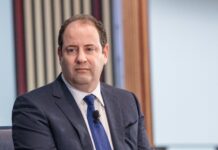
Instead, the most impactful broadcast media transaction in modern history was blessed by a woman who has been in her role for two months. Prior to taking on the role of Media Bureau Chief, Boone served as FCC Chairman Brendan Carr’s Senior Counsel; she still has that role. She joined Carr’s office after serving as Commissioner Nate Simington’s Chief of Staff and wireless advisor. Before that, Boone served as Deputy Division Chief in the Wireless Bureau’s Competition and Infrastructure Policy Division, where she led a team responsible for matters and rulemakings addressing mobile data and voice services, mobile spectrum holdings, and mobile broadband mapping, among others. She’s also served in the Enforcement and Wireline Competition Bureaus.
Ahead of her agency experience, Boone worked as Corporate Counsel for Federal Regulatory Affairs at T-Mobile from November 2005-June 2007. Boone later worked at Clearwire, and at Level 3 Communications.
Today, she has emerged as the Drum Major for the Deregulation Marching Band, batons swirling as the FCC, in Boone’s words, “takes an action that empowers these local broadcast TV stations to serve the public interest.” And, she added, “it does so by enabling them to expand the production of local news and information. This is especially so given the concrete commitments that Nexstar has made in the record, including on affordability, localism, and their commitment to divest a number of TV stations.”
Is more local news from a singular news organization bettering consumers and in the public interest? The eight Attorneys General and DirecTV each suing to stop the deal in a California federal court on Thursday morning say no, as does Commissioner Gómez. For those opposed to the Nexstar-TEGNA deal, swaying a federal judge may be the lone avenue left for blocking a deal that effectively closed just minutes after the Justice Department and FCC each issued their transaction approval notices. Getting the Carr Commission to think otherwise would be futile.
“Put simply, our action … promotes the FCC’s longstanding media policy goals of competition, localism, and diversity,” Boone argues, even as detractors argue that it reduces competition while leading to less diversity of viewpoints through newsroom consolidation and a reduction-in-force. She further opines that her Order allows “the relevant local broadcast TV stations to continue and in fact expand their investments in local news. It does so by allowing them to compete more effectively in the modern media marketplace. And it does so by allowing them to counteract the growing imbalance of power between those local broadcast TV stations on the one hand and the powerful Big Four national programmers on the other—namely, Comcast, Disney, Paramount, and Fox.”
That’s a warning shot over the bow from Washington to Hollywood and New York, and could further strain the relationship between the four companies — all of whom are licensees of broadcast TV stations in the U.S. — and the Carr Commission. “Approving this transaction—which will allow Nexstar to own less than 15% of television stations—will promote a more balanced relationship between the Big Four and the relevant local broadcast TV stations,” Boone said.
With that, Boone granted the relevant waiver needed for Nexstar and TEGNA to close a deal first announced in mid-August 2025 and filed with the Commission once the Federal Government reopened from a four-week shutdown due to lack of Congressionally approved funding.
A COMMITMENT TO DIVESTITURES THAT MAY NEVER HAPPEN
With approval of the transaction, some 23 Designated Market Areas (DMAs) where Nexstar will own two full-power TV stations will receive the FCC’s OK.
These DMAs are Dallas-Fort Worth; Houston; Washington, D.C.; Tampa-St. Petersburg (Sarasota-Lakeland-Sebring); Phoenix (Prescott); Denver; Cleveland-Akron (Canton); Charlotte; Portland, Ore.; St. Louis; Indianapolis; San Diego; Hartford-New Haven; Grand Rapids-Kalamazoo-Battle Creek; Norfolk-Portsmouth-Newport News; New Orleans; Memphis; Buffalo; Little Rock-Pine Bluff; Des Moines-Ames; Huntsville-Decatur (Florence), Ala.; Ft. Smith-Fayetteville-Springdale-Rogers, Ark.; and the Quad Cities of Illinois and Iowa
To make that happen, Nexstar has committed to make divestments in Indianapolis and the Norfolk DMAs that would result in it owning two full power television stations in those DMAs. Furthermore, Nexstar has also agreed to sell stations in Hartford-New Haven; New Orleans; and Northwest Arkansas.
Nexstar Media Group has committed to divest the following stations in order to complete its merger with TEGNA:
-
KTVD-20 in Denver, which just committed to airing “9News” local newscasts as part of a TEGNA local news expansion effort
-
WTHR-13 in Indianapolis, sold in August 2019 by Columbus, Ohio-based Dispatch Broadcast Group to TEGNA as part of a $535 million transaction
-
WCTX-59 in New Haven, Conn.
-
WAVY-10 in Portsmouth, Va.
-
WUPL-54 in Slidell, La.
-
KNWA-51 in Rogers, Ark.
Nexstar commits to divesting these stations “no later than two years following the TEGNA Closing Date, provided that a waiver of the Local TVO Rule remains necessary under the Commission’s rules at such time.”
There’s an important footnote to these divestitures.
Nexstar commits to divesting these stations “no later than two years following the TEGNA Closing Date, provided that a waiver of the Local TVO Rule remains necessary under the Commission’s rules at such time.”

Even so, Nexstar’s crosstown competitor in Indianapolis expressed pleasure with the terms, even as he earned a waiver to create a “triopoly” of full-power TV stations in the market. “I am very grateful that the FCC and DOJ supported my position regarding the required divestiture of WTHR in Indianapolis,” DuJuan McCoy, owner of Circle City Broadcasting, said in a statement. “I believe this decision creates a more level competitive landscape in the Indianapolis television market and presents a strong opportunity for me to pursue acquiring this asset.”
Given the pace at which the Carr Commission is moving forward with “modernization” of FCC rules, there’s little chance Nexstar will need to sell those properties as the 39% national ownership reach cap will be erased by March 2028.
With that, and buoyed with full confidence that the FCC has the authority to grant the approval, Boone signed off on the deal.