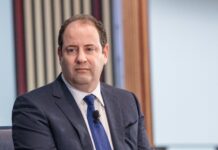
LAS VEGAS — He’s not at the 2025 NAB Show but his presence will undoubtedly be felt across the conference, which began Sunday morning with sessions and expo booths galore devoted to broadcast media, the growing interest in live sports programming and how AI tools can empower radio and TV owners.
Brendan Carr has left an indelible imprint on the FCC in less than three months. And in the latest rule “modernization” effort to emerge since he succeeded Jessica Rosenworcel, Carr is ready to review the Commission’s muddy view of foreign ownership.
In an outline of the Commission’s April Open Meeting agenda, Carr discussed how the Commission is making progress on spectrum — something vital to national security and economic interests. At the meeting, the FCC will “look to update our rules in the frequencies commonly known by satellite aficionados (read: nerds) as the Ka- and Ku- bands.”
Specifically, the Commission will vote to establish a new licensing framework for the lower 37 GHz band, effectively opening up 600 megahertz of spectrum for new commercial services.
As noted in an official notice distributed Monday, The Commission will consider a Notice of Proposed Rulemaking that would set clear expectations about the Commission’s review under section 310(b) of the Act of foreign investment in common carrier wireless, aeronautical radio, and broadcast licensees to reduce unnecessary burdens on industry while continuing to protect the public interest, including national security, law enforcement, foreign policy, and trade policy. It is formally known as GN Docket No. 25-149.
Cracking down on illegal robocalls is also up for another discussion, as violators continue to play “whack a mole” and elude the authorities with their actions.
But broadcasters may take particular interest in how Carr closes his blog.
“Not only are we moving quickly at the Commission, but efficiently too,” he writes. “Take the FCC’s foreign ownership rules. Over the years, those regulations have increased almost as quickly as interest in the Heard and McDonald Islands” — a reference to President Trump’s foreign tariffs and how these remote Australian islands could be impacted.
Speaking of the FCC foreign ownership regulations, Carr continues, “[I]n many cases, the FCC never codified those foreign ownership regulations in our rules. Not very efficient! Unwritten rules only make it harder for entities to understand and navigate our requirements, they risk inconsistent outcomes, and they can needlessly raise costs. We therefore initiate a proceeding that looks at codifying our requirements while asking about eliminating any needless ones.”
Foreign ownership has been a topic of concern in recent years, and in the Rosenworcel era of the FCC received heightened interest on claims that broadcast stations in the U.S. were airing propaganda designed to sway voters produced by registered foreign agents. This includes “Sputnik,” the English-language service of the Voice of Russia that had been airing for a few hours each day on an AM in Kansas City and as a 24/7 format on an FM translator fed by a Northern Virginia AM serving the Washington, D.C., market.
Then, there is the Chinese Communist Party and its cable TV channels, distributed across many cable and satellite TV providers in the U.S.
Of course, foreign ownership concentration is also a hot topic among radio and TV station broadcast groups looking to tap international coffers for Euros, Loonies, or perhaps some Dinars, Yuan or Rubles, let alone Pesos. And, it was a topic of concern among some Republicans with respect to an alleged FCC “fast-tracking” of Audacy Inc.’s post-bankruptcy ownership plan, giving control to Soros Fund Management.
Other companies have seen interest from foreign entities, including Cumulus Media (from Manoj Bhargava through a Singapore-related operation) and iHeartMedia (from Global Radio executive Ashley Tabor-King).
As such, what the FCC focuses on and how its foreign ownership rules evolve will likely become another hot topic of conversation for lawyers, brokers and executives across the Encore and Wynn Resorts for the next two days. And, it could be a question addressed to Anna Gomez, the Democratic FCC Commissioner, scheduled to appear in a Q&A with The Wall Street Journal‘s Joe Flynt before taking questions from attendees.