By Cameron Coats and Adam R Jacobson
There is an increased wariness among local ad buyers, and less spending is anticipated in the second quarter of 2025 — pushing it to its highest second quarter spending dip since the harrowing days of the COVID-19 pandemic.
That’s a key takeaway from Borrell Associates presented along with its findings regarding local ad budget trends as the second half of the year begins.

On that note, some 59% of respondents aren’t sure they are spending the right amount on advertising, with 30% saying “we are probably underspending.”
Should spending grow, will the dollars trickle to broadcast media? Clicks, likes, comment … social media engagement is a top measurement tool for local advertisers. And, as Gordon Borrell noted in a Tuesday webinar detailing the Local Ad Forecast, podcasting “hasn’t really taken off at the local level” while Facebook, Instagram and YouTube continue to get high marks from SMBs.
Only 10% of buyers may be buying YouTube, but more than half of them say the media is extremely effective. “That’s off the charts,” Borrell shared, noting that nothing ranked higher among those polled.
So, what are the most effective advertising formats for small and mid-sized businesses?
Radio ranks last, while broadcast TV is ahead of content marketing and mobile SBS/text alerts. Spot Cable is in the middle of the pack, but both TV and Radio and below digital media — including OTT and streaming solutions. Indeed, Connected TV and OTT is viewed as “the most effective video format” at 44% of respondents. This compares to 35% extremely/very effective scores for broadcast TV and cable TV, respectively.

As such, streaming video and OTT is the category that has seen agencies express more spending and increased interest than any other. Radio? Just 21% of agencies are increasing their ad dollars, compared to some 63% for streaming video/OTT.
Meanwhile, the latest update to Borrell Associates’ Local Ad Forecast reveals that a downturn in radio advertising may not be as steep, or as simple, as it seems. Why? Individual market results may vary.
While over-the-air revenue is expected to decline by approximately 12% between 2024 and 2029, the report suggests a “slow coast downhill” rather than a freefall for local AM and FM stations, with nuanced differences emerging across individual markets. In some markets, like Charleston, S.C., local radio spending is actually projected to rise just over 1% through 2029.
Other market projections aren’t so rosy. Cincinnati and Riverside-San Bernardino tell a different story, with declines of 10.6% and nearly 15%, respectively. This indicates more significant challenges depending on how stations are selling and bundling their offerings. Factors like commuting patterns, population demographics, and the health of local economies are also critical to understanding why some radio markets are outperforming others.
Local radio’s relative resilience in certain markets is linked to evolving sales strategies. Borrell found that some sales teams are leading with digital products and then adding radio into packages, helping to stabilize revenue. This bundling tactic has helped mitigate audience erosion caused by streaming and on-demand alternatives, and, in some cases, has allowed radio reps to maintain their value proposition to advertisers, even as media consumption habits shift and digital-first platforms continue to pull ad dollars.
Still, the long-term trend remains one of contraction. National spot and network radio are expected to decline faster than local, with drops ranging from 15% to 30%. This is in line with quarterly earnings reports representing the nation’s largest publicly traded radio broadcasting companies.
Innovation in creative advertising formats like local contests, sponsorships, and live reads is still drawing interest, but these alone won’t be enough to counterbalance the structural headwinds affecting the industry. Instead, it’s integrated campaigns and hybrid approaches that appear to offer the most promising paths forward.
Large advertisers are moving away from linear broadcast formats in favor of more scalable and targeted digital audio options like streaming and podcasts. Borrell previously predicted digital to account for 25% of radio revenue by the end of this year.
From $1.2 billion in 2024, spending is forecasted to exceed $2 billion by 2029, with year-over-year gains accelerating to double digits starting in 2027. This includes streaming audio, podcasting, and other locally targeted formats that benefit from AI-driven personalization and enhanced targeting for small businesses.
Borrell’s analysts also pointed to the changing regulatory environment as a factor boosting digital audio. New privacy laws and anti-spam measures are beginning to curb less effective forms of advertising like static display and email marketing, making digital audio a more attractive, high-engagement alternative.
In the report’s summation: “Radio isn’t falling off a cliff like some other traditional media,” but, “it’s definitely not climbing either.”
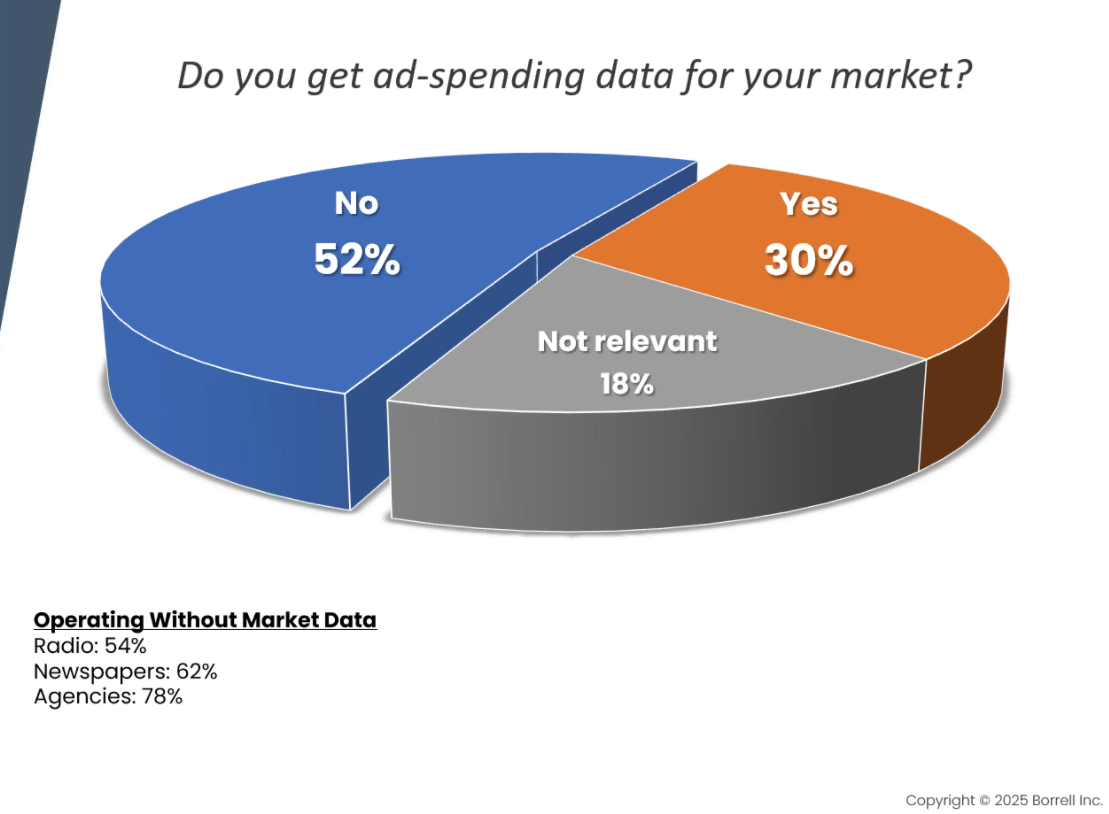
AD-SPENDING DATA VOID
Asked if they are receiving ad-spending data for their specific market, some 52% said they are not — but would be interested in receiving this information.