
LAS VEGAS — Across much of Sunday, there were scant broadcast television industry executives in plain sight across the 2026 NAB Show and shoulder events in locales ranging from the Wynn and Encore resort hotels to the Cocktails and Conversation gathering at the Capital Grille. In contrast, there were plenty of radio industry faces, ranging from engineers at a packed Nautel Radio Technology Forum to the Small and Medium Market Radio Forum.
The latter saw attendees listen to panel discussions focused on such topics as tackling AI guardrails, digital sales strategies, and more of radio’s biggest problems during a program built around independent operators who, as was proudly stated, “make the industry go round.”
Those were the words of NAB Joint Board Chair and Westwood One President Collin Jones, who welcomed NAB President/CEO Curtis LeGeyt to the stage to open the Radio Forum on its new Sunday home, after years of being held exclusively on Saturdays ahead of the NAB Show’s opening sessions.
LeGeyt delivered a direct status report on the association’s Washington activities, starting with optimism for the ongoing 2022 Quadrennial Review. “We are on the doorstep right now at the FCC on generational FCC ownership modernization,” he said. “This Commission very much has an open mind and a real understanding of the challenges that you’re facing in your local marketplace and in certain instances the need for a greater in-market scale to better compete for advertising dollars and listeners with these tech platforms.”
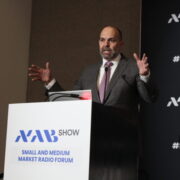 On the AM Radio for Every Vehicle Act, LeGeyt signaled the bill is, “Very, very close to getting that bill floor time above the House and the Senate.” He added, “We need to ensure that the listeners from there at the automobile aren’t being driven to our tech competitors simply because they’ve got the ability to be gatekeepers on the dashboard.”
LeGeyt also addressed performance royalties and what he called increasing government intrusion into newsrooms. “We’re playing defense on all of it, and we’re going to be successful as a result of your continued engagement.”
Lenawee Broadcasting President Julie Koehn, who helped organize the forum, grounded the NAB’s Washington work in the economics of small market ownership. “My community of license is 20,000 people. We have four radio stations,” she said. “NAB fights the fight. Millions of dollars are spent every year on lobbying, and even what NAB spends pales in comparison to what some of the Big Tech companies spend.” Koehn encouraged any non-members in the room to join, and argued that the group’s unique constraints are also a source of strength. “I find that most innovation comes from small and medium markets,” she said.
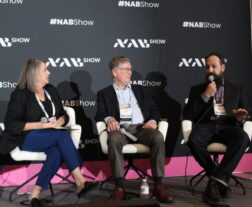
The forum’s AI panel brought together Townsquare Media Chief Product and Technology Officer Sun Sachs and broadcast media attorney David Oxenford to work through the practical and legal dimensions of artificial intelligence in station operations, with Koehn moderating.
Sachs described Townsquare as an organization that has embedded AI across content management, operations, sales, and advertising, with a strict policy where, “AI assists and humans approve.” Sachs said. “We never want to not have a human approve.” He cited BuzzFeed as a cautionary example of what happens when that standard slips. “All of their quizzes, all of their interesting content, have been genericized with AI.”
Sachs also described a structural content oversight model: an editor-in-chief equivalent at every station cluster, regional content leads, and executives who continually train, coach, and monitor output. On the sales side, he said AI has compressed the feedback loop on spec creative and proposal development. “The sooner we have a comprehensive plan in front of a prospect, the sooner we can start to dig in,” he said.
Oxenford focused the panel’s second half on legal exposure. He warned that using AI to generate celebrity voices or images in commercial contexts creates infringement liability in most states under common law, with Tennessee and California having adopted explicit statutory prohibitions. On AI in political advertising, he noted roughly 35 states have passed laws requiring disclosure or prohibiting use outright, and said broadcasters cannot rely on statutory exemptions if they knowingly air defamatory AI-generated content after receiving notice.
“You’ve got to take steps to figure out whether, in fact, AI has been used to generate it,” Oxenford noted. He and Sachs also cautioned operators against using free-tier AI platforms for sales proposals, noting that inputs on public models may be accessible to competitors. “Use closed source materials that prevent the inputs that you’re putting in from going out to the rest of the world,” Sach recommended.
On talent voice rights, Oxenford was direct: stations do not own them without explicit contractual agreement. “You can’t start suddenly generating AI room hours and then doing your programming 24 hours a day, even though they actually only record it in three or four hours in the morning,” he remarked.
The afternoon moved into peer-led roundtables covering nine topic areas, including digital strategies and practical AI for small and medium markets, innovative radio marketing strategies, connected car metrics via Xperi’s DTS AutoStage platform, podcasting strategies, digital sales and high school sports, engaging advertisers that don’t get digital, community brand building, AI-powered prospecting tools, and multichannel campaign design.