WASHINGTON, D.C. — The war of words between the Carr Commission and The Walt Disney Co. over the FCC’s strict scrutiny of the ABC Television Network — and ABC Owned Stations, giving the Commission the authority to speak — escalated on Thursday as the company now led by CEO Josh D’Amaro submitted eight license renewal applications “under protest.”
The submissions are early, and come in an unprecedented move by the agency led by Brendan Carr over what he’s repeatedly called “invidious” forms of DEI discrimination — and not about content.
The lone Democrat on the FCC, Anna Gómez, is on the record in stating one should have no doubts about the true intentions of the early license renewal demand by the Carr Commission.
“Disney and its ABC stations are the latest victims of this administration’s campaign of censorship and control,” Gómez said on social media platform X. “I am glad to see them expose the FCC’s actions as nothing more than naked political retribution and an unlawful assault on free speech and a free press.”
Detractors have sought to tie the timing of the license renewal request to comments made about First Lady Melania Trump by late-night talk show host Jimmy Kimmel just days after a gunman disrupted the 2026 White House Correspondents’ Association dinner on April 25 at the Washington Hilton. Kimmel noted Mrs. Trump had “the glow of an expectant widow.”
As ABC sees it, the FCC early license renewal demand has one “true purpose and inescapable effect” — to suppress speech and start a process in which a possible license revocation could transpire.
Worse, ABC believes the FCC’s actions could lead its broadcast peers to second-guess what it said, on the grounds that the federal government may react. This is why ABC stated that the Carr Commission’s order violates the First Amendment.
The FCC filing, made by Wilkinson Barker Knauer’s Emilie de Lozier, is tied to the license renewals of all of ABC Owned Stations’ properties, located in Fresno, San Francisco, Los Angeles, Houston, Philadelphia, Raleigh-Durham, Chicago and New York.
“The ultimate injury here is not to the station or its parent company. It is to the public,” the WABC-TV filing states. “When a broadcaster must weigh regulatory retaliation before making editorial decisions, the public loses access to journalism that is free from government influence. The Order — both on its own terms and as a signal to other broadcasters — advances exactly that result. A press that edits itself to avoid government displeasure is not a free press. The Commission should not be the instrument of that outcome.”
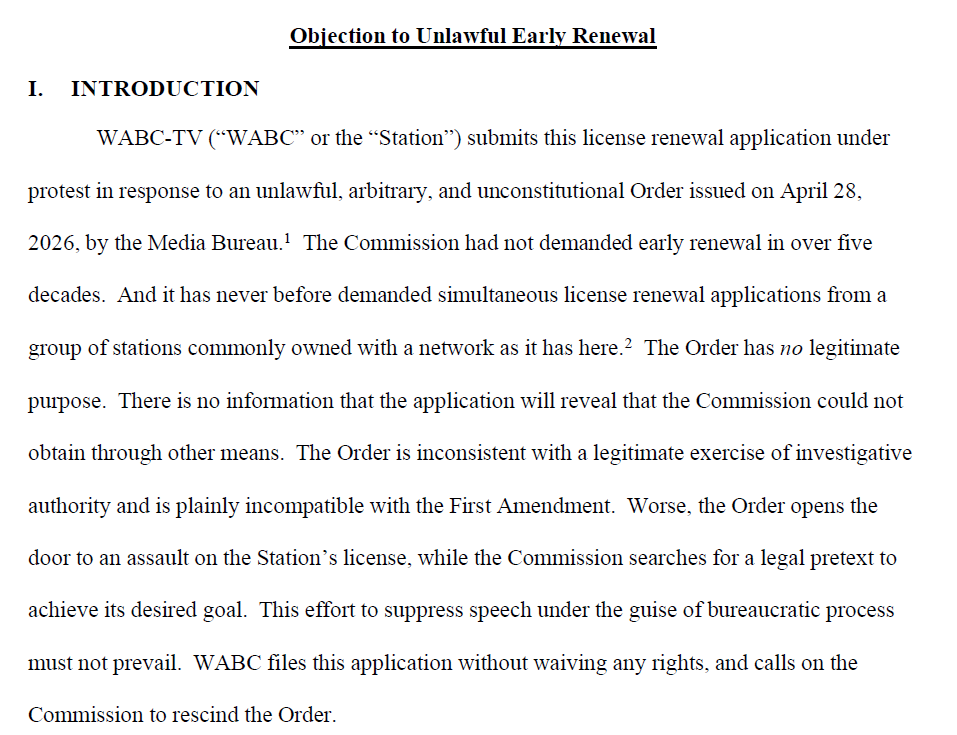
ABC also notes that the FCC has until now refrained for more than five decades in issuing an early renewal order. Furthermore, it has never before demanded simultaneous license renewal applications from a group of stations commonly owned with a network as it has here, the company said in its application.
Additionally, ABC says, “The Order has no legitimate purpose. There is no information that the application will reveal that the Commission could not obtain through other means. The Order is inconsistent with a legitimate exercise of investigative authority and is plainly incompatible with the First Amendment. Worse, the Order opens the door to an assault on the Station’s license, while the Commission searches for a legal pretext to achieve its desired goal. This effort to suppress speech under the guise of bureaucratic process must not prevail. WABC files this application without waiving any rights, and calls on the Commission to rescind the Order.”
ABC also says the FCC “has elsewhere committed to identifying and eliminating obsolete or unnecessary regulations. Here, it does the opposite — excavating an arcane procedural relic, dormant for decades, to justify its actions. The ‘call-up’ provision that it now invokes was designed for a regulatory world that no longer exists: an era of shorter license terms, comparative hearings weighing applicants’ merits, and exhaustive renewal showings on program content. That world is gone.”
The first of ABC Owned Stations’ broadcast licenses come up for renewal in 2028.
As the 6pm hour neared in Washington, Carr offered his own thoughts in response to ABC and Disney.
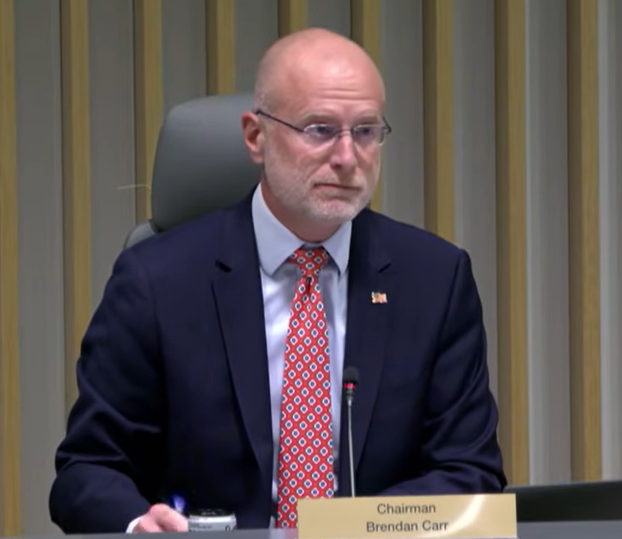 “Contrary to Disney’s claim that the FCC called in their broadcast licenses for early renewal for no reason, the record shows something very different,” Carr said on X. “The FCC has been investigating Disney for over a year now after reports surfaced alleging that it had been discriminating against people based on race, gender, or other protected characteristics in violation of federal nondiscrimination laws. The allegations include concerns about Disney hiring, promoting, compensating, and providing or denying workplace opportunities based on protected characteristics. Disney only filed these applications to renew their ABC broadcast licenses after the FCC informed the company that their responses to the agency’s investigation had been disingenuous, deficient, and improper. Broadcast licensees have a unique obligation to operate in the public interest. The FCC will follow the facts and law wherever they may lead.”
With reporting by Adam R Jacobson, in Phoenix