

Privacy is still a major issue for users of voice control on any device, as well as among potential buyers of smart speakers.
That’s the key takeaway from a newly released voice control device study from Hub.
Yet, more than 4 in 10 respondents own a smart speaker, and nearly all of them use it to interact with entertainment content.
In spite of consumers’ concerns, smart speakers are poised to play a pivotal role in the discovery and consumption of entertainment content.
The study from Hub finds that about three quarters of smart speaker owners use their smart speaker to search for media content – music, TV programs, movies, podcast, or audiobooks.
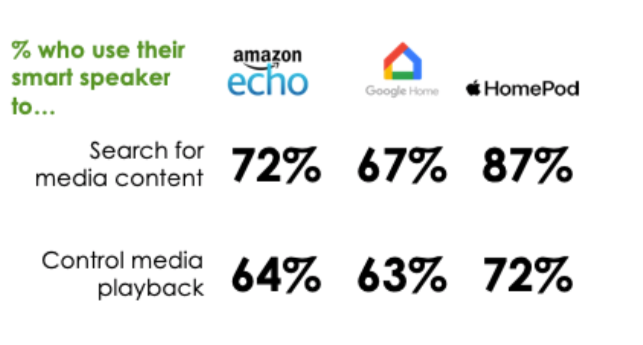
Further, about two thirds of smart speaker owners use their device to control playback of media on the device itself or on other devices to which it is connected.
Aside from media, other key categories of use of smart speakers include answering questions (such as search, navigation) and getting information (such as news, weather, calendars), cited by about two thirds of smart speaker users. Lesser used categories include communication, smart home, and retail.
Another key conclusion of the Hub study is that concerns about privacy and security “are a significant roadblock to both wider use of voice control for sensitive topics and ownership of smart speakers.”
- Among those who don’t yet have a smart speaker and don’t intend to buy one, two thirds (66%) say that privacy concerns are an important reason for not buying.
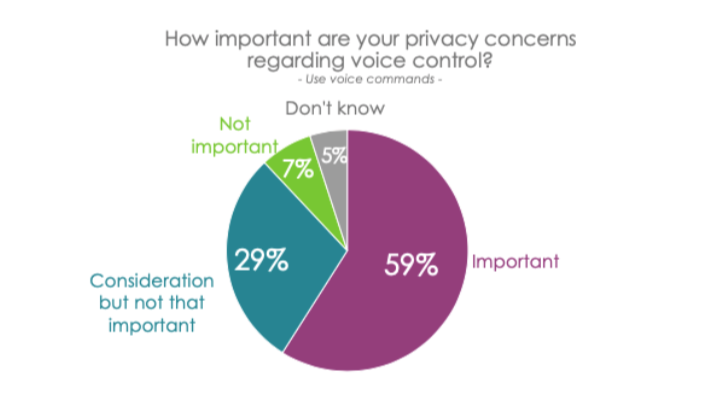
- But it’s an issue even for existing users – 59% of those who regularly use voice control have concerns about privacy.
Almost all users of voice control with privacy concerns cite worries about unwanted listening by speakers (91%) and concerns about what data is being collected about users (90%).
Yet, in spite of privacy concerns, voice command technology is already familiar to mainstream consumers.
Including all types of devices – smartphones, tablets, computers, remote controls, smart speakers, and in-car – 80% of consumers say they’ve used voice command technology at some point. Among younger consumers age 16-35 it’s even higher (88% ever used).
“This new report shows just how pervasive voice control is, and how quickly consumers have embraced it, even if they have major privacy concerns,” said David Tice, senior consultant to Hub and co-author of the study. “These privacy issues may be a key reason why ‘retail’ uses (e.g., shopping, financial) lag well behind other activities like entertainment on smart speakers.”
The findings are from Hub’s “The Case for Voice Control” study, conducted among 2,512 U.S. consumers. Use of voice control with smartphones, tablets, computers, TV remotes, in-car, and smart speakers is explored in the study, with a “deep dive” among smart speaker owners. Interviews were conducted in early December 2019.
A free report excerpt of the findings is available on Hub’s website.