


As the first quarter of 2023 winds to a close, no one can deny that a Chinese ByteDance-owned video sharing app has become an integral digital and popular platform for brands, in particular those seeking audiences between 12 and 34 years of age.
“TikTok plays a growing role in culture around the globe,” says WARC Media Head of Content Alex Brownsell, who has released a report that takes a deeper look at the app to provide an overview of the key data points that advertisers need to know about, spanning investment, consumption and performance insights.
The report’s release couldn’t be more timely, as TikTok CEO and Harvard Business School 2010 MBA holder Shou Chew will appear before the House Energy and Committee on March 23 to testify on the app’s consumer privacy and data security practices, the platforms’ impact on kids, and its relationship with the Chinese Communist Party.
Then, there’s President Biden’s call for ByteDance to divest TikTok or face a U.S. ban.
Committee Chair Cathy McMorris Rodgers (R-Wash.) on Thursday (3/16) provided details of a full House E&C hearing with Chew, who will appear before the committee to testify.
It is poised to be Chew’s first appearance before a Congressional committee, and the hearing bears the name, “TikTok: How Congress Can Safeguard American Data Privacy and Protect Children from Online Harms.”
Rodgers, like many on Capitol Hill regardless of political affiliation, have been seeking to block TikTok from U.S. consumers for several years. In December 2020, in the waning weeks of the Trump Administration, U.S. District Judge Carl Nichols put a stop to the White House’s attempt to ban TikTok in the U.S.
Lawyers for TikTok had argued that the White House under Trump exhibited a “failure to adequately consider an obvious and reasonable alternative before banning TikTok,” thus rendering a crackdown against the app “arbitrary and capricious.”
Now, 2 1/2 years later, the Biden Administration is harkening the U.S. Commerce Department under President Trump by demanding that ByteDance sell its share in TikTok or face a ban across the U.S. TikTok responded with a statement indicating that “divestment won’t solve the problem.”
But, what exactly is the “problem”? U.S. national security is a key concern, and McMorris Rodgers acknowledged this ahead of next week’s House E&C hearing.
“Americans deserve to know the extent to which their privacy is jeopardized and their data is manipulated by ByteDance-owned TikTok’s relationship with China,” she said. “What’s worse, we know Big Tech companies, like TikTok, use harmful algorithms to exploit children for profit and expose them to dangerous content online. We need to know what actions the company is taking to keep our kids safe from online and offline harms. We look forward to hearing from Mr. Chew directly and continuing Energy and Commerce’s efforts to bring Big Tech CEOs before the committee to answer for their companies’ destructive actions.”
DEFYING THE HEADWINDS
According to the Future of Media report, a part of WARC’s Marketer’s Toolkit survey released on Thursday, 75% of marketers plan to increase their ad spend on TikTok this year.
Brownsell comments, “[TikTok’s] potential ad reach stands at a reported 1.05 billion, including 409.1 million users aged 18 to 24. In 2022 it was the most downloaded app in the world for a third year running, according to data from Sensor Tower. And its full-screen, vertical video format has inspired copycat products such as YouTube Shorts and Instagram Reels.”
Given that growth, what’s the projection for global ad revenue in 2023 for TikTok?
TikTok is forecast by WARC Media to reach $15.2 billion in global advertising revenue in 2023.
“A year in which the wider digital ad market is set to slow and media models are coming under increasing pressure, TikTok is defying the trend as its two-year growth is set to carry on into this year,” Brownsell concludes.
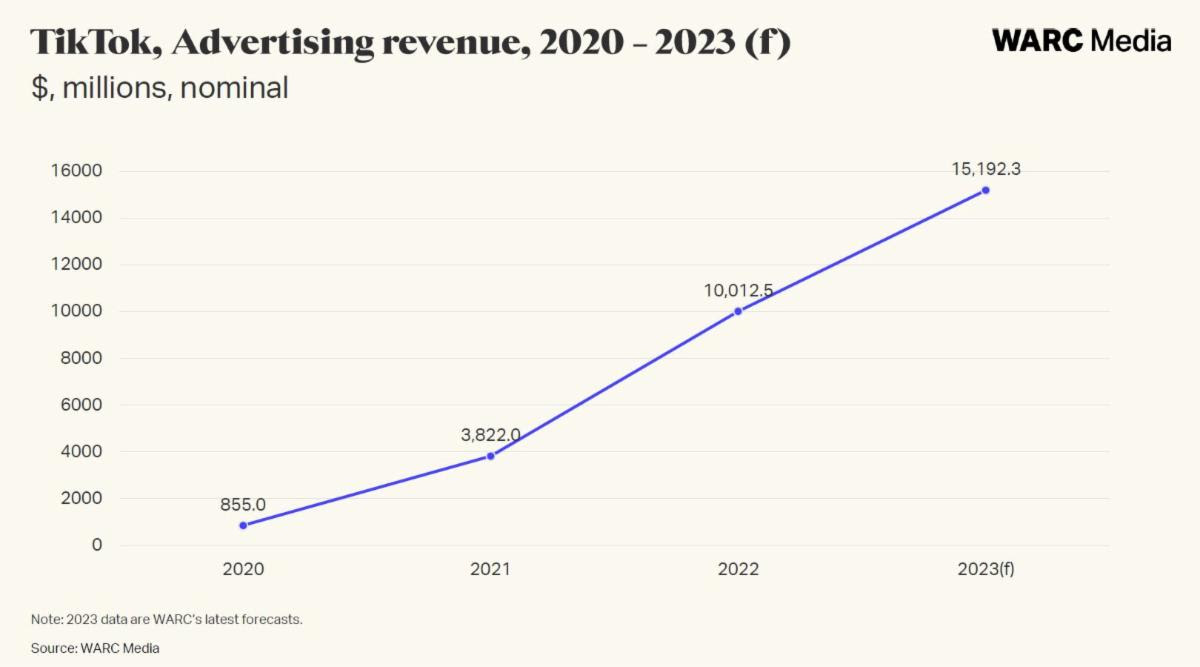
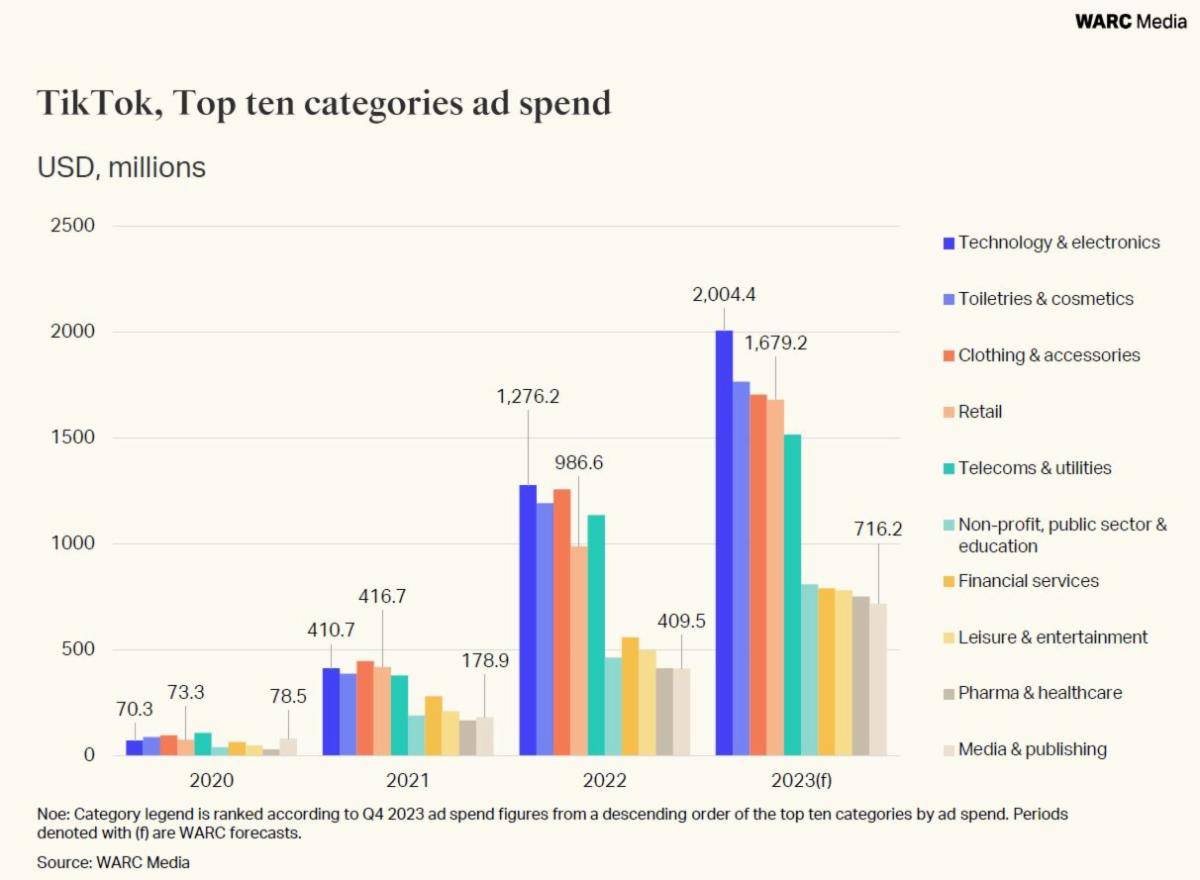
Furthermore, increased TikTok ad investment is being seen in practically every category.
Each of the top five spending categories — technology & electronics ($2 billion), toiletries & cosmetics ($1.8 billion), retail ($1.7 billion), clothing & accessories ($1.7 billion) and telecoms & utilities ($1.5 billion) — are forecast to see their combined annual spend on TikTok surpass $8.5 billion in 2023.
While those figures represent global growth projections, WARC Media finds that in the U.S., Consumer Packaged Goods drove significant growth, increasing ad spend with TikTok by 84% in Q4 2022 compared to the quarter prior, according to data from Pathmatics.
Given the continued fight being waged by the NAB against “Big Tech,” and the desire of many in broadcast media leadership for more deregulation of FCC ownership rules, McMorris Rodgers will likely be armed and ready to discuss just how uneven the playing field is for TikTok — in addition to its perceived threat, lurking on the smartphones of young Americans across the continent.