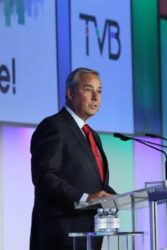
“Nexstar delivered solid first quarter Net Revenue, Adjusted EBITDA, and Adjusted Free Cash Flow, driven by record first quarter distribution revenue and disciplined expense management.”
That’s the official assessment from Nexstar Media Group founder and Chairman/CEO Perry Sook. And, its a statement that could require some explanations for investors, as net revenue fell by nearly 4%, net income shrank by close to 42%, Adjusted EBITDA declined by 15.7%, and Adjusted Free Cash Flow dipped by 10.5%.
The challenges for linear local media in a non-political year were nevertheless met as expected.

As Sook explained in prepared comments released ahead of Nexstar’s Q1 earnings call on Thursday morning, the company in Q1 deployed its Adjusted Free Cash Flow to repay debt, pay dividends, repurchase stock and — “what we hope to be an increasing use of our strong balance sheet” — move ahead with the $22 million acquisition of WBNX-TV in Cleveland, creating a duopoly.
“For the balance of 2025, we remain focused on renewing distribution contracts representing approximately 60% of our subscriber base in total for the year, continuing our path towards profitability at The CW, preparing for the 2026 political cycle, and pursuing deregulation,” he added.
The results were more than satisfactory to investors, with “NXST”, which trades on the Nasdaq exchange, rising by more than 5.5% in pre-market trading to $164.68. This reverse a 30-day slide for Nexstar shares that brought the shares to a year-to-date low.
Overall, Nexstar’s net revenue fell to $1.234 billion, from $1.284 billion, on weaker Advertising on a political basis (it was down 10.2%, to $460 million from $512 million). While a $32 million decrease in political advertising to $6 million is a big factor, Nexstar also was faced with a $20 million reduction in non-political advertising revenue “due to advertising market softness.”
Distribution revenue, which includes the controversial retransmission consent dollars MVPDs pay broadcasters for the right to profit from the use of their stations, was statistically flat, moving to $762 million from $761 million.
Add it up, and net income attributable to Nexstar Media Group slumped to $108 million ($3.37 per diluted share), from $175 million ($5.16).
Again, tough comps are at play, and the EPS beat the $3 estimate offered by an analyst reporting to Yahoo! Finance. Additionally, the $1.234 billion in revenue narrowly surpassed the consensus estimate based on 8 analysts’ forecasts.
Meanwhile, Nexstar’s consolidated debt, which includes variable interest partner Mission Broadcasting, at the end of Q1 2025 was $6.5 billion, including senior secured debt of $3.8 billion.
By comparison, iHeartMedia, the nation’s biggest owner of broadcast radio stations, had $5.07 billion of total debt and $4.52 billion of net debt.
“Achieving deregulation is my top priority.” — Perry Sook
DEREGULATION: SOOK’S BIGGEST DESIRE
Speaking on the company’s Q1 earnings call, which began at 9am Central from Nexstar’s Dallas headquarters, Sook declared, “Achieving deregulation is my top priority,” making the statement well ahead of potential questions during the Q&A session with financial analysts.
That didn’t stop Dan Kurnos of Benchmark to ask if Sook believed Congress was the Washington organ that would be better in getting deregulation to the finish line, rather than the FCC. Sook’s response? A Notice of Proposed Rulemaking from the FCC is the most likely way forward, and with Olivia Trusty likely to be seated as a third Republican Commissioner within weeks, once that transpires it’s off to the races for Chairman Brendan Carr.
Steve Cahall of Wells Fargo further asked about the likelihood of a NPRM. Would this make Nexstar comfortable in putting “pen to paper” in making some significant mergers and acquisitions come to light? Sook replied, “It depends on the circumstances and having a willing parting party able to do so.”
Sook also noted that Nexstar’s efforts in seeking a “firm transition date” from ATSC 1.0 to ATSC 3.0 digital broadcast television is equally important, given the potential revenue associated with broadcast data internet services.
Speaking on the call, President/COO Michael Biard noted that national advertising remains weak while local advertising is resilient given the macroeconomic challenges facing the U.S. economy.