By Adam R Jacobson and Cameron Coats
Streamline Publishing
WASHINGTON, D.C. — A writer at large for The New York Times focused on media and politics is to thank for getting the Chairman of the Federal Communications Communications to suggest that a tiered premium licensee opportunity could be one way a broadcast radio or TV station would be able to avoid adhering to strict public interest obligations.
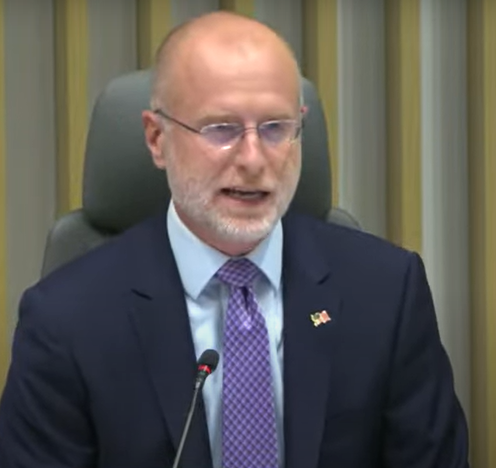
Answering a question from reporter Jim Rutenberg on whether Mark Fowler, the Chairman during the Reagan Administration who many believe is the Republican’s gold standard for Commission leadership, “went too far” and “his legacy now needing a corrective,” today’s FCC head — Brendan Carr — had no comment on the Fowler Chairmanship.
But, Carr could state that, in his view, “over the last dozen or so years the FCC walking away from enforcing the public interest standard … I don’t think is us complying with the laws passed by Congress.”
He made it clear if Congress wanted to pass legislation that removed licensing obligations on broadcasters, erasing the public interest standard or “news distortion.” But, until Congress did so, “we have to enforce the law. If broadcasters don’t like it, they can turn their license in, and they can go to a different type of platform. They can become full-time streamers, can go to cable shows, they can become podcasters.”
While that’s a reiteration of comments previously stated by Carr, he then raised the prospect of a fundamental shift in broadcast licensing — something monumental that largely went under the radar until Radio Ink first published Carr’s commentary on October 1.
“Maybe there’s a future in which we have some sort of auction and broadcasters can bid to get out from under the public interest obligation and have something that looks much more like a flexible use license,” Carr said. The idea, at first glance, would allow broadcasters to remain under traditional public interest requirements or compete for a new class of licenses with fewer regulatory constraints that look more like spectrum rights held by mobile carriers. “Licenses come with conditions,” Carr continued, noting that this goes across the agency, mentioning a matter involving EchoStar. “We’re going to move vigorously forward on this.”
The idea that broadcasters could essentially pay extra to remove themselves from abiding by the FCC’s public interest obligation and related regulatory constraints would mark an unprecedented change to a system firmly in place since the landmark Red Lion ruling in 1969. That case, which saw a licensee sue the FCC, saw the Supreme Court declare that it is permissible under the First Amendment to require media outlets to make broadcast time available for responses to personal attacks.
Growing concerns over the FCC’s monitoring of speech could make such a change appealing to operators, who are increasingly wary of being caught in disputes over political coverage, news distortion complaints, or indecency rules. This would place traditional radio and TV operators on more even footing with unregulated competitors like SiriusXM, streaming, and podcasts. In return, the FCC would have more dollars in its coffers.
At present, federal law explicitly conditions broadcast licenses on serving the public interest. Thus, implementing such an auction would almost certainly require congressional approval. The federal courts would also be drawn into the debate over whether scarcity still justifies differential treatment of broadcasters in a marketplace dominated by cable, satellite, and streaming.
Broadcasters themselves could end up divided. Those that remain in the traditional framework may feel disadvantaged against auctioned licensees who would face fewer regulatory costs and restrictions.
Carr has framed his proposal as one way to give stations more options in a rapidly shifting media environment. But if pursued, the auction model could ignite a major policy fight over whether broadcasters can, or should, escape the obligations that have defined their role as public servants.