By Adrian Zupp
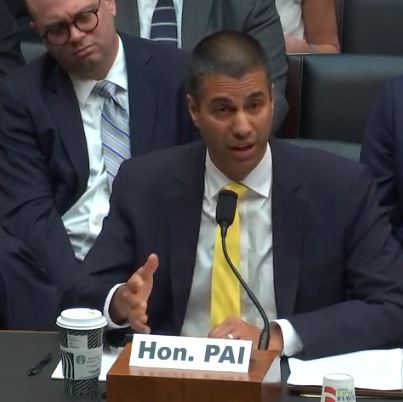
On Monday, FCC Chairman Ajit Pai published a new blog post. The primary focus of the post was robocalls. But, Pai also discussed three TV items that are worth taking a look at.
The post was titled “Robocall Relief Springs Forward.”
While that is a big topic of interest for all in media, the Commission is rounding out its March agenda with a trio of items from the Media Bureau.
The first: a proposal to make it easier for broadcast TV stations to use a distributed transmission system, or DTS.
DTS uses multiple transmitter sites within a station’s authorized service area, each operating on the same channel, in order to provide better service to the public.
Among its benefits, DTS technology makes it easier to serve hard-to-reach viewers, improves indoor and mobile reception, and uses TV spectrum more efficiently.
“As the discerning reader may recall, the FCC majority allowed and encouraged the broadcast television industry to innovate by developing and deploying the next generation broadcast television standard (ATSC 3.0)—essentially an Internet Protocol-based broadcast technology that could deliver richer video content on more devices for consumers,” Pai writes. “That deployment is now on our doorstep, with broadcasters announcing plans to, by the end of 2020, activate ATSC 3.0 stations in the largest 40 TV markets and release 20 ATSC 3.0 compatible TV models in stores. But there are concerns that the Commission’s current rules inhibit expanded DTS deployments with the new standard.”
Thus, Pai has circulated a Notice of Proposed Rulemaking, based on a proposal by America’s Public Television Stations and the NAB, that seeks comment on whether and, if so, how to modify the DTS rules to ensure that broadcasters planning to deploy ATSC 3.0 are able to use DTS effectively. :Specifically, we would look at amending the Commission’s rules to permit, within certain limits, DTS signals to spill over beyond a station’s authorized service area by more than the currently allowed ‘minimal amount,'” he notes.
The Commission will also consider a proposal to change its rules governing the resolution of program carriage disputes between video programming vendors and multichannel video programming distributors (MVPDs).
“We propose modifications to time-limit requirements for filing complaints and effective dates for decisions by our Administrative Law Judge, which are designed to provide additional clarity to both potential complainants and defendants, as well as adjudicators,” Pai writes. “We are also seeking to harmonize our rules, where possible, for the resolution of program carriage, program access, retransmission consent, and open video system (OVS) complaints in these areas.”
Pai is optimistic that these changes “would help ensure an expeditious program access, program carriage, retransmission consent, and OVS complaint process.”
Lastly, the Commission will take up a Notice of Proposed Rulemaking to examine modernizing the methodology for determining whether a television broadcast station is “significantly viewed” in a community outside of its local television market and thus may be treated as a local station in that community for broadcast signal carriage purposes.
This is, well, significant, as the FCC’s significantly viewed stations rules currently rely on market survey data from Nielsen.
“However, it appears as though Nielsen’s survey systems no longer align with our rules, making it difficult to demonstrate that a station is significantly viewed,” Pai concludes. “In some markets, this data is not even available, making it difficult, if not impossible, to meet the standard. Given marketplace changes since the current process for determining a station’s significantly viewed status was adopted nearly 50 years ago, this NPRM examines whether this process has become outdated or overly burdensome, particularly for smaller entities, and if so, what changes we should make to our rules.”
The March Open Meeting is set for March 31 at 10:30am Eastern at the FCC Headquarters building in Washington, D.C.