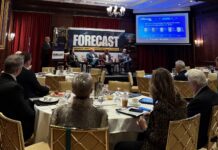
On 10/3 at NABOB’s 37th annual Fall Broadcast Management Conference/13th Annual Power of Urban Radio Forum, Charles Warfield, COO, YMF Media Holdings (he announced he’s retiring as of 10/4); Johnny Shaw, President/Shaw Broadcasting/WOJG, Jackson, TN (also a Rep. in the Tennessee General Assembly and a pastor); Kevin Perry, VP/COO, Perry Publishing and Broadcasting and Kim Guthrie, EVP/Radio, Cox Media Group, talked about radio’s connection with the consumer and the state of Urban radio today.
Deborah Parenti EVP/Radio Ink, was the moderator. Co-chairmen for the forum were Chris Wegmann, RVP/ Market Manager for Radio One, Jim Watkins, VP/GM at Howard University’s WHUR-FM DC and Steve Swenson, SVP/Market Manager for CBS Radio.

Left to Right: Kevin Perry; Johnny Shaw; Deborah Parenti; Charles Warfield; Kim Guthrie and Jim Winston, NABOB Executive Director and General Counsel.
Parenti began with nothing that Urban Radio, as an American media enterprise and business model, has few peers. It boasts an extremely tight-knight consumer connection and strong ratings. These sometimes get overlooked in media buys.
Do you believe that you are able to convert ratings to revenue just like top-rated stations in the market?
Guthrie: “Thanks to Katz Radio Group, we’ve always been able to do that because we’ve had great ratings. At the end of the day, if you get the results, it works.”
Shaw: “For me, as an independent owner, I think it’s relationships with my advertisers—both local and national. I think we can make it happen, but form my standpoint, it’s a little harder”
Warfield: “The reality in NYC with WBLS and WLIB…with the ratings, WBLS is having a tremendous year, but we’re still not getting our fair share, if you look at the Miller Kaplans. We always want to measure our performance against the marketplace to see where our growth can come from—when another station gets growth, that’s opportunity for us. It’s never easy, we think we never get our fair share. That’s what drives us to continue to tell our story. These advertisers are not going to reach that audience without us.”
Perry: “Believe it or not, it’s really not hard to sell Urban in Oklahoma City. I think some stations worry about converting ratings to revenue. We go out and see everyone door to door. Local dollars drive the ship. National dollars are nothing but added icing on the cake. How do we get around that? Building relationships. We sell qualitative. You figure out the story to tell.”
Parenti: Everyone knows NABOB’s past issues with PPM. What’s the update?
Warfield: “It’s not an urban issue. I think the industry is still not served by the data. I am hopeful that Nielsen Audio will be able to invest in their products. We need to get credit for all places are audience is listening—smartphones, tablets, PCs, car radios, etc. We need to speak with Nielsen Audio to see what really will help our industry to succeed—the best measurement they possibly can provide over all platforms.”
Parenti: What impact will the Nielsen-Arbitron merger have going forward?
Guthrie: “I’m excited about the combination. Together, they will combine resources, put their heads together and do a better job of measurement. We have found that with DDIs (Designated Delivery Index) with African Americans and Hispanics, we’ve had to put our foot on their neck to keep those numbers up. If we can’t measure what we do, the agencies are not going to want to buy radio. Arbitron does an absolutely horrible job of measuring smartphone listening—especially when these folks are wearing their headphones.”
Perry: “The problem with Arbitron was that it is extremely expensive. The economies of scale in the top 50 markets, I can’t afford. Do we subscribe? No? Do I have great sales? Yes? I worry that Nielsen Audio will not give me a fair shake against companies that do subscribe to what was Arbitron.”
Parenti: What things have impacted Urban radio and what things need to be changed or improved?
Warfield: “There is a disconnect about who we are and the people that make the buying decisions. But that becomes part of the challenge we have. You have to continue to educate the industry. We have to find a way to continue to invest in our product and continue to believe in ourselves. When listeners want to know what’s going on in our community, they come to us. We need to go where they are too. We can’t ignore younger demos. In this business, there’s a change that’s going on that we have to be a part of – what music that’s being listened to, whether I like it or not. Who is coming up? You can’t be in this business and get old. You have to be a part of the changes. HD Radio, satellite ratio, we have to understand it all. We are competing for people’s ears and their time. You have to think about why should they spend their time with us? You have to put some money behind it. Part of it is the technology and part of it is getting people in our businesses that can teach us.”
Perry: “Live and Local. Jim Watkins gets it. I get envious of him. And he has an open checkbook to make it happen. I used to remember selling in my demo of 18-34. Now they call me old man. So I try to surround myself with folks who do understand the younger demo. When you get a rental car and want to know what’s going on in the black community, you look for a black station. We have it, but we have to enhance it. Urban has it, we have to stay live and local. Also, develop and monetize your email list.”
Parenti noted that Emmis CEO Jeff Smulyan was not able to make the panel session—his mother recently passed. Guthrie, in his place, supplied an update on the FM chip: “It’s designed to be in your phone. It’s probably the first thing that our industry has done together. We fight over the 7% of the advertising pie. But not on this, thanks and kudos to Jeff. Sprint is the only carrier we have now, but it’s a great place to start. We spent a good deal of money for it, but the other companies will likely cost more.”
Warfield: “This is an industry effort. The chip is the beginning of putting us in the devices that people are walking around with. It doesn’t drain your data plan. The cost is only some spots to get the word out. The industry should get behind the effort that has been pushed by Jeff.”

Left to Right: Kevin Perry; Charles Warfield; Johnny Shaw; and Kim Guthrie.
Parenti: How has social media changed things at your stations?
Perry: “If anyone is monetizing their digital platform, please see me in the back. You have to be all in our all out with digital and social. We have made that capital investment, but have not done a good job of monetizing that. I’m trying to get the digital budget as well, but I have not mastered that.”
Warfield: “We were trying to figure out how to do this…We kept hearing the market is flat but digital was up. So we made mistakes along the way developing platforms and a website, but we had no one to sell it. We had really nothing to offer. Now someone has that responsibility—to monetize it—at our company. The growth is going to come from digital, but we need to crack that code of monetization with the advertiser and clients.”
Parenti: We also need better metrics to be able to sell digital integrations.
Guthrie: “If we put our brand everywhere where people can hear us, that’s where we want to be. Kiss/WALR in Atlanta has twice the engagement of any other station we have in that market. We want to capitalize on that. We have apps that let people do requests online. They get a text that tells them when their song will be played. The things we are doing, like for Trayvon Martin, they are not doing that with Pandora. You have to be local. Syndicated programming might have run its course.”
Shaw: “Our morning man out-rates Tom Joyner. Radio can affect a person a thousand ways from home to work. Our local people can make a person feel like this is your radio station.”
Parenti: Do you see further consolidation in the Urban marketplace?
Warfield: “This week (10/4) is the day I will step down a president COO of YMF Media. I will stay with the company, however. I have a smile on my face and I owe my wife a lot of time. I’m still committed to this industry. I’m not retiring, but stepping aside. It’s the third time I’ve done this, so it’s nothing new.
I think consolidation in will continue and Urban radio will be part of it. Will it be easier? No. We’ve seen how difficult how the last 10 years have been. We want people to help us with capital. But media consolidation will continue. Consolidation is a way to grow and if we don’t consolidate, some of us eventually won’t be in this room.”