The NAB’s top legal team, led by Chief Legal Officer and EVP/Legal and Regulatory Affairs Rick Kaplan, has told the FCC in a 55-page filing that the agency “has failed to reckon” with how “robust competition” from unregulated platforms dominated by “Big Tech” impacts broadcast stations and their ability to offer over-the-air services at no charge to the public.
The chief culprit, the NAB argues, is the FCC’s “asymmetric and overly burdensome
broadcast regulatory regime,” which Kaplan and his team say “should be reformed” to account for “undisputed – and indisputable – marketplace realities.”
With Kaplan joined by SVP/Deputy General Counsel Erin Dozier, Senior Deputy General Counsel Jerianne Timmerman, recently appointed deputy Nandu Machiraju and Vice President of Innovation and Strategy Alison Martin, the NAB presented an argument that paints the communications marketplace for audiences and advertisers as “fierce and flourishing,” and largely thanks to “an overabundance of audio and video choices accessible from virtually anywhere via any device,” and at all times.
For local advertisers, where to place their marketing dollars mirrors where consumers wish to spend their media time. As such, advertisers can choose from a plethora of competing ad options, whether traditional, mobile, or online, including Big Tech’s dominant platforms.
This led the NAB to once again urge the Commission to “carefully analyze all the non-broadcast sources of competition to local radio and TV stations in its upcoming report and in future broadcast regulatory proceedings.”
Previous competition reports to Congress, the NAB says, “correctly recognized” that radio and TV broadcasters participate in broader audio and video markets that include online
content providers and multichannel programming distributors.
The report begins with Kaplan and his legal team noting that, despite congressional intent and the total transformation of the audio and video marketplace since the signing into law by President Clinton of the Telecommunications Act of 1996, “the Commission has yet to address in any meaningful way its antiquated broadcast regulatory regime.”
To that end, the NAB says, “From its ownership restrictions preventing necessary scale and discouraging investment, to its unwillingness to foster broadcast innovation, to its infatuation with paperwork and compliance burdens that serve to check political boxes more than the effective pursuit of important substantive goals, the FCC consistently refuses to consider how its regulatory approach imperils the competitive viability of local television and radio stations.”
The NAB also believes the Commission “takes for granted that broadcasters must provide a service at their own expense but free to the public, even though it is a unique and enormous public service obligation: only radio and TV stations are required to provide their products directly to the public through local outlets for free.”
And, it says, “Contrary to Congress’s clear intent evidenced in major legislation to ‘ensure that our system of free broadcasting remain vibrant,’ the Commission has never addressed how the math will continue to add up for free, over-the-air broadcasting.”
In conclusion, Kaplan and his legal team believe that, should the FCC continue on its current path, “at some point the industry’s asymmetric burdens may well lead some broadcasters to conclude that the best competitive strategy may be a shift to offering
audio and video content via unregulated platforms — and at a price to consumers.”
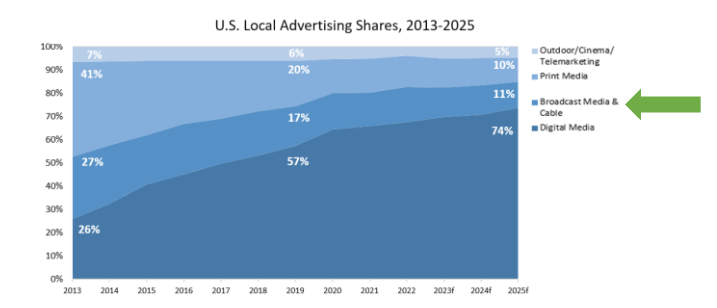
Data from Nielsen’s The Gauge and Edison Research’s Share of Ear report were cited as evidence consumers are gravitating toward digital platforms free of Commission regulatory policies. It then provided a visual look at U.S. local advertising shares since 2013, citing Borrell Associates research.
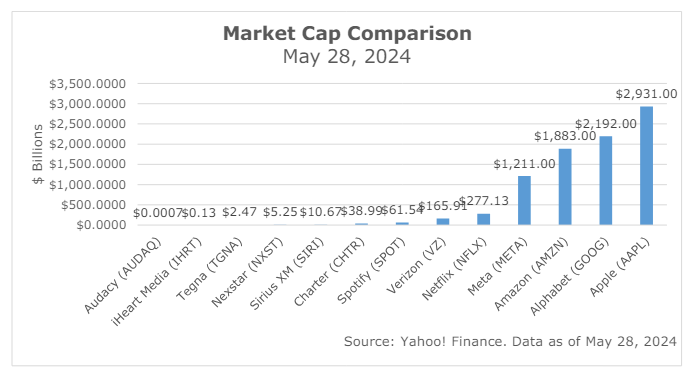
There is also a market cap comparison that has gained attention already Inside the Beltway, as it illustrates the financial inequities between radio and TV’s largest publicly traded companies and “Big Tech.”
The full FCC filing from the NAB can be viewed by clicking here: NAB FCC 060724