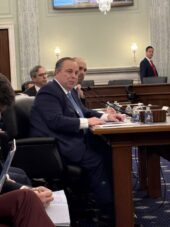
For Newsmax and founder Chris Ruddy, an appearance in February at a key Senate Commerce Committee hearing was designed to establish the outspoken critic of Nexstar Media Group’s merger with TEGNA as an individual with influence who could possibly sway Capitol Hill’s most prominent politicians after failing to do so with confidant President Trump and FCC Chairman Brendan Carr.
While some argued that Ruddy had no standing to even be a Witness at the hearing, it is very clear that FCC Media Bureau Chief Erin Boone believes he has no standing to contest the transaction in front of the Commission.
Addressing issues brought to the Commission’s attention regarding the Nexstar-TEGNA transaction focused on a potential negative impact for retransmission consent fees — thus a threat to the cable TV industry for which his channel serves — Ruddy emerged as a vociferous opponent of the deal.
There’s just one problem in Boone’s eyes. “Under the Act, only a ‘party in interest’ has standing to file a petition to deny,” she wrote in the Memorandum Opinion & Order clearing the way for Nexstar to complete its TEGNA deal, which it did within minutes.
DirecTV and EchoStar had standing, and their arguments were considered. Four label and consumer advocacy groups were found to have standing in certain DMAs where Nexstar and TEGNA own stations. State Cable Petitioners had standing, too.
Ruddy’s Newsmax cable TV network, which presented allegations that Nexstar uses its broadcast stations “as leverage to coerce pay-TV distributors to pay a higher license fee” for its NewsNation than they do for Newsmax, does not. “The courts have made clear that ‘standing is accorded to persons not for the protection of their private interests but only to vindicate the public interest,'” Boone said.
But what about the supposed harms that relate to retransmission consent, which were presented not just by Newsmax but by the other aforementioned parties, all of whom had standing?
“[T]he Petitioners and Opposing Commenters effectively ignore a basic and fundamentally important fact,” Boone said. “The Nexstar programming that consumers get through an MVPD has a readily available and free substitute. The Nexstar programming is broadcast free over the air. Assuming arguendo that Nexstar attempted to raise prices on MVPDs in a way that could produce cognizable harms or reach a point of program blackouts on MVPDs, consumers could switch to viewing Nexstar for free over the air. This dynamic disciplines both Nexstar and MVPDs. We find that this ameliorates any concerns raised in our record.”
Lastly, a key agreement that shows Nexstar “has made specific commitments” that are relevant is spelled out in Paragraph 75, which immediately gained the attention of one independent TV station owner who spoke with RBR+TVBR for what it seeks to do. “While Nexstar notes its stations are always available free, over-the-air, to help consumers with MVPD affordability, ‘Nexstar commits to offer those MVPDs with which Nexstar has an existing retransmission consent agreement (RTCA) that expires after the TEGNA closing date and before November 30, 2026, an extension of such RTCA at the existing rates through November 30, 2026.”
That’s a total of eight months and two weeks.
For the Media Bureau head, “We accept these commitments as enforceable commitments.”
For Ruddy, taking DirecTV’s cue and that of eight Attorneys General by suing to stop a deal that’s already closed could be his next action.