In South Dakota, Carr Outlines His ‘Build America Agenda’

0

In a major policy speech delivered in Sioux Falls, S. Dakota, at a tower climber training center, on Wednesday, the Chairman of the Federal Communications Commission offered details regarding his intentions for an agenda “that will guide much of the FCC’s upcoming work than right here ‘in the real SF.'”


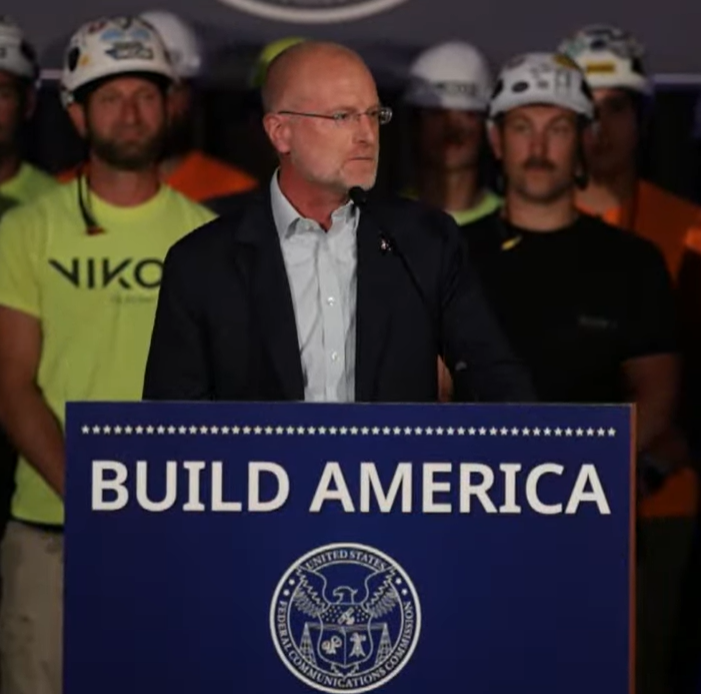
That would be Sioux Falls, and not San Francisco, he joked, as he returned to a training center he first visited at its ribbon cutting ceremony in 2018. With a host climbs with tower crews, Brendan Carr says he’s learned a lot about the work it takes to build infrastructure.

With that as a backdrop, Carr rolled out a regulatory policy in “precisely the types of communities that we need to keep in mind as we develop policies to ensure every American has a fair shot at a high-speed connection.”

Regarding Carr’s plans, he believes “this is precisely the type of change we need in the telecom sector,” taking a swipe at the Biden Administration’s stated goal of connecting millions of Americans to high-speed Internet service by commenting how it “foundered on reams of red tape and progressive policies that needlessly delayed the promise of new infrastructure builds … While the Biden Administration fell into the slow lane, our global competitors and adversaries passed us by, and the FCC’s authority to auction spectrum lapsed for the first time ever.”

Now, Carr wishes to “unleash new growth and opportunity” as he unveiled the FCC’s “Build America Agenda.”

What are the core objectives?

  • We will unleash high-speed infrastructure builds.
  • We will restore America’s leadership in wireless.
  • We will boost the U.S. space economy.
  • We will advance our national security.
  • We will strengthen America’s tower and telecom workforce.

“We will deliver on all of this by implementing smart policies while carrying out a massive and comprehensive deregulatory agenda,” Carr said, adding that “Build America” is an agenda “inspired by the men and women that make up America’s telecom workforce” and one “that ensures America doesn’t just keep up with the rest of the world, but leads it.:

On the topic of wireless, Carr revealed that later in July he will ask Olivia Trusty and Anna Gómez to vote on an order “that will move us another step closer to auctioning the spectrum licenses in what we refer to as the AWS-3 band.” He continued, “These are spectrum licenses that have been laying fallow for years. Getting it into consumers’ hands is the right decision. It’s also a good outcome from a national security standpoint, too, because proceeds from this auction are being used to complete the ‘rip and replace’ program to get Huawei and ZTE gear out of our networks.”

Restoring our auction authority, which has proved elusive over the last two years, also appears to be near with the House of Representatives considering the Senate’s revisions to the reconciliation bill President Trump calls a “big, beautiful” legislative package.

INCREASED VELOCITY FOR RULE DELETION 

Lastly, Carr addressed the need for “cutting red tape and modernizing FCC operations.” There’s new news on this front.

“I am announcing this week that we are increasing the velocity of our Delete proceeding with a vote at our July Commission meeting,” he said. “That is when the Commission will unveil a streamlined process for removing regulations at scale without having to go through years of unnecessary legal procedures. For this first tranche of regulations that we will vote on later this month, we will move directly to delete 40 rules or requirements, spanning more than 17 pages and 7,600 words. It’s hard to believe we still have regulations for telegraph, rabbit-ear broadcast receivers, and phone booths on our books. Starting this month, that will change.”

With all of this, Carr said the Commission is focused “on ensuring the FCC delivers great results efficiently. And that means modernizing our own internal processes and operations. One big step we are taking on this front is to bring our licensing and other databases forward (albeit belatedly) into the 21st Century. If you regularly submit filings or ping agency databases, you know there’s a lot of room to make progress on this front. We are working on it, and I expect that you will find a better experience ahead.”