
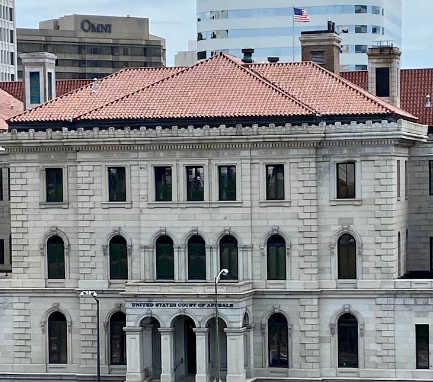
RICHMOND — The U.S. Court of Appeals for the Fourth Circuit has ruled in favor of four Capitol Hill politicians who took the Federal Communications Commission to court in an effort to put a stop to a Public Notice they claim opens the door to what Democratic FCC Commissioner Anna M. Gómez calls “dark money spending” on political ads.
A three-judge panel voted 2-1 in favor of setting aside the Public Notice.
Ex-Ohio Senator and now Democratic nominee for U.S. Senate in Ohio Sherrod Brown (who would fill Vice President J.D. Vance’s old seat), joined Georgia Democratic Senator Jon Ossoff; former North Carolina Governor and Democratic Senate Candidate Roy Cooper III; and Rep. Kristen McDonald Rivet (D-Mich.) in filing the lawsuit.
As 86-year-old Circuit Judge Robert Bruce King explained in a ruling distributed late Tuesday, the case is centered on a “time-sensitive matter” regarding who is entitled to the “lowest unit charge” for broadcast campaign advertisements in the run-up to elections.
The statutory LUC requirement provides that during the 45-day period preceding a primary election and the 60-day period preceding a general election, “[t]he charges made for the use of any broadcasting station by any person who is a legally qualified candidate for any public office in connection with his campaign” must be at “the lowest unit charge of the station for the same class and amount of time for the same period.”
The biggest question: Are political parties and joint fundraising committees with non-candidate members entitled to the LUC? The FCC has asserted that they can, and a Public Notice issued by the Media Bureau on March 30, 2026, outlines this interpretation of the LUC.
Gómez, the lone Democrat on the Commission, earlier on Tuesday lambasted the public notice as the four Washington politicians awaited a call from King’s courtroom.
The Democrats running for office got what they wanted from King:
“As explained herein, we are confident of our jurisdiction to review the Public Notice. Further, we conclude that the LUC requirement and campaign finance statutes are clear that neither political parties nor joint fundraising committees with non-candidate members can be entitled to the LUC. We therefore grant the Petition for Review, such that we set aside and hold for naught the Public Notice.”
With the Fourth Circuit in opposition of the FCC, the Public Notice that takes effect on September 4 is effectively put on hold. It’s a win for the Democratic politicians who sued in the Fourth Circuit, with King noting that they argued “the Public Notice contravenes the plain language of the LUC requirement and pertinent campaign finance statutes.”
The FCC’s defense saw the National Republican Congressional Committee and the National Republican Senatorial Committee join in as intervenors, making the case a partisan battle. The FCC and the Party Committees separately — but similarly — argued that the Fourth Circuit lack jurisdictions to review the Public Notice and that the Public Notice is correct on the merits.
King disagreed. This signals that a Bureau-level order is reviewable by the court, a direct rebuke to Commission lawyers and the D.C. Circuit. That jurisdiction concluded in Free Press, et. al. v. FCC that the Media Bureau’s clearance of the Nexstar Media Group merger with TEGNA on waivers could not be fought in court because the Commission had not yet cast a full vote including Gómez, Olivia Trusty and Chairman Brendan Carr.
Now, King has delivered a judicial split, which could aid those seeking to unwind Nexstar’s TEGNA deal — including highly visible California Attorney General Rob Bonta.
Notable in the decision from King is that the FCC notified the court that Chairman Carr on August 14 circulated a proposed order to Commissioners Trusty and Gómez that — rather than passing on the Public Notice’s merits — would dismiss the Federal Candidates’ Application as an “improper vehicle” for the Commission’s review of the Public Notice.
The FCC received an Application for Review from the candidates in April; it did not act on it as the Fourth Circuit on April 29 received its Petition for Review.
“Simply put, the LUC requirement and pertinent campaign finance statutes are clear that neither political parties nor joint fundraising committees with non-candidate members can be entitled to the LUC,” the ruling reads. “In asserting otherwise, the Public Notice is plainly contrary to law and cannot stand.”
With that, the Fourth Circuit granted the Federal Candidates’ Petition for Review and set aside “as unlawful and hold for naught” the Public Notice issued by the FCC’s Media Bureau.