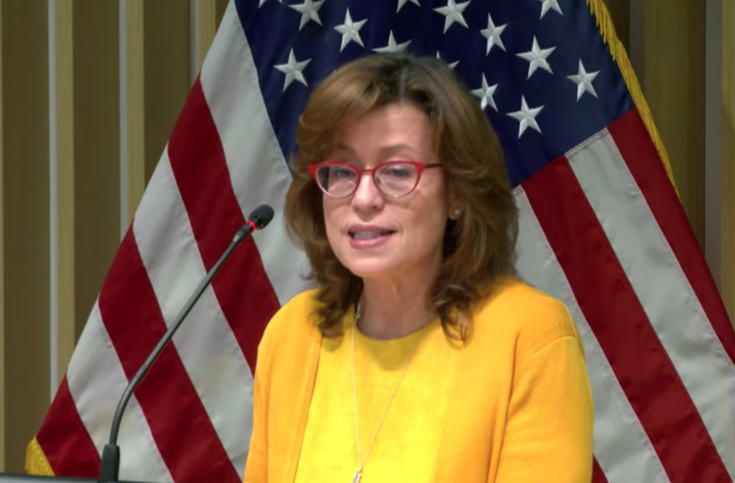
The FCC Commissioner aligned with the Democratic Party has lashed out at a Media Bureau “Order” she claims “unlawfully” expands the interpretation of which political entities qualify for discounted broadcast advertising rates.
Yet, in her own public notice issued Tuesday, it is explained that the “Order” is a Public Notice that’s taken some heat from those opposed to the Carr Commission for what it purportedly changes.

As Anna M. Gomez and Capitol Hill Democrats have lamented, a Public Notice issued earlier this month by the Commission “expands the interpretation” of which entities qualify for the lowest unit charge on broadcast political advertising.
In the view of Gomez, “This change was made by agency staff, not through a full Commission vote. There was no public input, no notice and comment, no docket, no way for the public to track proposed changes from proposal to implementation the way they do with agency rules.”
That said, industry advocacy group Television Bureau of Advertising (TVB) wasn’t pleased with the notice either, and filed a challenge with the Media Bureau. It was dismissed, on the grounds that a public notice is simply that — a reminder of existing rules.
That’s where Democrats and Republicans clash, as four candidates for federal office in Ohio, Georgia, North Carolina, and Michigan filed a joint challenge against the full Commission in the U.S. Court of Appeals for the Fourth Circuit. Late Wednesday (8/25), that court ruled in favor of the plaintiffs — Sherrod Brown, Jon Ossoff, Roy Cooper III, and Kristen McDonald Rivet.
Gomez is howling also for the fact that the public had zero opportunity to weigh in on the tweaks she claims came in the Public Notice.
These changes, she asserts, “will now allow joint fundraising committees and party committees to purchase airtime at the same steep discount the law provides only for candidates, just weeks before voting starts in the fall general midterm election.”
The discount window opens September 4, and for Gomez, this means her colleagues at the FCC are “unleashing a flood of coordinated campaign money into broadcast advertising, just as the Supreme Court has cleared the way for unlimited coordinated spending between parties and candidates. This unprecedented, last-minute decision gives the biggest political spenders an even bigger advantage over everyone else by expanding the candidate-only discount established by law to joint fundraising and party committees, an advantage that will make it hard for anyone else to catch up before Election Day.”
Gomez adds that, in her view, broadcasters are being directed to slash prices and sell their most valuable inventory during their busiest and most lucrative season, “even as this same FCC has spent months arguing broadcasters need economic and regulatory relief to compete with Big Tech and streaming. You cannot claim broadcasters are struggling to survive and then force them into a fire sale on the one thing that could actually help them compete and increase revenue.”
Even more concerning for Gomez is that “this decision was made behind closed doors by agency staff, not by the full Commission, and it contradicts what this administration itself told the Supreme Court less than a year ago about who qualifies for this discount.”
She concludes, “In direct conflict with the administration’s position, the FCC relies on alleged staff-level guidance that was never provided in writing and that nobody could find, and adopted it with no opportunity for the public to weigh in. The American people should not have sweeping election-year rule changes forced on them in the dark, on the eve of an election, without an opportunity for public input. It is past time this Commission listens to them, not to the billionaires seeking to empty their pockets into dark money groups to try to influence the outcome of this upcoming election.”