FCC’s Gómez: Nexstar-TEGNA Deal Can’t Get Waiver OK

0

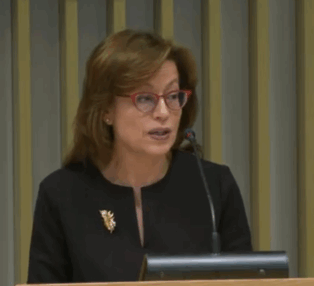
At a press conference held following Thursday’s hourlong FCC November Open Meeting, during which the Commission voted to propose rules for 5G and 6G services in the Upper C-band (3.98-4.2 GHz), the lone Democrat serving as a Commissioner lashed out at the Republican leadership for its efforts to censor the media.


Anna M. Gómez also made it clear that Nexstar Media Group‘s proposed acquisition of TEGNA — a deal that would put Nexstar well above the Congressionally mandated local TV national reach limit — can’t simply get the FCC’s approval with a waiver.


In response to a question asked following prepared comments in which Gómez derided the Trump Administration’s “censorship” efforts across the last 10 months, the Commissioner made it clear that any waiver request cannot be granted.

“I don’t think the agency has the authority to lift or waive the statutory 39% cap,” she said. “The cap is in the statute. It does not give us the authority to waive … we don’t waive statutes.”

If the FCC were to grant a waiver, likely on a 2-1 vote and subsequent court challenge seeking to block the waiver, Nexstar’s national ownership reach would leapfrog to 54.5% of TV households nationally.

What does FCC Chairman Brendan Carr have to say? In his own post-November Open Meeting press conference, he alluded to reporters that he’s made no decision on changing the current 39% cap put into law by Congress. But, he’s open to an amendment as the FCC seeks comment on the network-affiliate relationship seen for broadcast TV in the U.S. today.

With TEGNA shareholders giving their OK to a Nexstar merger, the company founded by Chairman/CEO Perry Sook believes its transfer of control applications — filed Monday with the Commission — “address why, if certain of the FCC’s rules governing television ownership remain in effect, waiver of the rules would serve the public interest, especially in the local communities Nexstar’s stations will serve.”

Like the Trump administration, Sook said Nexstar is focused on achieving deregulation. “[W]e continue to advocate for the elimination of the antiquated constraints on local television ownership as the best solution to level the competitive playing field for all media.”

As Nexstar waits for the FCC to complete its rule-making process, the broadcasting company — already the largest single-owner of UHF and VHF properties — submitted waiver requests “to bypass the major barriers that prevent us from competing fairly—including with legacy media and Big Tech— massive entities with vast resources that afford them enormous influence that extends into every pocket, purse and backpack of Americans everywhere.”

DEFENDING THE NETWORKS

With no “Big Four” net Carr work seeking a license renewal for any of its owned stations anytime soon, Gómez senses that a “witch hunt” orchestrated by the Trump Administration is at play when it comes to investigating ABC, CBS and NBC and carrying out any threats based on what Carr has repeatedly tied to public interest obligations.

“If the FCC were to take the unprecedented step to revoke a license on the grounds that reporting by a network is unfavorable to this administration, it would run headlong into the First Amendment and fail in court,” Gómez said in a statement.

In prepared comments ahead of taking questions, Gómez noted that even during the federal government shutdown, the Carr Commission was active — and, in her view, up to no good. In particular, she took aim at an issue that she’s seen since the beginning of the second Trump Administration — “its role in enabling a growing and pervasive campaign to censor speech and to control the media.”

Gómez then pointed to a threat that emerged earlier this week. That involves the Commander-in-Chief’s insult lobbed at Bloomberg White House Correspondent Catherine Lucey, who asked about Jeffrey Epstein files while aboard Air Force One. President Trump cut off Lucey while asking a follow-up question, and snapped, “Quiet. Quiet, Piggy.”

The FCC’s Democratic votemaker criticized the incident, not for its crassness but for the fact that the White House then expressed its desire to “revoke the non-existent license that a major network does not have, simply because they did not like the tone a reporter asked.”

This followed calls from President Trump to have NBC fire late-night talk host Seth Meyers, on the grounds that comments pertaining to the lurid Epstein files and the current administration were the result, in the Commander-in-Chief’s words, of Meyers “suffering from an incurable case of Trump Derangement Syndrome (TDS). He was viewed last night in an uncontrollable rage, likely due to the fact that his ‘show’ is a ratings DISASTER. Aside from everything else, Meyers has no talent, and NBC should fire him, IMMEDIATELY!”

The president on November 15 posted the comment on the Truth Social platform; it was shared the same day on X by FCC Chairman Brendan Carr, who happened to be with President Trump at Mar-a-Lago in Palm Beach last weekend.

These comments are part of efforts no different than what the Trump Administration sought from the FCC in September, after “Jimmy Kimmel Live!” was suspended for making erroneous statements about the alleged assassin of conservative political activist Charlie Kirk.

In some ways, Gómez continued, threats to broadcast media “have become more direct and blatant. In other ways, they are more muted and subtle to avoid public scrutiny. But the message remains the same: if you disagree with this administration or criticize it in any way, you will be punished.”

And when the agency or the White House threatens action against independent media, Gómez said, “our collective reaction is to respond with alarm and fear.” She’s here to remind us that while the FCC is a powerful regulatory agency, “that power does not exist without limits.”

What’s the strongest guardrail against these limits? The First Amendment, she said.

While the threats are disconcerting and worrisome and “may sound ominous,” the threats are “empty” and the point, Gómez concluded. “They are desperate attempts to force society to bend to this administration’s will.”