
Updated at 3pm Eastern
WASHINGTON, D.C. — On Saturday, August 1, viewers of CBS Television Network programming in seven cities will face a sudden change in how they access this content. On September 1, St. Louis will see a shift for the ABC Television Network, resulting in a channel change for the first time in three decades.
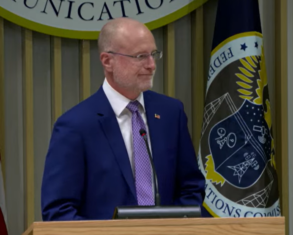
This is disconcerting to the Chairman of the FCC, who spoke with a former cable television industry PR chief turned Capitol Hill Wonk on Thursday. “We are taking investigatory action right now on at least one, if not more, of these affiliation transactions,” Brendan Carr said.
Just how the FCC can regulate a private business transaction, one in which discussions started in May ahead of an August 1 deadline, is unclear. What is clear is that, in Carr’s view, the unintentional act of giving a “Big Four” network more power and influence could run afoul of a licensee’s public interest obligations.
He’s also made it clear that a digital multicast channel is “problematic” for a network affiliation — even though such shifts in a ATSC 1.0 world aren’t as rare as one thinks.
In an interview with Policyband Editor-in-Chief Ted Hearn, Carr discloses that the Commission has started a process to see if any recent “Big Four” network affiliation changes violate federal policy.
What federal policy would a broadcast TV licensee be in violation of? That’s perhaps the biggest question many in the industry may be asking of Chairman Carr, whose comments come at a delicate time for ABC.
On Thursday, network representatives were making a full-court press with the media to ensure its views regarding whether “The View” is a bona fide news program free of equal time rules were known. At the same time, ABC PR team members offered a plethora of defensive statements fueling its calls to the FCC to dismiss early renewal proceedings “as untimely and unwarranted.” The comment window in the early renewal proceeding involving ABC Owned Stations’ eight television properties closed on July 30.
Now comes the possibility that Sinclair Inc.’s decision to conclude its relationship with ABC in St. Louis could be tied into that greater review of ABC by the Commission. “I think there are concerning instances,” Carr said. “I think there’s one involving Gray where they’re taking affiliation from another station.”
As RBR+TVBR first shared one week ago, Gray Media is poised to assume ABC network affiliation rights in the Gateway City come September, with KDTL-LD, which uses a PSIP of Channel 32, replacing Sinclair‘s adjacent KDNL-30.
It’s a move similar to that seen one year ago in Miami, when BH Media’s WPLG-10 dropped its ABC network affiliation after nearly seven decades over reverse compensation disagreements; Sunbeam Television acquired the ABC rights in the market, placing it on WSVN-7.2 ahead of a lease agreement allowing the company to use WDFL-18 as a primary home for “ABC Miami.”
“I think Hearst has been involved in taking affiliations away from other stations, and so I think some of the conduct from Gray and Hearst has been drawing FCC scrutiny in recent days and weeks,” Carr said.
Here, Carr is referencing the shift of CBS affiliation from a small selection of Nexstar Media Group stations:
- In Albuquerque, KRQE-13′s CBS affiliation will move to the digital subchannel of KOAT-7.
- In Jackson, Miss., WJTV-12 will lose its CBS network affiliation, with programming going to a digital multicast channel associated with WAPT-16.
- In Birmingham, CBS will shift from WIAT-42 to a digital subchannel of WVTM-13.
- In Greenville-Spartanburg, S.C., and Asheville, N.C., WSPA-7 will lose its CBS network affiliation as it will relocate to a digital multicast signal of WYFF-2.
In the conversation with Hearn, Chairman Carr expressed concern that the network affiliation shifts could “leave local TV stations in a weaker position relative to their Big Four suppliers of national news and entertainment programming.”
If true, Carr could be contradicting himself on what the future of broadcast television looks like in the U.S. Repeatedly, he has shared the view that if a network is displeased with his Commission stance that scarce spectrum requires ensuring a licensee is acting in the public interest, they can go to an unregulated platform such as streaming media.
Stephen Colbert did just this when he was told by CBS not to air an interview with a political figure seeking re-election. Rather than appear on the now-concluded Late Show, Colbert placed the interview on YouTube; it reached roughly four times the average viewership of his former late-night program on broadcast television.
Furthermore, many industry observers believe that in the near future, broadcast television will no longer be a primary home for networks, given the push of Paramount + for CBS News & Stations’ parent; Peacock for NBCUniversal; Hulu and Disney+ for ABC’s parent; and FOX’s newly launched over-the-top platform. At the same time, the narrative from broadcast TV companies including Nexstar is that increased investment in news programming and original offerings with local appeal warrants increased retransmission fees from the MVPDs that carry their channels.
In Atlanta, Gray Media’s home, its two broadcast TV stations are part of a live-and-hyperlocal move driven by the acquisition of live sports carriage agreements and a build-out of local news — free of network affiliation.
A CHAIRMAN’S LACK OF UNDERSTANDING?
For Carr, the affiliation swaps — which include the move of CBS in four Nexstar DMAs where Hearst Television is getting the affiliations, and three cities where Forum Communications is gaining CBS from Nexstar — are being treated as if there are no rules.
“This is not the Wild West, or as I like to say, it’s not Nam,” Carr told Policyband. “To the extend that some broadcasters are of the view that this is a complete and total Wild West, I think that they are mistaken in that position.”
Yet, Carr himself may be mistaken in just how the network affiliation shifts involving Nexstar Media Group stations transpired. In his conversation with Hearn, he suggests that Gray and Hearst engaged in conduct that may run afoul of the FCC’s rules. Yet, RBR+TVBR has spoken with various individuals close to the matter who confirm that Hearst was presented these opportunities by CBS network affiliation relations executives after Nexstar agreed not to meet CBS’s asks on reverse compensation payments for the respective impacted markets, which include Albuquerque, Birmingham, Greenville-Spartanburg-Asheville and in Jackson, Miss.
Then there’s the matter of what rule could be possibly tied to a private business transaction arrangement that is hardly unprecedented. Just ask longtime television viewers in South Florida.
Since 1988, the NBC television network has aired on three Miami stations — moving from Channel 7 to Channel 4, and eventually to Channel 6. CBS programming shifted from Channel 4 to Channel 6 and then back to Channel 4. In West Palm Beach, ABC network affiliation shifted from Channel 12 to a then-unknown Channel 25. This resulted in CBS network programming moving from little-watched Channel 34 to Channel 12.
Network affiliation moves were also widespread in the mid-1990s when FOX Television Stations was formed, forcing CBS network moves in a host of markets including Detroit.
Today, there’s one key difference that is potentially driving Carr’s concern. In the case of the Nexstar CBS affiliations being shifted to Hearst, per CBS Television Network agreements it is directing, programming is moving to digital multicast networks. Carr believes it is “problematic” because these stations “could offer lower-resolution video quality and could be more difficult to find in pay-TV lineups.”
EASY ACCESS VIA MVPDs
The latter is indeed a concern. A Hearst spokesperson pointed to statements offered on the station websites in the four markets where it is gaining CBS affiliation. In Albuquerque, CBS programming will be available on KOAT 7.4, and on Channel 2 (SD) and Channel 1002 (HD) on Xfinity systems. For those in Asheville and in Upstate South Carolina, CBS programming will be broadcast on WYFF-4.3, and will take Channel 7 on Spectrum and DirecTV channel lineups.
For those in Birmingham, WVTM-13.4 will be the free-to-air TV home for CBS, with cable carriage on Channel 8 for Xfinity and Spectrum MVPD customers. DirecTV and Dish customers will find CBS in Birmingham on Channel 12. Viewers in Mississippi’s state capital will get CBS programming on WAPT-16.4; Xfinity HD Channel 1015 is a key MVPD home, while Channel 12 is the place on DirecTV, Dish, U-Verse, C Spire and MaxxSouth.
Some distribution agreements remain pending and are expected to be finalized soon.
How the FCC proceeds could present another dogfight between at least one TV network and Carr, who told Policyband, “There are FCC rules and regulations that are relevant to the entry [and] the exit of affiliation agreements. There are plenty of opportunities for the FCC to get involved if there is an instance where it’s ultimately not consistent with agency policy … If there are broadcasters that are doing this in a way that is undermining the ability of stations to fulfill their public interest obligations, that’s going to be a problem — whether it’s at license renewal phase or potentially much sooner in other circumstances.”
Lastly, Carr opines that some broadcast TV station groups could be unintentionally placing more power in the hands of the nation’s “Big Four” networks.
“To the extend that some local stations are allowing national programmers to effectively take affiliations away from TV stations that at least in some circumstances is net-net shifting power dramatically back in the hands of programmers — it is going to result in a worse financial situation for local TV programmers,” Carr concluded. “Maybe a TV station feels like they’re net better off in the short run by participating in that process. But in the long run, it’s a very negative trend for local TV stations and a very positive trend for the national programmers to have complete Wild West unregulated affiliation situations.”