
With some in the radio industry opening questioning if the sale of KPWR-FM “Power 106” in Los Angeles signals a coming sell-off of all Emmis Communications radio stations, Wall Street financial house CapitalCube has taken its stethoscope and given the company led by Chairman/CEO Jeff Smulyan a check-up.
Emmis was placed alongside Saga Communications, Entercom, Urban One, Beasley Broadcast Group, Salem Media Group and one media company that’s exited the radio business—The Walt Disney Company.
What’s the prognosis?
CapitalCube first looked at Emmis’ market share versus profits and analysed its revenue history since Q4 2016, taking account the final quarter of fiscal 2016 and all of fiscal 2017, which ended Feb. 28.
Emmis’ fiscal Q3 was its strongest, with revenue of $58.77 million.
The weakest quarter was Q4 2017, representing December 2016-February 2017. Revenue in this period was $43.49 million.
In each of the five quarters, Emmis failed to reach its peer median on net revenue.

CapitalCube then examined Emmis’ earnings history for the last five quarters. A wild ride was seen, with Q4 of fiscal 2016 and Q4 of fiscal 2017 both underperforming the company’s peers. Yet, fiscal Q3 saw Emmis’ net income of $17.68 million greatly surpass the six companies CapitalCube compared Emmis with.
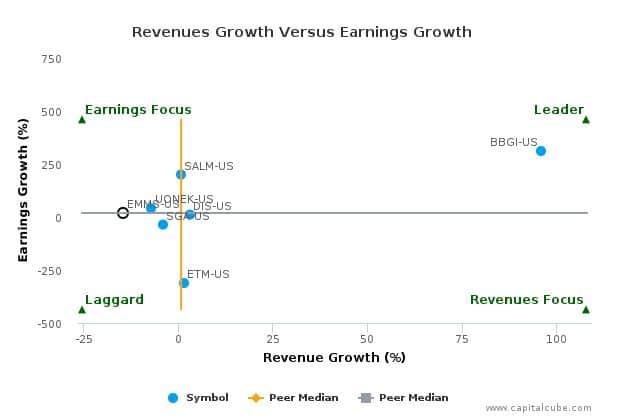
The key takeway: Emmis’ change in revenue during these five quarters, compared to a year earlier (down 14.5%) is nearly the same as its change in earnings and is about average among the announced results thus far in its peer group, CapitalCube finds.
This suggests that Emmis is holding on to its market share.
Yet, Emmis is behind its peers with revenue growth versus earnings growth.
A key finding here: Beasley is way out in front of this group of six radio broadcast companies, and Disney.
“The company’s earnings rose year-on-year, but this growth has not come as a result of improvement in gross margins or any cost control activities in its operations,” CapitalCube says. “Gross margins went from -5.16% to 5.91% for the same period last year, while operating margins (EBITDA margins) went from -8.39% to 2.98% over the same time frame.”
CapitalCube then engaged in a Gross Margin Trend. It explains why by saying, “Companies sometimes sacrifice improvements in revenues and margins in order to extend friendlier terms to customers and vendors. CapitalCube probes for such activity by comparing the changes in gross margins with any changes in working capital. If the gross margins improved without a worsening of working capital, it is possible that the company’s performance is a result of truly delivering in the marketplace and not simply an accounting prop-up using the balance sheet.”
Here’s how Emmis looks:

By then taking a look at Emmis’ Working Capital Days history, CapitalCube determined that the company’s dip in gross margins was offset by some improvements on the balance sheet. “The management of working capital, for example, shows progress,” it says. “The company’s working capital days have fallen to 6.71 days from 13.75 days for the same period last year. This leads CapitalCube to conclude that the gross margin decline is not altogether bad.”
Cash Versus Earnings – Sustainable Performance?
“It is important to examine a company’s cash versus earnings numbers to gauge whether its performance is sustainable,” CapitalCube says.
For Emmis, its change in operating cash flow of 29.41%, compared to the same period last year, is about the same as its change in earnings this period. Additionally, this change in operating cash flow is about average among its peer group. “This suggests that the company did not use accruals or reserves to manage earnings this period and that, all else being equal, the earnings number is sustainable,” CapitalCube concludes.
Therefore, Emmis gets a clean bill of health from this check-up, and with its exit from Los Angeles following a stellar performance at its St. Louis cluster, Emmis’ radio future — coupled with its TagStation and NextRadio holdings — looks bright.