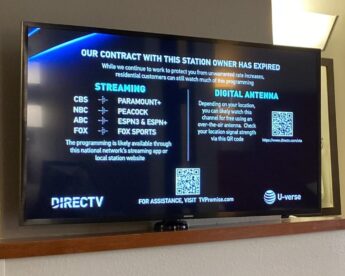
One of the most frustrating results of a retransmission consent dispute that results in the blocking of a channel, by law, to a MVPD viewer is the inability to view one of the nation’s “Big Four” networks.
EchoStar Corporation — the parent of Dish Network — wants the FCC to help viewers in these instances by replacing the “blacked out” channel with a national feed, akin to what airline travelers get in-flight.

The request from Dish’s parent can be found in an ex parte filing made in response to GN Docket No. 25-133, a sweeping new initiative from FCC Chairman Brendan Carr dubbed “In re: Delete, Delete, Delete,” in which the agency seeks comment “on every rule, regulation, or guidance document that the FCC should eliminate for the purposes of alleviating unnecessary regulatory burdens.”
EchoStar cheers the initiative, which it says will eliminate “those regulations that impose
unnecessary burdens, stifle innovation, and no longer serve the public interest.” In its view, this includes “outdated, disproportional rules” which hinder EchoStar’s “ability to innovate, often with little or no corresponding public interest benefit.”
Considering what EchoStar wants, fierce opposition from the NAB and broadcast television industry leaders is likely to come in response. Specifically, the Dish Network parent wants to abolish the syndicated exclusivity and network non-duplication rules. EchoStar also asks the Carr Commission to exercise the Commission’s “statutory discretion under 47 U.S.C. § 338(l) to cease granting satellite television market modification requests, as the process imposes undue burdens and the need has diminished significantly due to technological and marketplace changes.”
The biggest ask? EchoStar wants the Carr Commission to “effectively delete the prohibition on importing distant network signals during a ‘Blackout’.”
This would permit the importation of a distant signal during blackouts.
For example, should a TEGNA/Dish dispute result in a “blackout,” depending on the time zone, a “Big Four” affiliate from either New York or Los Angeles could be plugged in as an interim solution.
In the view of Dish’s parent, this is “a simple way to protect consumers and restore balance to negotiations.” And, it adds, “broadcasters have the power to waive the distant signal restriction.” EchoStar explains, “The Commission can accomplish this significant pro-consumer outcome by reminding broadcasters of the totality of the circumstances standard (47 C.F.R. § 76.65(b)(4)) applicable to the good faith requirement and explaining that a refusal to grant a waiver in such circumstances can be relevant under the standard.
Intriguingly, EchoStar references the 1980s and early 1990s era of “superstations” and sports rights as an example of how the rule harmed broadcasters, shifting rights away to cable TV networks. Indeed, in the early 1990s cable television viewers in South Florida could tune to three affiliates of The WB Network — WGN-9 in Chicago, WPIX-11 in New York and WDZL-39 in Miami (today WSFL-TV).
There’s more: EchoStar wants the FCC to delete the rules (47 C.F.R. §76.66(k)) requiring the carriage of all broadcast stations in a local market in “HD” if the satellite carrier carries any broadcast station in that local market in HD, as there is a strong argument these rules are not required by statute.
With ATSC 3.0 bringing NEXTGEN TV and a Run3TV environment to broadcast TV, how broadcasters negotiate bringing NEXTGEN TV signals to DBS providers and MVPDs will become an increased concern. As such, this request could be closely examined by legal executives and the NAB’s team led by Rick Kaplan.
EchoStar also wants the Carr Commission to kill the political file rules for DBS providers Dish and DirecTV, which was poised to merge with Dish until the deal imploded last autumn.