By Brian Galante
Special to Radio + Television Business Report
The first NEXTGEN TV launch in the Caribbean is on its way, as the first phase of a ATSC 3.0 deployment strategy has been completed thanks to the ongoing efforts of Maine-based Sinclair Inc. subsidiary Dielectric.

It marks an advancement toward the establishment of a single-frequency network for ATSC 3.0-pwered digital broadcasts by Television Jamaica, with new Dielectric ATSC 3.0 antenna systems to eight transmission points across this island nation.
The TVJ project also represents the world’s first ATSC digital TV (DTV) transition plan to bypass ATSC 1.0, moving the privately-owned broadcaster direct to ATSC 3.0 from analog service.
Phase two will expand the network by 12 additional sites.
TVJ’s first NextGen TV broadcasts went live more than two years following a January 2021 mandate from the Government of Jamaica. That decision confirmed the choice of ATSC 3.0 adoption with the suggestion that Jamaican broadcasters should begin transitioning in January 2022. Following the launch of a pilot site at TVJ’s Kingston headquarters, the broadcaster moved forward with an RF study to determine the ideal locations and design specifications for each transmission site. That study would determine the antenna patterns for a single-frequency network (SFN) that would ensure NextGen TV services could cover nearly the entire population, most of which live along the island’s coastal areas.
“The RF study determined we would need in excess of 18 sites to meet the government mandate of reaching 95 percent of the Jamaican population,” said Michael Henlin, Chief Technology Officer for TVJ owner RJRGLEANER Communications Group. “Dielectric’s response to our RFP (Request for Proposal) confirmed that they could meet the precise technical specs for each site, made more critical being the country’s first ATSC 3.0 SFN.”
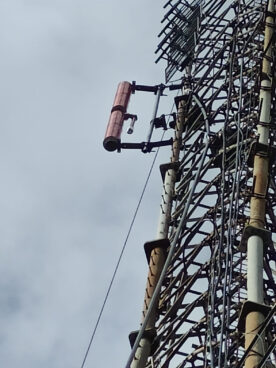
Dielectric specified slot antennas from its TFU-DSB and TLP Series UHF families upon absorbing requirements for each site, based largely on coverage patterns and power required for each location. TFU-DSB antennas were selected for high-power sites; TLP Series Powerlite antennas were assigned to lower power sites. Dielectric also supplied flex transmission line for each site and sent Dielectric technicians to test each system following installation, handled through a local tower crew.
“The TFU-DSB is a broadband slot antenna that can handle eight kilowatts per input. That alone made this antenna the ideal fit for the high-power sites, at least some of which plan to add a second frequency in the future,” Bizet said. “Network-wide, the choice of slot antennas proved important for Television Jamaica, as they minimize connection points, reduce wind load, and simplify both installation and maintenance. That adds up to exceptional reliability over the long term.”
With phase one now completed, Dielectric antennas are bringing NextGen TV services to approximately two-thirds of the population. Following the pilot site in Kingston, TVJ has completed work at Coopers Hill, Oracabessa, Flower Hill, Shot Over, Huntley, Winchester and Mount Airy.
Henlin says Coopers Hill and Huntley were the most challenging deployments to date. “These two sites required Dielectric to add special design characteristics since they cover the widest geographical areas,” he said. “The SFN requirement gave us some unique challenges because of the longer distances to some of the population served from these sites. The towers are higher as are the install points for the antennas to ensure all viewers receive the same quality of service.”
Phase two of TVJ’s ATSC 3.0 network deployment is being planned for the near future, with the final 12 sites expected to be live within 12 months of commencing.
TV Jamaica’s ATSC 3.0 broadcasts are delivered free to air on UHF Channel 25.