LAS VEGAS — The Consumer Electronics Show is already abuzz with futuristic gadgets turning the heads of thousands of attendees keeping a watchful eye on devastating wildfires in Southern California while making mental and written notes of what they’re seeing across Southern Nevada’s biggest city.
From XR glasses, stretchable TVs, smart microwaves, and even a robot sloth bag charm, there’s much to digest. For the VAB, cutting through the clutter can start with the latest usage data on the 16 most-common connected devices today.

Connected devices per U.S. households has doubled in less than 10 years, the Video Advertising Bureau notes.
What does this mean for broadcast media companies? “Alongside a shift in consumer habits, there are more ways for brands to engage with their audiences in more meaningful and personalized ways as they meet consumers on their most used devices,” the group, which advocates for advertising in a cross-platform manner, says.
While the VAB’s bias may oftentimes position streaming and digital media ahead of terrestrial video platforms, the data cannot be ignored as consumers continue to eschew MVPDs in favor of over-the-top options as free-to-air TV consumption has grown in recent years.
In a 24-page PowerPoint presentation being distributed today, the VAB notes, “The growth of an ever-expanding list of connected devices both at home and on the go — from TVs and wearables to voice-activated assistants and smart home technology — signals a deeper integration of technology into every aspect of daily life. This shift not only reflects evolving consumer habits but also unlocks a host of new occasions for brands to engage with their audiences in more meaningful and personalized ways.”
Translation: in-app ads, voice-activated promotions or tailored video content on connected TVs are hot commodities for CMOs and brand managers to consider when finalizing a media plan and budget, the VAB argues. For broadcast TV eager to monetize their streamed newscasts and other locally produced content, it is advice that cannot go unheeded.
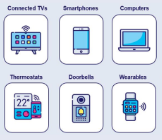
The 16 connected devices examined are comprised of connected TVs, smartphones, computers, tablets, gaming consoles, smart speakers, smart home hubs, thermostats, doorbells, wearables, AR/VR headsets, smart glasses, connected cars and place-based video screens.
Among the key data points:
- Two-thirds of drivers use connected cars and nearly half of all adults are willing to pay for an in-vehicle entertainment system
- Two-thirds of all TVs are now Smart TVs as household penetration with multiple smart TVs continues to grow
- As smartphone AI devices have become ubiquitous, over a quarter are now using them to perform a range of audio and visual tasks
- Console gamers are projected to remain relatively consistent at just over one-quarter of the population
- Smart speaker ownership has plateaued recently at around one-third of the population as users leverage them for specific core activities
- After some fluctuation, AR/VR headset adoption is projected to grow as consumers look to balance affordability, performance and user comfort
Meanwhile, reach and engagement of consumers in bars and restaurants, Quick-Service Restaurants, automotive centers, gyms and retail stores remains significant, the VAB says, thanks to place-based video screens remaining high in number.
And, whether you like it or not, the VAB points to the ubiquitous TVs found in nearly every taxicab in the City of New York and in some rideshare services as a growth opportunity. So are seatback TV screens found in airplanes for a host of major U.S. airlines.