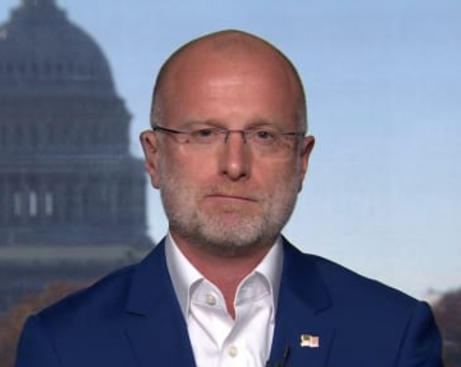
Forthcoming FCC Chairman Brendan Carr has been making the rounds of the nation’s cable TV news and political chat networks since being designated as the successor to Jessica Rosenworcel by president-elect Donald Trump. Carr has been seen on Fox News Channel and on NewsNation. On Friday morning, he appeared on “Squawk On The Street,” a feature on CNBC that saw Carr discuss “some of his deregulatory plans, bias in tech and the media and how it could be addressed from the FCC.”
CNBC noted how Carr has “previously clashed with ‘Big Tech’ companies,” and is preparing an “aggressive agenda to rein in social media, free up wireless spectrum, and accelerate the licensing process to support the space and satellite industry.”
Speaking one-on-one with CNBC’s David Faber, the deregulatory agenda was first on the list of topics he wished to discuss with Carr. “What is top of mind in adding and/or putting in to action those deregulatory plans?”
Answering Faber, Carr pointed to four main ideas he’s been discussing frequently of late. “First and foremost I want to make sure that I continue to work with the Trump transition team to make sure I understand 100% what their agenda is,” he said. For his part, looking at “tech censorship” and, secondly, “a whole set of media issues that I think deserve the FCC taking a fresh look at.” Third, Carr believes several economic issues from permitting reform to spectrum to the space economy, “where, frankly, we’ve got to add some rocket fuel,” are also key agenda items ripe for consideration come January 21, 2025.
National security, particularly with ‘Salt Typhoon’ and internet breaches seen this week, has also been top of mind for many — including outgoing FCC Chairwoman Jessica Rosenworcel.
Carr then turned his attention to the media side of the FCC and its regulatory policies by noting that trust “is at an all-time low,” adding, “There’s a lot that needs to take place to restore trust and confidence in media, and there’s a role for the FCC — at least on the broadcast side. For instance, they have to operate in the public interest and I think it is probably appropriate for the FCC to take a fresh look at what that requirement looks like.”
Democrats have resisted this, and have taken an opposing view. So has retired Washington, D.C., communications attorney Erwin Krasnow, who has written about how the FCC and its approach to public interest concerns should be in direct contrast to what Carr is advocating.
Faber asked Carr if his comments meant that a TV network could have owned-and-operated stations see their licenses revoked if they have, for example, a perceived liberal bias. How did Carr respond? “Look, the law is very clear. The Communications Act says you have to operate in the public interest and if you don’t, yeah, one of the consequences is potentially losing your license. And of course that’s on the table. Broadcast licenses are not sacred cows.”
At the same time, Carr looks at media and believes there are two separate issues. One involves national networks, which provide a lot of the content that the actual licensed local broadcasts disseminate. “We need to look at empowering those local broadcasters to serve their local communities even if it that is in conflict with the interest of those national networks,” Carr said.
What could this then mean for the Media and Democracy Project and its quest to have WTXF-29 in Philadelphia’s license revoked on the grounds that it aired false and misleading information provided by FOX News Channel during the 2020 U.S. presidential election news cycle? With President Trump making comments against ABC and CBS, is there a danger of politicizing Communications Act regulatory interpretation?
Faber didn’t ask about “FOX 29” and instead told Carr he was expecting the soon-to-be Chairman to discuss “some of the antiquated rules around ownership,” including cross-ownership and foreign ownership. Could CNN and FOX be owned by the same parent company in the future?
“We need to look at those issues at well,” Carr said, noting how “Big Tech” can reach 100% of the country yet local broadcasters are limited and can only reach a certain portion of the country. He also called for increased investment in local journalism, and local news, with potential rule changes affording new interest in such financial endeavors.
CNBC reporter Melissa Lee then jumped into the conversation, asking Carr if he can share who determines if a media organization is “too liberal” and if there is an example in the marketplace today. At the same time, is there a media organization deemed “too conservative,” that he’s aware of?
Carr clarified that he didn’t say “too liberal” but said “public interest,” and that’s something the FCC needs to take a look at. “There’s a statutory provision that prevents the FCC from engaging in censorship. I don’t want to be the ‘Speech Police.’ But there’s something different about broadcasters than, say, podcasters, where you have to operate in the public interest. Right now … we should maybe start a rulemaking to take a look at what that means.”
Still, Carr noted the “news distortion” complaint regarding CBS over an interview with Vice President Kamala Harris. He also discussed potential “Equal Time Rule” issues regarding Harris’ appearance on NBC’s Saturday Night Live just days before Election Day. “I just think we need to sort of reinvigorate the FCC’s approach to these issues as Congress has envisioned,” Carr said.
With 20 seconds remaining in the first five-minute segment, Lee concluded the interview by asking, “Are you basically saying to broadcasters ‘be on guard under my watch’?”
Carr replied, “I’m saying follow the law. This is a law that has been on the books for a long time. It is not my decision to hold broadcasters to a public interest obligation. It is Congress, and if they don’t like that they should go to Congress to change the law. My job at the FCC is to enforce the law passed by Congress and that is what I intend to do.”
— With reporting by RBR+TVBR in Northville, Mich.
Returning for a final two-minute segment with Carr was Faber, who asked about smashing the “censorship cartel” and the interplay between the FCC and the “GAFAN” group of digital social media companies. Carr noted that looking at Section 230, something former Commissioner Mike O’Rielly declined to do, is up for consideration.