Capital Call Letters: AM Radio Gets Its House Spotlight

0

WASHINGTON, D.C. — What would happen if AM radio were to disappear from all radio vehicles? For the President of midwestern licensee Woof Boom Radio, it all comes down to access. From diversity that includes a Black Gospel station in Indianapolis to providing emergency information in Anderson, Ind., Jerry Chapman shared to key U.S. House of Representatives Members why AM radio matters.


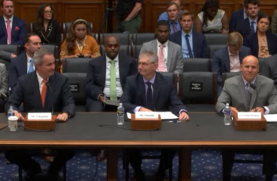
Chapman wasn’t alone in explaining at a House Energy & Commerce Subcommittee on Communications and Technology Hearing held Tuesday as to why AM radio, based on its technical attributes, is essential to the nation’s Emergency Alert System.

Yet, a representative of the Alliance for Automotive Innovation wasn’t exactly keen on ensuring AM radio’s survival, based on his statements.


“Certainly, we need all platforms available to our residents,” Lt. Col. Christopher DeMaise, Homeland Security Branch Commander for the New Jersey State Police, told Gainesville, Fla.-based Rep. Gus Bilirakis (R-Fla.), who shared with DeMaise how he enjoys listening to baseball games on the radio. The Tampa Bay Rays’ local affiliate is WRUF-AM 850.

WRUF has an FM translator to help it reach as many listeners as possible. So does Woof Boom’s WHBU-AM 1240, which can cover Muncie, Anderson and much of Indianapolis on its AM service while its FM translator only covers metropolitan Anderson.

That narrative is key to how services “supplement” AM, including digital platforms such as TuneIn, which is now offering all licensed AM broadcasters in the U.S. no-cost inclusion in its TuneIn On Air service “to help extend their broadcast reach.”

For Chapman, “In the event of a significant disaster, these stations reach more than 90% of the U.S. There is no other technology, or no other medium, that is ready to replace that.”

Chapman offered those comments to Rep. Anna Eshoo (D-Calif.), while Scott Schmidt, Vice President of Safety Policy for the Alliance for Automotive Innovationfocused on costs associated with AM radio’s continued availability. “My understanding from reading some of the FEMA documents is that the EAS system is a fairly cost-intensive system to maintain,” he said. “The key thing is to how to make that more cost-effective as we move forward. As we look at technologies that may be declining we find alternatives that can address that in a more cost-efficient manner and still deliver the safety benefits.”

This led Eshoo to ask why it is so expensive. Schmidt’s reply? “I don’t know,” he admitted, explaining that “you have these hardened stations … and they are not just AM stations, there are other stations … and I don’t have the specifics on that,” while telling Eshoo that he can pull that reference and get it to Eshoo. “I’d appreciate that,” she replied.

IF FORD CAN, WHY NOT ALL?

Rep. Cathy McMorris Rodgers (R-Wash.), who heads the full House Energy & Commerce Committee, was then recognized by subcommittee chairman Bob Latta (R-Ohio). She immediately directed her first question to Schmidt, pointing out that in Ford Motor Company’s announcement on May 23 that for any owners of 2023 Ford EVs without any AM broadcast capability, an “over-the-air” software update would be conducted to make it available.

“How is Ford able to turn on AM broadcast capability with the flip of a switch while other car manufacturers are not?,” she asked.


“How is Ford able to turn on AM broadcast capability with the flip of a switch while other car manufacturers are not?” — Rep. Cathy McMorris Rodgers, Chair of the House Energy & Commerce Committee, to Scott Schmidt, Vice President of Safety Policy for the Alliance for Automotive Innovation.


Schmidt’s reply was based on what Ford told the alliance regarding the removal of AM radio, and how it was able to easily return it; he added that he could not speak of Ford’s plans for beyond 2024, while not answering McMorris Rodgers’ question directly.

“Are you aware of any other auto manufacturers who are choosing not to provide AM radio despite having the technology and capability to do so,” McMorris Rodgers then asked Schmidt. His reply? “We haven’t done a Census to see which vehicle manufacturers are or not. This is something that manufacturers look at customer preferences very closely so they do a lot of market research and try to determine how to deliver the most value to the customers.”

McMorris Rodgers wouldn’t relent, asking Schmidt if he does have any insight into whether any companies in the Alliance for Automotive Innovation plan to charge extra for AM/FM radios in cars through a subscription service. Schmidt’s reply, “I can’t really talk about, you know, content. I can talk about safety, so we are committed to providing free alerts. Um, as far as the content, as you know in any … um … in this realm there is a lot of free content and a lot of subscription content for everything.”

Schmidt concluded his answer by reiterating that his organization is reaffirming that drivers have access to “free public alerts and safety warnings” through the Integrated Public Alert and Warning System (IPAWS) program.

Thus, the possibility of paying for AM/FM radio was not refuted or dismissed by Schmidt.

McMorris Rodgers then shifted her questions to Woof Boom Radio President Chapman, who oversees a group of 12 stations serving five cities in central Indiana and west central Ohio. The company was formed in 2013 with the acquisition of stations from Barry Drake’s Backyard Broadcasting.

“From your perspective, what effect would the removal of AM radios from cars have on the  diversity of thought in the broadcasting space?” McMorris Rodgers asked, noting that a “large portion” of AMs offer conservative talk programming or religious content.

Chapman replied with two examples. One Woof Boom station in Muncie, Ind., WMUN, is “cost-intensive” but was recently refocused to place an emphasis on community issues. “It is important that we have a place for the Fourth Estate to act to talk about public issues,” Chapman noted. “Like a lot of the communities in the Rust Belt, this town has been somewhat challenged over the years. But if there is not the place in the declining forms of other media to discuss these things, we cannot depend on social media to help communities shape its decisions. It’s a role that we need to play as a broadcaster, and that is something AM stations do really well.”