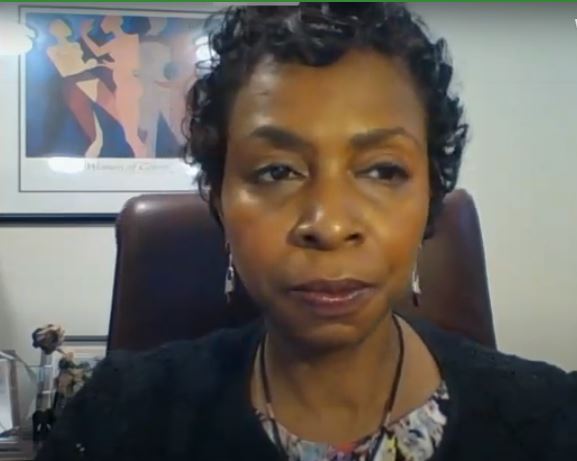
LONG ISLAND CITY, N.Y. — Her Congressional district includes such Brooklyn neighborhoods as Park Slope, Brownsville, Crown Heights, Midwood, Flatbush and Sheepshead Bay, home to a diverse group of constituents ranging from Eastern European immigrants to African Americans and observant Jews tied to Chabad.
During the final two years of Barack Obama’s presidency, she commended the FCC’s efforts tied to “AM revitalization” by continuing an application period for FM translators exclusively for AM radio stations. As 2020 came to a close, she expressed pride in the FCC’s consideration of modifying FM booster rules “that could potentially help minority-owned stations better serve their communities.”
Rep. Yvette Clarke (D-N.Y.) was referring to GeoBroadcast Solutions’ ZoneCasting technology, presently under review and subject to a Notice of Proposed Rulemaking from the FCC.
Now, it appears Clarke has retracted that statement, and is now against ZoneCasting.

On Dec. 1, 2020, Democratic FCC Commissioner Geoffrey Starks issued a statement regarding the adoption of a NPRM seeking comment on whether to modify the Commission’s FM Booster Rules to permit geo-targeted content to originate from booster stations — presently allowed simply as a rebroadcast service to fill-in a primary signal due to terrain issues.
In the waning days of the Pai Commission, GeoBroadcast Solutions presented a plan for ZoneCasting that would amend those rules by allowing a booster to originate its own programming. Technically speaking, it’s a complex issue. In subsequent tests, GBS says it worked in hilly areas northeast of San Jose, Calif., at KSJO-FM; and in Jackson, Miss., at an FM with a rimshot signal of the state capital. In other areas, it could lead to a cacophony of competing audio signals that the NAB asserts could create a public safety concern. Already, parts of the lower Catskills in New York State suffer from radio signal saturation, as multiple terrain changes within a single stretch of Route 28 yield signals from Albany; Hartford; and the New York metropolitan area that may share signals with FM translators sprinkled across the region.
While the Upstate New York example may be a rare one for ZoneCasting’s intended rollout on a voluntary basis, it could impede the desires of groups such as the National Association of Black Owned Broadcasters (NABOB) to gain a new way for small and minority-owned stations “to better serve their communities by offering hyper-localized content including alternative language news, weather, emergency alerts, and advertising periodically during the broadcast day.”
Starks was immediately drawn to the proposal. He said in December 2020, “This is exactly the type of creative policy-making we need to help strengthen the staying power of struggling broadcasters and begin to close the appalling disparity that we see in minority ownership numbers. I see great potential in this proposed FCC action to improve the local radio experience for audiences of small broadcasters and broadcasters of color, and to better position these broadcasters to compete for listeners and advertising dollars.”
In response to the NPRM, Rep. Clarke expressed her support. “I am proud of the FCC’s consideration of modifying FM booster rules that could potentially help minority-owned stations better serve their communities,” the Member of Congress said 18 months ago. “I applaud Commissioner Starks’ leadership on this issue. As we battle the COVID-19 pandemic, it is important for hyper-localized content, like news and emergency alerts to be delivered to the communities that need this tailored content the most. We must ensure that innovative technologies, like geo-targeting, are used in ways to uplift marginalized communities and spur small business growth.”
Since then, Clarke’s views on ZoneCasting have greatly evolved. On July 6, she joined Rep. Darren Soto (D-Fla.), whose district includes the Hispanic hotbeds of St. Cloud and Kissimmee, Fla., in expressing “serious concerns” about the very FM booster rule modification she previously cheered.
“We are deeply concerned about the potential harms of this technology on communities of color, which rely disproportionately on broadcast radio for news, emergency information and entertainment,” Clarke now says, along with Soto, in a letter to FCC Chairwoman Jessica Rosenworcel co-signed by the House Members. “Radio broadcasters are licensed by the FCC to operate in the public interest and the Commission must not allow geo-targeting technology to be used as a tool for advertising redlining that will enable its users to ‘cherry pick’ only the most affluent listening audiences in a station’s market. The proposal before the Commission is cleverly marketed as a tool to serve Black and Brown communities, when in fact it can be used for just the opposite — to avoid serving those communities.”
Soto, and Clarke, also argue that as members of the House Commerce Committee, which has jurisdiction on ZoneCasting issues, that they are also are concerned about any technology “that could degrade free, over-the-air radio service by introducing harmful interference.”
READ THE LETTER TO FCC CHAIRWOMAN JESSICA ROSENWORCEL FROM HOUSE MEMBERS SOTO AND CLARKE BY CLICKING HERE
What changed? Clarke, like Soto, represents constituents of radio stations owned by Spanish Broadcasting System. In Orlando, SBS’s efforts to launch WPYO as “El Nuevo Zol 95.3” have included various unproven accusations of racism and sabotage by WPYO’s previous operator, Cox Media Group. Meanwhile, WPYO seeks to compete in an environment with several established FM translator stations serving Hispanics in Soto’s district. For Clarke, SBS’s “93.1 Amor” WPAT-FM and WSKQ-FM “Mega 97.9”, like stations targeting African Americans owned by MediaCo Holdings (WBLS-FM and WQHT-FM “Hot 97”), could potentially see their potential billing totals shaken up should ZoneCasting allow stations to microtarget parts of the New York Tri-State Area.
Is this what fueled a significant flip-flop on a hot issue for Clarke?
Clarke’s Press Secretary, Jeanette Lenoir, was reached for comment; she exited her position on June 29. Her interim successor, Press Assistant Dan Kalmowitz, responded to RBR+TVBR‘s request for comment. “As was stated in our previous comment, we must ensure that innovative technologies are used in ways that uplift marginalized communities,” he said. “As we learn more about issues related to targeted advertising, concerns about the potential for harmful and discriminatory practice abound. The issues brought to light by the recent Department of Justice settlement of discriminatory practices claims against Meta are an apt example of this in the social media space. We remain concerned about this kind of discrimination in broadcasting and other industries.”
Perhaps Clarke, and Soto, also learned more as the proceeding moved along — including, perhaps, a June 7 RBR+TVBR article providing details of a 27-page comment filing from the NAB legal team led by Chief Legal Officer and EVP/ Legal and Regulatory Affairs Rick Kaplan that is nothing short than a verbal assault on GBS. The NAB claims neither of GeoBroadcast Solutions’ tests near Jackson, Miss., and San Jose, Calif., demonstrate that ZoneCasting is “technically sound.”
The comments are based on NAB analysis of technical reports of geo-targeted demonstration systems. In particular, the NAB used an analysis of technical reports of geo-targeted demonstration systems at two radio stations employing ZoneCasting technology conducted by John Kean, a senior engineer at Cavell, Mertz & Associates Inc.
The independent analysis found, among other things, a “misrepresentation of use of NPR Labs data on ZoneCasting network design,” and “inconsistencies in ZoneCasting booster site data” filed with the FCC.
Furthermore, Kean slams the GBS study for its “fundamental lack of understanding of multipath measurements used to assess transition areas.”
As such, the NAB asked FCC to reject the proposed rule change sought by GBS.
GBS responded to Kaplan and his team. “We are confident that geo-targeting technology for radio is a viable and outstanding opportunity for radio stations, listeners, and advertisers,” the company said in a statement. “Interestingly, our critics were once our champions.”
Now, the group of critics includes a Member of Congress once hot on ZoneCasting.