At first glance, one would believe that Emmis Communications had a disappointing fiscal Q2 2018. Total net revenue declined to $42.85 million, from $58.77 million. Publishing revenue sank, while the core radio revenue for the media company dipped to $41.76 million, from $45.97 million.
But, there’s more to the story. Emmis can’t compare year-over-year results because it no longer owns radio stations in Terre Haute, Ind., and in Los Angeles. The company has also shed much of its glossy publications since a failed attempt to go private led to tough decisions from the company led by founder and CEO Jeff Smulyan.
Pro forma, radio revenue is up in the just-completed quarter.
Indeed, when subtracting KPWR-FM 105.9 “Power 106” in Los Angeles and the stations formerly owned by Emmis in the Indiana city, radio revenue for the company would have risen 2% in fiscal Q2 2018.
Even so, the all-important Station Operating Income for Emmis in the quarter moved downward, to $9.12 million, from $11.98 million. Slightly higher corporate expenses are to blame, as they moved in fiscal Q2 to $2.54 million from $2.45 million.
Overall, net income came in at $69.9 million ($5.59 per diluted share), from the non-comparable fiscal Q2 ’17 of $335,000 (3 cents).
“It’s been an interesting quarter — a good quarter,” Smulyan said.
Emmis’ key radio markets — Austin, New York, and St. Louis — are all up, with Smulyan noting that 3% grow is being seen in these core radio locales for Emmis.
But, Smulyan added, it was Hot 97 Summer Jam ticket sales and improved ratings among adults 18-34 in recent Nielsen Audio surveys for New York for the station, Hip-Hop WQHT-FM 97.1.
Meanwhile, Smulyan noted that Emmis closed on its sale of KPWR-FM to Meruelo Group. While it’s still a disappointing move for Smulyan, he is excited for what the tough divestment means for Emmis.
“This leaves us with a balanced sheet that allows us to proceed in the future without a lot of the constraints that we have had,” Smulyan said.
But, Emmis EVP/CFO Ryan Hornaday provided some shaky advertising details for the company’s radio stations: automotive ad dollars were down, as was the financial institutions category. Offsetting this were media dollars and home improvement businesses, such as The Home Depot.
Meanwhile, Smulyan said additional capital could be raised from “possibly selling land.”
GOTHAM AM SALE STALLED?
There’s also the sale of WLIB-AM 1190 in New York, which has been on the market for months. During Emmis’ fiscal Q2 conference call for Wall Street analysts and investors held Thursday morning, Smulyan elaborated on WLIB’s future by noting, “There’s renewed interest — it’s certainly taking a lot longer when we thought.”
But, when there’s a right fit, Emmis will be ready to say goodbye to the facility, a unique Class B with 10kw daytime from 3 towers and 30kw at night from 4 towers. This gives the station coverage of nearly all of the New York Tri-State Area.
Then, there is the sale of a tower site in Indiana, a “little longer process” for Emmis that involves one of the hottest areas for real estate in the Hoosier State. “This is an obvious positive … that will help the balance sheet,” Smulyan noted.
Both the land sale and WLIB spin would bring Emmis capital structure positives, and an improved ability to attract lenders, Smulyan said.
“We know that the industry has not had the revenue that we’d like, but we think there are some trends in the industry that will be positive — the CBS Radio/Entercom merger will be one of them,” Smulyan noted.
He concluded the call by reflected on Emmis’ past, present and future. With all of the company’s publications excluding Indianapolis Monthly now shipped off to new owners and a few less radio stations for a company that once owned big Top 40 stations in Minneapolis and Washington, D.C., Smulyan said, “We’ve survived an awful lot of crazy things, and I am excited as to what happens next.”
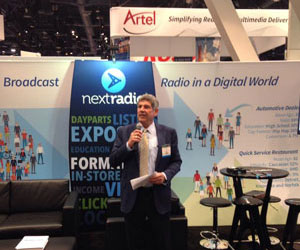
The “next” includes NextRadio, the App that “activates” the FM chip inside Android-powered headsets that is now available via a streaming audio version on iOs-powered devices. And, there’s TagStation, a cloud-based software platform that allows a broadcaster to manage album art, metadata and enhanced advertising on its various broadcasts. Both allowed Emmis’ Emerging Technologies unit to see revenue rise to $238,000, from $183,000.
With debt on the minds of many Wall Street investors eyeing radio, the bottom line for Emmis is that it’s shrunk: Credit Agreement Debt as of Aug. 31 was $79.4 million, down from $152.25. Proceeds from the sale of KPWR made this happen. While Emmis still has a way to go, it’s sliced off a significant chunk of its leverage.
Should the land sales and divestment of a big-signal AM in New York transpire soon, that debt will be lowered even further, making Emmis even healthier as it begins its next chapter under its founder.
RBR+TVBR