
Wednesday, September 9, saw the man who has served as President of Missouri-based Zimmer Communications since September 1980 and since 2008 as the co-owner of Honolulu Coffee Company engage in key conversations “about the importance of ownership rules reform for small radio broadcasters” with all three FCC decisionmakers.
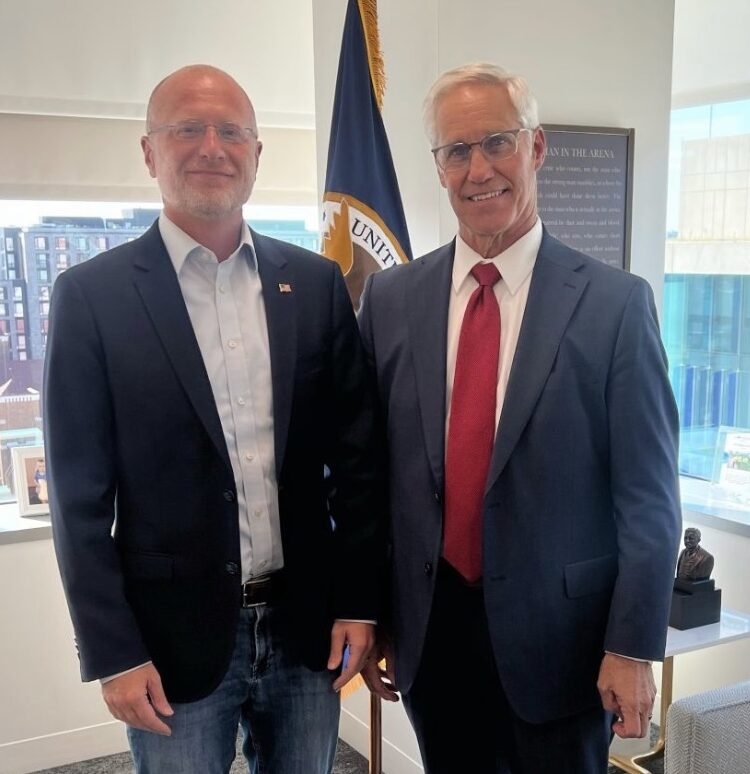
John Zimmer paid a visit to Washington, D.C., and got a chance to meet with Chairman Brendan Carr and those in the offices of Commissioners Olivia Trusty and Anna Gomez, who Zimmer thanked on social media platform LinkedIn for their “time and good questions.”
As Streamline Publishing’s Radio Ink first reported, Zimmer used the single-day visit to FCC headquarters to once again state his case for melting the Commission’s local radio ownership caps. While the Carr Commission has moved ahead with rule reform for broadcast television, it has been slower in addressing the AM/FM local radio ownership caps, as there is a lack of industry unison on allowing companies to increase their in-market holdings further.
Specifically, Mr. Zimmer met with Carr and Legal Advisor Allison Howell, while meeting separately that same day with Marcus Maher, Senior Legal Advisor to Commissioner Trusty; according to a notice filed with the FCC. A third meeting followed, featuring Deena Shetler of Commissioner Gomez’s office. At that gathering, Mr. Zimmer was joined by the NAB’s two chief legal eagles: Rick Kaplan and Jerianne Timmerman.
Across all three, Mr. Zimmer’s message stayed consistent: Repeal the local radio ownership rules as part of the 2022 Quadrennial Review.
It is a refrain Zimmer Communications’ head has been repeating for seven years. He first petitioned the FCC for ownership rule changes in 2019. In May, he continued the battle, submitting a filing with the Commission in which he expressed how broadcasters now compete with platforms that didn’t exist when the caps were set — a statement echoed in recent times by the NAB in its quest for radio station ownership rule reform. That case built on a separate victory last year, when Zimmer helped end the FCC’s TV Top-Four Prohibition in the Eighth Circuit Court of Appeals.
Mr. Zimmer’s central claim is that the rules, frozen in place since 1996, describe a market that no longer exists, as Spotify, YouTube, SiriusXM, Pandora, Amazon Music and Apple Music didn’t factor into the FCC’s math three decades ago.
Zimmer says their rise has steadily pulled listeners, and the advertisers who follow them, away from local radio. Digital ad platforms compound the problem. In his telling, he puts local ad spending at close to three-quarters digital, with Google and Facebook alone pulling in roughly 85% of that local share, while chains like Walmart and Amazon continue to squeeze out the local retailers who once filled radio’s ad inventory.
Public safety features prominently in his case. “Only viable local broadcast stations can provide this reliable and trusted disaster alerting and emergency journalism,” Zimmer wrote in his filing, adding that “despite their greater resources, online and satellite radio outlets…do not offer these types of vital local services.”
Meanwhile, Zimmer isn’t just lobbying for rule changes in the abstract. He’s testing the limits of the current framework directly, with a pending FCC waiver request that would let him fold four Mid-West Family Broadcasting stations in Springfield, Missouri, into his existing five-station cluster there. By his own numbers, the deal would push his revenue share in the market from 8.5% to 33.6%, just shy of SummitMedia’s 34.8%, and lift his audience share from 9.2% to 21.3%, narrowly behind iHeartMedia’s 22.3%.
“Radio broadcasters must be allowed to achieve greater economies of scale to survive in a marketplace with vastly increased numbers of competitors for both listeners and advertisers,” Zimmer told the FCC.
— Additional reporting by Adam R Jacobson