WASHINGTON, D.C. — Six former Federal Communications Commission vote-makers were joined by the current junior Republican Commissioner on the FCC at the Multicultural Media, Telecom and Internet Council’s annual symposium.
Exceptional activity from the agency led for 18 months by Brendan Carr has much to do with increased interest in the event, MMTC President Bob Branson noted.
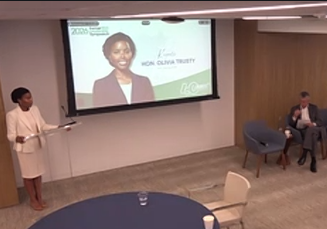
Held at Hogan Lovells in downtown Washington, just three blocks east of the White House, Olivia Trusty offered a top-level review of her time at the FCC, and her focus on technology-driven regulatory policy.
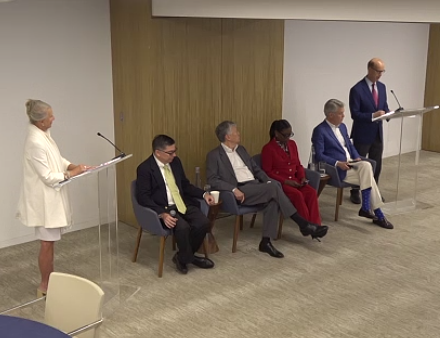
“Like many people who come to the Commission, I thought I had a fairly good understanding of the agency, and then I arrived,” she quipped as Trusty delivered a Keynote Address ahead of a roundtable discussion featuring FCC Commissioners and Chairs of the past — Robert McDowell, Mignon Clyburn, Reed Hunt, Michael O’Rielly and Jonathan Adelstein.
For Trusty, she quickly learned that there’s a difference between understanding the FCC and experiencing the FCC. “All of it has been a tremendous amount of fun, and it certainly kept me on my toes, but I’m used to that as a former collegiate gymnast,” she joked.
This has helped Trusty in advancing U.S. leadership in next-generation technologies. Making that happen are some of her “most valuable experience,” which have occurred outside of the Nation’s Capital.
“In the past 12 months, I have traveled to more than 15 states, meeting with communications providers, broadcasters, technology companies, and engineers, as well as public safety officials, community leaders, and consumers, getting to see firsthand the extraordinary innovation taking place across the country,” she said, noting that she has been “consistently impressed with the ingenuity and drive” among those leading these initiatives.
That’s helped to create a path to rule modernization being championed by the Carr Commission that Trusty can directly relate to. “Behind every proceeding, every filing, and every docket, there are people who are working to connect Americans, to strengthen communities, and to create opportunities for the future,” she said.
Trusty then acknowledged her new global role for the Commission, working with regulatory agencies similar to the FCC around the world to help shape sound policies domestically.
“What I’ve learned is that maintaining U.S. leadership in communications will require continued engagement with our partners and allies, active participation in international institutions and a clear commitment to policies that promote innovation, security, and investment, particularly as we prepare for the World Radio Communications Conference in 2027,” she said.
Now, as Trusty looks ahead to her second year at the Commission, she believes that we are living through “a golden age of communications,” one that keeps her hopeful about what’s ahead as she confirmed her allegiance to the Carr Commission’s advancement of the public interest.
“I remain optimistic about the future,” she said. “I’m also optimistic because our communications networks continue to improve and support technologies that can open up and expand opportunity and improve lives. I’m optimistic because American companies continue to innovate and I’m optimistic because the communications community has repeatedly demonstrated its ability to adapt.”
With former Commissioners Adelstein and Taylor-Tate moderating a bipartisan discussion on the Commission today, former Chairs Clyburn and Hundt took the opportunity to offer prepared statements of length. Clyburn used her time as a warning to the Carr Commission on overreach; Hundt addressed the Trump v. Slaughter Supreme Court ruling that effectively allows the Commander-in-Chief to fire an agency Commissioner, should that be desired.
For Hundt, the question of whether or not a president would want a partisan FCC was addressed. During the Clinton Administration, the desire was to have a bipartisan agency — with a goal of keeping a middle-ground and a goal of securing re-election in 1996.
McDowell’s remarks touched on the America 250 celebrations leading up to Independence Day by saying, “Speaking of fireworks, those who saw the big show here in D.C. as I did, it’s the biggest I’ve ever seen. At the FCC, we’ve also seen probably the biggest fireworks in the history of the Commission, something way beyond anything that we witnessed in our era … the level of attention. And in particular, you know, it started with some of the fracas over Jimmy Kimmel.”
He added that two “really diverging approaches to media regulation in Washington” have emerged. “On the one hand, the FCC took the near unprecedented step of ordering early license renewals for Disney’s ABC stations under the banner of a DEI investigation, which critics call unconstitutional, shilling of speech, you know, especially after … the fracas we saw,” McDowell said. “On the other hand DOJ just cleared the Paramount Skydance massive $110 billion acquisition of Warner Brothers Discovery. As former regulators, I’m wondering from your perspective, how do you kind of square the FCC aggressively Using its power under the renewal process to pressure existing licensees while you see antitrust regulators allow historic newsroom consolidation that comes under a single roof? What does this paradigm shift mean for the future of localism and media diversity?”
As the conversation continued, spectrum scarcity as it pertains to speech and First Amendment protections were addressed by the panelists. For Clyburn, newsroom economics and shrinking trusted outlets for local news and information were addressed.