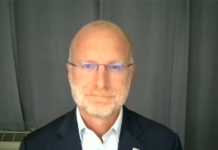
Standard General, the New York-based hedge fund led by Soohyung Kim, has been desperately trying to force the FCC to vote on its proposed acquisition of broadcast TV company TEGNA.
On Wednesday, its chief legal counsel, including Pillsbury Law attorney Scott Flick, were present at the Commission’s Washington, D.C., headquarters.
Why? An initial status conference in its hearing in front of the FCC’s Administrative Law Judge was held, and on Thursday an Order summarized what transpired.
The big takeaway: After discussing timing issues with the parties during the status conference, the Presiding Judge ruled that the optimal course of action is to suspend this hearing proceeding until further notice.
Representing Soo’s SCGI Holdings III LLC and Community News Media LLC, each of which are tied to Standard General, are Flick, Jessica Nyman, Miguel Estrada and Jonathan Bond.
They were joined by TEGNA’s legal counsel, Jennifer A. Johnson and Jocelyn G. Jezierny; and Michael D. Basile and Henry H. Wendel, representing CMG Media Corporation and Teton Parent Corp.
On the opposite side of the ALJ hearing are Arthur V. Belendiuk, Andrew Jay Schwartzman and David Goodfriend, appearing on behalf of The News Guild-CWA and National Association of Broadcast Employees and Engineers-CWA and Common Cause Education Fund. These groups are dead-set against the sale of TEGNA to Standard General, with a significant non-voting minority stake going to Cox Media Group parent Apollo Global Management.
Joining the union and Common Cause were legal counsel Cheryl Leanza, on behalf of United Church of Christ Media Justice Ministry.
Representing the FCC Enforcement Bureau were Pamela S. Kane and Pamela Gallant.
With vociferous calls from Standard General to get Chairwoman Jessica Rosenworcel to stop the hearing and bring the merger to a full Commission vote, TEGNA, Cox Media Group and Standard General have proposed a schedule “that does not include time for discovery” and would conclude by May 17.
That proposal was submitted as requested by the Presiding Judge on April 19 — the final day of the NAB Show in Las Vegas, where Soo was a panelist and used the venue to again stress the importance of allowing Standard General to close on its TEGNA transaction. The NAB has come out in support of Soo Kim.
Speedily concluding the hearing by May 17 is essential for the TEGNA deal to reach the finish line, as the transactions and financing arrangements underlying their proposed merger will expire on May 22.
The groups against the TEGNA deal sought a six-month discovery period, followed by six months of pre-hearing motions and other submissions. These petitioners, and the Enforcement Bureau, suggest that six months is a reasonable period of discovery “for a complicated transaction that allows time for them to review the existing documentation” and determine what additional discovery might be required, including interrogatories, document requests, and depositions.
This led to a serious discussion over “timing issues,” ultimately leading the Presiding Judge to suspend the hearing proceeding.
In making that decision, ALJ Jane Hinckley Halprin explained, “Section 309(e) of the Communications Act, 47 U.S.C. § 309(e), requires that when a broadcast application is designated for hearing, that proceeding ‘shall be a full hearing in which the applicant and all other parties in interest shall be permitted to participate.’ Several steps are necessary in this hearing to fulfill that mandate.”
First, a revision of the existing Protective Order governing proprietary or confidential information is needed before the documentation previously provided to the Media Bureau can be shared with new counsel.
Moreover, because the Hearing Designation Order concluded that the materials already submitted by the TEGNA/Standard General/Cox Media Group applicants were “inadequate” to resolve all issues raised by the proposed transactions, “at least some discovery is necessary,” Halprin ruled.
“Those tasks, and other pre-hearing matters that are likely to arise, will take the duration of this hearing beyond the May 22, 2023, deadline that [the] applicants deem necessary to preserve their merger arrangement,” Halprin said. “Rather than require Applicants, Petitioners, the Enforcement Bureau, and the Office of Administrative Law Judges to spend time and resources in furtherance of this hearing proceeding when the underlying transactions might not survive past May 22, the Presiding Judge determined it best to hold this proceeding in abeyance until sometime after that date has passed.”
But, what does that mean for Standard General? Must it now persuade the full Commission to force a vote, or else the transaction will die without so much as an ALJ hearing?
RBR+TVBR reached out to both Mr. Flick and to Standard General’s communications team for comment.
Standard General provided RBR+TVBR with a statement, in which the company said, “As we have said for months, the FCC Media Bureau’s decision to designate the applications for hearing was a deliberate move to kill the transaction rather than to assist in making a decision. At any point between now and May 22, the FCC has the ability to override the Media Bureau’s deeply flawed Hearing Designation Order and bring this deal to a vote. We urge the FCC to listen to the countless bipartisan voices calling for a vote and fair treatment of the applicants.”
For Halprin, the next step is for Standard General, TEGNA and Cox Media Group to file a status report on or before June 1 to update the record.
What update they could possibly have on that date, other than a death certificate, remains unknown.