Radio Fights Back At One-Sided Senate ‘AMFA’ Hearing

0

WASHINGTON, D.C. — An aging iconic rock star was present, albeit incoherent at times. So was a foe of the radio industry eager to place new fees on the airplay of popular recorded music who succeeds a man who lost his primary reelection race to polarizing Democrat Alexandria Ocasio-Cortez.


They were there to support in very friendly territory the latest iteration of the American Music Fairness Act (AMFA) at a Senate Judiciary Committee Subcommittee on Intellectual Property hearing on Tuesday afternoon.

Defending Radio was the President of a small licensee in Greenville, N.C.

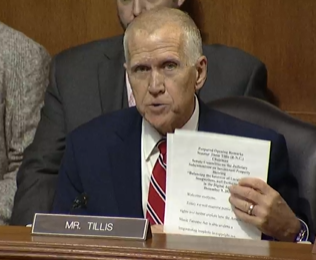
The Subcommittee, led by Sen. Thom Tillis (R-N.C.) and Ranking Member Adam Schiff (D-Calif.), focused the Tuesday afternoon hearing on S.326, the current version of music industry-led AMFA, which has regularly failed to get to a full floor vote in Congress.

As of today, AMFA has 5 co-sponsors in the Senate — with Schiff and Tillis among the quintet of legislators who believe recording artists deserve more from Radio, and not from profit-driven record label conglomerates and associated entities long-known for strongarming artists into unfavorable contracts. Sen. Marsha Blackburn (R-Tenn.), representing the interests of Music Row, introduced the AMFA in the current Congress. Blackburn, and co-sponsor Sen. Alex Padilla (D-Calif.), also spoke during the largely one-sided affair, pushed forward by the few Senators who want AMFA to succeed. Blackburn restated past rhetoric about “righting this wrong” and “closing a loophole in copyright law”; there was no mention of the royalty fees Radio already pays to rights organizations or its long-standing role as a promotional vehicle for recording artists.

The hearing, “Balancing the Interests of Local Radio, Songwriters, and Performers in the Digital Age,” saw Henry Hinton, President/CEO of Inner Banks Media, appear as a witness opposite SoundExchange President/CEO Michael Huppe and iconic KISS band member Gene Simmons in the Dirksen Senate Office Building meeting room. Simmons’ testimony and comments across the hearing were rambling in nature, with references to Elvis Presley peppering commentary that drifted from praise of President Trump to tomorrow’s stars who “don’t have a way to get paid for their hard work.”

Inner Banks is the owner of five radio stations, including conservative Talk simulcast partners WTIB-FM in Williamston, N.C., and WRHT-FM in Morehead City, N.C. And, it is led by a NAB Board Director ready to combat efforts to attract more co-sponsors to AMFA, which would bring new performance royalty rates to broadcast radio in the U.S. — even as he was literally unable to respond to accusations and misstatements from Sen. Blackburn during the hearing. For example, Blackburn assailed Hinton for non-payment of royalties on his stations — with little proof behind her statement — for the airplay of Sam & Dave’s “Soul Man.” That song was released prior to 1973, and thus under different copyright protections than post-1973 compositions under law.

Henry Hinton
Henry Hinton

In prepared testimony shared with Streamline Publishing’s Radio Ink, Hinton underscored radio’s enduring role as a trusted lifeline for communities during emergencies and its unmatched promotional value to musicians. “Broadcast radio has impacted the lives of Americans in many beneficial and significant ways,” Hinton said, citing previous Radio Ink coverage. “We inform, educate, and alert listeners to important events, issues, and emergencies. We entertain listeners with sports and talk programs. And we are local, involved in our communities, and proud to serve the public interest.”

Hinton’s testimony argued that the AMFA’s proposed performance royalty would place new economic burdens on small-market stations already challenged by declining ad revenues and rising operational costs. He noted that local broadcasters invest heavily in public service, local programming, and community engagement, while also paying existing fees to performing rights organizations and the FCC. “Stations have to make the choice between covering local football games or paying new fees; between making their payroll or sending more money to big record labels,” Hinton said. “Make no mistake: enacting the AMFA would jeopardize jobs, require radio stations to cut back their involvement in local communities, and place more pressure on stations already struggling to survive.”

The Inner Banks owner added that the U.S. recording industry reached a record $17.67 billion in 2024, while radio revenue has fallen 20% since 2019 and is forecast to decline further through 2026.

Senator Blackburn challenged Hinton’s views before even offering his prepared testimony. “I know that Mr. Hinton doesn’t agree with me but this bill provides strong protections for non-commercial, small and college radio stations,” Blackburn said, acknowledging the importance of Radio and how Congress “has an obligation to protect them and that we pay them for the content that they create.”

Whether the hearing is yet another dog and pony show with an aging entertainer of note in the room or a legitimate call to act for AMFA supporters may be questioned by some. What is clear is that the non-binding resolution known as the Local Radio Freedom Act has 215 House and 26 Senate co-sponsors. It gained on December 1 the support of Rep. Thomas Massie (R-Ky.).

— Additional reporting by Cameron Coats