Reflect. It is something the National Association of Broadcasters has spent much time on over the last several months in preparation for its centennial conference. In 1923, perhaps 23 people were in attendance in a New York hotel meeting room.
Today, some 65,000 attendees are expected at the Las Vegas Convention Center at an affair with shoulder events that began Saturday morning and three expo halls through of technology from companies serving radio and TV’s backbone on display through Wednesday.
At the end of the day, there’s been one constant over the 100 years of the NAB, and 101 years of Radio — even in today’s dramatically changing media landscape: Localism.
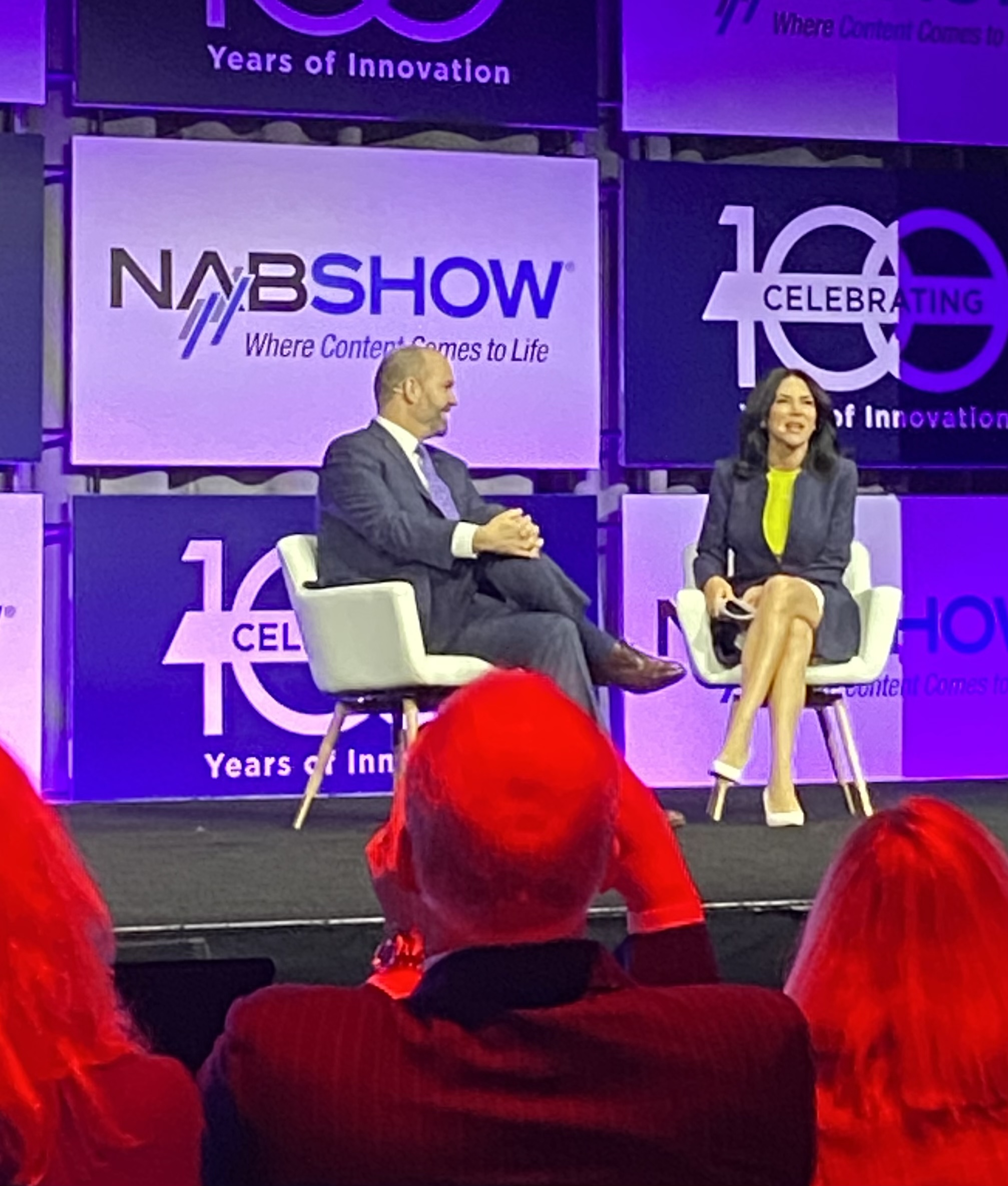
Yet, fragmentation took up much of the conversation as NAB President/CEO Curtis LeGeyt participated in a Welcome Session Q&A with Univision/Los Angeles journalist and KMEX-34 anchor Gabriela Teissier that touched on a variety of hot topics facing radio and television broadcasters.

“Is there a place in the future for AM radio?” was one big question she asked, given her experience on-air at KTNQ-AM 1020. LeGeyt reiterated his belief that the auto industry needs to understand the facts — 82 million Americans tuned in to AM radio in the U.S. over the last month. “This idea that AM radio has lost relevance shows just how focused we are on what is next and the new shiny object and not on what is around us.”
LeGeyt also said that AM’s role in the emergency alerting system “is irreplaceable,” as a wireless technology such as data and cellular services could easily get interrupted.
As a champion of the industry, he also spoke of how AM is producing niche, in-language programming “where the economics just don’t make sense to do it through other mediums. It can’t simply be replaced through podcasting or even through migration through FM. It is still a very relevant medium and we need to understand automakers of that.”
Policymakers in Washington, D.C., understand this, LeGeyt believes. Thus, AM radio has supporters on Capitol Hill who have a vested interest in keeping it in vehicles. Of course, many of these politicians rely on — or perhaps may appear — on the numerous conservative Talk radio programs that largely air on AM radio stations owned by Salem Media Group, iHeartMedia and independent broadcasters across the U.S.

The comments came following an introduction from Salem’s CEO, Dave Santrella, who welcomed attendees to the Main Stage nestled in the rear of the North Hall expo hall.
Teissier, who interviewed LeGeyt in English but works in Spanish at Univision’s L.A. radio and television group, asked about the outsized importance of broadcast media to Hispanics. LeGeyt acknowledged this, noting that Spanish-language communities are more reliant on broadcast media than the total market because of the disinformation that can spread across social media.
LeGeyt’s commentary also touched on broadcast media’s local connectivity, and how it has proved to be the single-biggest attraction point for consumers.
“What is the future of the container for broadcasting?”
This was one of the first questions from Univision’s Teissier, and LeGeyt believes it has not been designed yet. On the show floor, there’s “a lot of deliberation as to what that looks like,” both for radio and television. LeGeyt said, “These innovations are providing us the opportunity to further our connection with our local audiences. Some of that will be done through furthering the traditional broadcast to our viewers and our listeners.”
Also discussed by Teissier and LeGeyt: Why NEXTGEN TV is so vital because of the role broadcast media plays in emergencies, and how COVID-19’s silver lining was that local media provided information not found elsewhere. “It’s not something Amazon and Apple are ever going to cover,” LeGeyt said. “There is a renewed reinvigoration for Local media.”
That’s why, LeGeyt said, broadcasters are going to thrive by being “Free. Local. Live.”