A former FCC Commissioner who lost his seat after disagreeing with President Trump over constitutionality concerns tied to Section 230 of the Communications Decency Act has urged the agency to “strongly reject” any government regulatory policy that requires the abandonment of ATSC 1.0 broadcast signals in order to bring ATSC 3.0 opportunities to their fullest potential.
The essay was distributed by Free State Foundation one day after a Senior Fellow of the independent, non-profit free market-oriented think tank founded in 2006 took pen to paper to alert the FCC and its Chairman that it best refrain from reviving what it calls “social contracts” to address inefficiencies in the nation’s video marketplace.
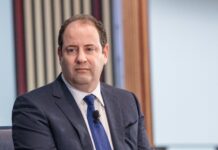
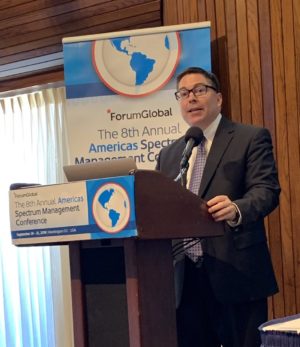
Mike O’Rielly pulls no punches when it comes to where he stands. And, the NAB and broadcast TV station executives won’t be pleased with what he says — even if he may carry less sway today than when he sat alongside FCC Chairman Brendan Carr.
“Some broadcasters want the Federal Communications Commission to force consumers, broadcasters, and a host of intertwined companies to convert to NextGen TV as – they assert – one of the only ways to save the shrinking broadcasting industry,” O’Rielly, today a an Adjunct Senior Fellow at the Free State Foundation, writes. “But this is disingenuous: one can support a healthy American broadcasting industry without endorsing the real costs and dubious benefits that will accrue if the FCC goes down this prescriptive path. As an admirer and friend of broadcasting, I suggest that policymakers allow NextGen TV to develop naturally and voluntarily to determine if consumers even want it.”
That’s the view of Consumer Technology Association (CTA), Public Knowledge, NCTA – The Internet & Television Association, ACA Connects – America’s Communications Association (ACA Connects), American Television Alliance (ATVA), and the LPTV Broadcasters Association (LPTVBA). And, these groups have come together to challenge the NAB, which saw Chief Legal Officer Rick Kaplan on Wednesday lob his own missive at the association’s detractors.
O’Rielly’s reasoning is succinct, and sends a strong message to the broadcast TV industry.
“The extensive governmental intervention that would be needed to move NextGen TV forward cannot be understated,” he writes. “First, the FCC would need to declare the old television standard dead at some set date and prohibit its use. Second, the FCC would have to require that every new television set made or sold have a new tuner to receive these magical new broadcast signals.”
Third, over-the-air-only broadcast viewers would be forced to either buy new televisions, some type of converter box or antenna, or lose access to their broadcast programming, including news and emergency weather alerts, O’Rielly claims.
O’Rielly even claims the “broadcast industry itself does not agree about moving to this new standard,” likely pointing to “SuperFrank” Copsidas and the LPTVBA, which is attempting to bring 5G Broadcast to fruition in the U.S. as it presently gets a beta test in Europe.
The former FCC Republican also states that any entity that carries broadcast stations, like cable or satellite providers, would be obligated to buy new equipment to “down-convert” the signals – “thereby undercutting any technological improvements embedded in the new standard – or replace every customer device used to receive video content, which would take years.”
With American consumers “picking up the tab” for these costs, O’Rielly then attempts to land a sucker punch in the heart of TV broadcasters by stating “broadcasters’ real hope is that new television mandates will unlock the use of its underlying spectrum for side hustles paid for by consumers.”
Translation: “The next great television conversion is really about generating new, non-television revenue streams for broadcasters.” Sinclair Inc. is championing these NTR channels.
“Under this thinking, this hodge podge of possible uses, such as sending wireless updates to products, would somehow solidify broadcasters’ balance sheets and ensure the future,” O’Rielly states. “It’s like allowing mailmen to use U.S. postal trucks to deliver Christmas trees. Even if these services materialize, remember that the government would be allowing broadcasters to leverage the spectrum that they use to offer these services for private gain and far afield from providing broadcast services to the public. Is this the best use of a scarce resource?”
The NAB and most broadcasters say yes. Whether or not O’Rielly’s words carry any weight today will be left to Chairman Carr and votemakers who arrived after O’Rielly. And, chances are they will politely thank the former Commissioner for his thoughts while deciding for themselves the best way to “delete, delete, delete” old FCC rules in need of modernization.