Beyond Deregulation: The Media CFO Path To Financial Success

0

Updated May 20 at 4:35pm Eastern to correct the date of a cybersecurity incident at Sinclair Inc., and to clarify comments made by Sinclair CFO Lucy Rutishauser regarding EdgeBeam as it pertains to ATSC 3.0. Rutishauser did not discuss Run3TV or addressable advertising in her May 19 CFO Panel at the Media Finance Management conference in Arlington, Va. RBR+TVBR regrets the errors.


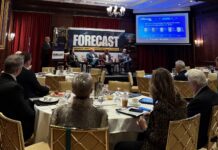
ARLINGTON, VA. — With the main ballroom at capacity, the 2025 Media Financial Management annual conference kicked off in earnest on Monday with an in-depth and revealing panel discussion featuring three key Chief Financial Officers representing broadcast media moderated by the Publisher/President of the Radio + Television Business Report and Radio Ink. 

Deborah Parenti navigated through a variety of topics, including cybersecurity concerns, Artificial Intelligence and its benefits and challenges, leadership and talent acquisition. Of course, top regulatory topics were also a major part of the conversation featuring Hearst Television SVP/CFO John Drain, Saga Communications EVP/Treasurer/CFO Sam Bush, and Sinclair Inc. EVP/CFO Lucy Rutishauser.

Parenti began by asking the CFOs about their views on what the next five years will bring for broadcasters and for their respective organizations. Rutishauser was eager to begin her comments by stating how she’s “very optimistic” about what lies ahead for Sinclair.

“On the net retrans side, and subscriber churn, it is beginning to moderate and that will all help our net retrans numbers,” she said. “You have live sports, which is starting to migrate back to broadcast. That’s important, not only for teams and leagues because the value of their league and their team is based on fandom, and where else can you get big fandom but on broadcast.”

Rutishauser also pointed to two big political cycles on the horizon, the mid-term elections in Congress and the 2028 U.S. presidential election, with no incumbent in the race. The midterms will likely see Democrats having to spend a lot of money to woo voters to take back control of either the House of Representatives or the Senate. At the same time, Republicans will be spending heavily for this not to happen.

The Sinclair financial leader also pointed to datacasting models showing the ATSC 3.0-powered business reaching critical mass within the next three to five years, in addition to deregulation. On that subject, Rutishauser noted, “M&A activity will allow us to compete against ‘Big Tech’ and ‘Big Media.’ That will open up revenue opportunities and expense synergy savings.”

Automation, whether it is fueled by artificial intelligence or other means, will also help the broadcast TV business in scaling, “be agile,” and add profitability to the bottom line. “For the TV broadcast industry, we’re very optimistic,” Rutishauser said. “I’ve not seen this landscape look so positive in a long time.”

Drain couldn’t agree more with Rutishauser, joking that his answer to Parenti’s question was, “What Lucy said.” He continued, “I’m really optimistic. There’s no doubt that there is challenges but deregulation will help us. We can’t rely 100% on that, though. From a programming standpoint and from where people are getting their news, we need to be more innovative about how we’re connecting with the younger generation. My three kids consume media very differently than I do. We need, as broadcasters, to work on our innovation and connect with that group.”

From the community standpoint, Drain believes there’s no substitute for what broadcast does in terms of informing the communities we serve. From weather alerts to weaving a news team into the community, as seen in the Midwest for Hearst, this will help keep broadcast TV resilient even as he admits 2025 and 2027 “will be tough.” Continued innovation will help broadcasters on the path to continued profitability.

THE AUDIO OPERATOR VIEW

From Sam Bush’s perspective, while he agrees wholeheartedly on what both Rutishauser and Drain said, he commented, “I was going to use words about being very optimistic, but there is still a lot of uncertainty. It is challenging to see what the next five years are going to bring and it is going to be disruptive.”

Yet, for Bush, the disruptive part is what is going to bring Radio the biggest opportunity. “In a disruptive environment we have the ability to do things differently,” he said. “If we change how we do things it will put ourselves in position to continue to serve our communities, which is what TV does very well and Radio does extremely well.”


“In a disruptive environment we have the ability to do things differently.” — Sam Bush


From a technology standpoint, radio broadcasters aren’t just terrestrial broadcasters. While Saga is late to the game on digital monetization of its assets, Bush made it clear that Saga wants to be wherever the audiences is — regardless of platform. “There’s a great opportunity out there for us as we go through and address all of the challenges,” he said.

Parenti then asked Bush to comment on how deregulation and expected mergers and acquisitions could impact Saga and its radio industry peers. He replied, “It’s very hard to look at that with any certainty yet. But as I talk to people in the industry and even outside the industry, I think it’s going to be a big opportunity.”

Bush also offered a fresh perspective on what led Saga to exit broadcast television station ownership in September 2017 with the $66.6 million sale of CBS affiliate KOAM-7 in the Joplin, Mo. market, which includes city of license Pittsburg, Kan., and most of its Victoria Television Group, to Morgan Murphy Media. 

“We don’t own TV anymore,” Bush said. “When we did, one of the things that drove me nuts was that the FCC would allow us to enter Shared Services Agreements but it cost us lots of money to have those partners. If we could have owned those stations ourselves we could have put that money back into the business as opposed to spending it on partnerships.”

With that perspective, Bush is a believer that deregulation and the ability to own more stations in a single market will allow an operator to become more important to the local community.

Will there be a lot of deals done? Yes, but Bush believes it will be like a major league sport trade, where three teams are involved in a multi-player deal. “Out of it all, you have a much stronger community in the local markets to develop and offer radio and television services.”

With emerging trends the subject, Rutishauser took an opportunity to promote Sinclair’s lead role in the rollout of NEXTGEN TV as well as EdgeBeam and datacasting models. Specifically, Rutishauser discussed the formation of an Edgebeam joint venture to commercialize datacasting use cases such as connected cars, enhanced GPS and streaming offload.  Broadcast data was also mentioned by Rutishauser.

For Drain, the last four years have seen the emerging trend of AI help in creating financial reports that previously took people seven to eight hours to produce, bring a “game changer” to the advertising operations team at Hearst. Otherwise, Hearst is on the Oracle platform, and what tools they can provide in the realm of AI is still a conversation to be had with the company.

Cybersecurity and ransomware attacks were then addressed by the panel, with Rutishauser asked about how the company addressed in October 2021 a potentially crippling company-wide event. What lessons did Sinclair learn from the hack? “It’s a Sunday morning. I get up, and I get all of these texts from our Chief Information Officer that we’ve been hacked and we’ve been locked out of our system. What are some of the lessons? Siloes and individual achievements go out the window. It is not about yourself. You’re in a crisis. Second, you cannot panic. We had 10,000 employees dependent on the company and the leadership team to work through this crisis to ensure we had a viable business when we came out on the other side.”

The other lesson? “Never let anybody tell you that you cannot transform,” Rutishauser said. “This is a perfect example. We couldn’t get our content out on the air and find a new way of doing it. We couldn’t get invoices get out the door. You’ve already lived through a crisis with the pandemic. Keep that in mind: You don’t need a crisis to tell you that you need to be creative and transform.”

As it pertains to the cyber incident, Rutishauser offers three lessons:

  • Make sure you have each other’s phone numbers, because if you are locked out of email you need to find a way to communicate.
  • Ensure you have an IT department incident response plan.
  • Connect with the company’s “cyber insurer” first to review an approved list of people who you will want to work with. The first person? The third-party law firm, serving as project manager, along with the approved crisis communications companies to work with, and who will negotiate, handle forensic, or remediate.