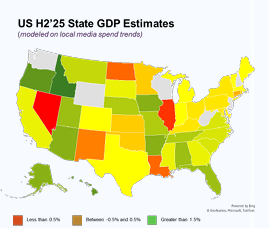
Yesterday, the Federal Reserve and the Bank of Canada each cut interest rates by 25 basis points, citing weakening job markets and inflation heating up. The Fed has signaled potential for two more cuts this year based on changing economic conditions. Guideline examined its local media spend trends modeled on economic data, and it estimates 36% of states have negative GDP for Q2, with an additional 20 states trending downward in the second half of 2025.
These economic headwinds will likely slow media spend, Guideline concludes.
What does this mean for broadcast media and advertising?
“Facing increasing economic headwinds, brands will need to pivot strategies,” Guideline says. “Publishers proving ROAS or ROI will fare better in economic downturns as brands will be under pressure to show results benefiting topline revenue or cost savings.”
In a report distributed Friday, Guideline shares that the summer has seen economic and media spend growth moderate as tariff related costs navigate their way through the economy. Using an econometric model, Guideline’s local media spend was found to be predictive of state level GDP. “Given Guideline’s data is available roughly 3 months ahead of state level GDP, we modeled out what the economy could look like in the second half of 2025 based on state level local media spend trends,” it said.
The conclusion? “As Q3 winds down, our economic model shows conditions worsening in most states as local ad spend is on pace to decline faster than historic benchmarks, a potential bellwether of economic activity for the second half.”
This tracks with research by Moody’s Analytics that showed 33% of the U.S. is already in a recession. “For added context on average, 11% of the U.S. states have negative quarterly GDP since 2006, so 33% is elevated but not full recession territory,” Guideline said.
Guideline’s econometric model projects 23 states’ GDP to be below 0.6% in the second half of 2025. “September is not fully closed so the forecast may turn around, but taken with the Fed’s rate cuts, weakening job numbers and CPI heating up, it signals a softening U.S. economy.”