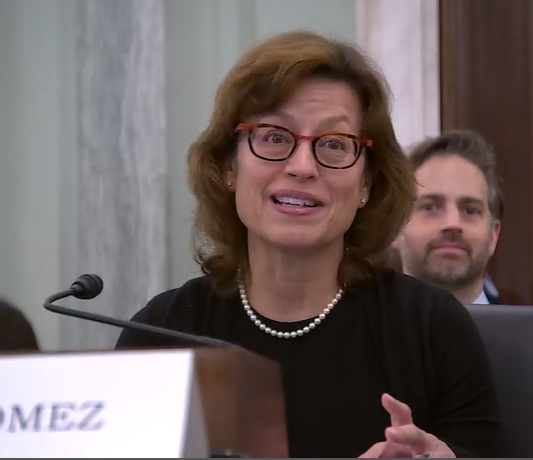
She’s been a FCC Commissioner for three months, and perhaps a pivotal decisionmaker when it comes to the future of the Commission’s local ownership rules for Radio.
This could explain why the heads of Mid-West Family Broadcasting and Connoisseur Media were joined by one of Washington’s most high-profile communications attorneys for a Monday Zoom meeting with two members of Anna Gómez‘s office to discuss the 2018 Quadrennial Review — which the FCC is under a court order to complete in 10 days.
Indeed, the virtual meeting on December 18 saw Jeffrey Warshaw of Connoisseur and Tom Walker of Mid-West, along with Jennifer Tatel and David Oxenford of Wilkinson Barker Knauer, discuss the FCC’s consideration of the five years’ late Quadrennial Review with Deena Shetler and Harsha Mudaliar.
Shetler and Mudaliar were representing Gómez, and sat in on a presentation which emphasized that the radio marketplace “has significantly changed” since the adoption of the Telecommunications Act of 1996 — legislation signed by President Clinton that ushered in a wild period of consolidation for the U.S. radio industry.
As Warshaw, Walker and Oxenford see it, broadcast radio stations don’t necessarily compete amongst themselves. In fact, they argue, “digital competitors are unquestionably
part of the same marketplace for both advertisers and listeners as are radio broadcasters.”
They discussed how digital media, “unconstrained by regulation,” now takes “well more than half of the local advertising revenue in every market — revenue that previously sustained broadcaster’s local service efforts.” They added that “no radio station in any market has more than 1% of the local advertising market share” while Google, Facebook and Amazon divide more than half of that local revenue and “provide no local service.”
While some may say that the rise of local digital came at a time when a consolidated radio industry cut costs by eliminating local programming, marketing and contesting, thus making the content less appealing to listeners, many radio industry leaders point to rate structure differences and the ability for marketers to engage in “addressable advertising.” While Radio is empowered to do so via station websites and streaming audio, the bulk of the ad buys with its clients remain focused on on-air spots.
For Warshaw, statistics were shared that show radio’s share of the local listening audience and its share of local advertising revenue to both be cut in half in the last 12 years.
Walker noted that, as such, the revenues received by broadcasters today do not allow new
owners or small operators to earn enough to support local services.
Thus, they assert, “There is simply not the financial support for new entrants to come in to radio markets and buy a standalone station that will provide local service.” Indeed, media brokers have told RBR+TVBR over the past several years that the most logical buyer would be a broadcaster already in the market who could achieve more scale through a station acquisition.
Several years ago, this would have been heavily criticized, with one company cornering the market and creating a Radio monopoly. Not today, given the presence of digital media, Warshaw, Oxenford and Walker argue. In fact, a single owner in a market could create more diverse program offerings. For Mid-West Family Broadcasting, Spanish-language and Farm programming are the direct result of owning multiple stations in smaller markets; these stations would not survive on their own, Walker says.
While conventional wisdom in Washington says Gómez would align with FCC Chairwoman Jessica Rosenworcel and Geoffrey Starks, who sided with a failed court challenge of rule “modernization” undertaken by the Pai Commission, Oxenford used the opportunity to allow her to hear from two independent radio broadcasting company leaders. This could allow her to form her own opinion and perhaps side with Walker, in particular thanks to the Spanish-language services Mid-West is able to provide.
For Oxenford and for brokers, of course, further deregulation means business. Literally.
“There are radio owners in many markets today who want to exit the market and cannot
find a buyer for their stations,” he said in an ex parte filing with the FCC detailing the Zoom meeting. “There is not a shortage of stations to buy, but a shortage of buyers willing to invest in stations that cannot achieve scale in their markets.”
As such, allowing companies like Mid-West and Connoisseur to own more their stations in their markets has myriad benefits, with the preservation of local service perhaps the biggest of them all.