The question of whether the Commission should modify, retain or eliminate the 39% national audience reach cap and/or its reinstated “UHF Discount” used by broadcast TV to calculate compliance with the cap will now be put to the public.
The FCC said yes on a party-line 3-2 vote to an NPRM that, Republican Commissioners note, won’t do anything but ask the question of whether changes should be made.
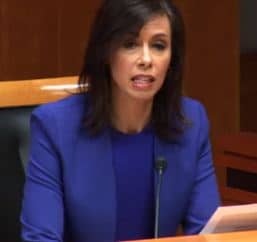
However, such changes are all but certain, Democrats including Commissioner Jessica Rosenworcel warn.

MB Docket No. 17-318 begins what the FCC calls “a comprehensive review” of its national TV ownership cap and asks the question of whether or not ownership caps should be lifted.
It was incorrectly reported by at least one journalist on Twitter that the FCC today lifted its ownership caps.
The approval of the NPRM came some 3 1/2 hours into one of the most momentous FCC monthly meetings in years, as the Commissioners in a 3-2 vote removed Title II classification of broadband internet — a move made two years ago by the FCC under former Chairman Tom Wheeler.
While news organizations and bloggers largely covered the vote on the end of “net neutrality,” there was nary a word on a subject that has been nearly as controversial: The “UHF Discount.”
Much has been debated and discussed about the FCC’s restoration under Republican Chairman Ajit Pai of the UHF Discount, which permits stations broadcasting in the UHF
spectrum to count only 50% of the television households in their market when determining compliance with the national cap, as opposed to 100% of the households attributed to VHF stations.
Those in opposition to the discount say it is a relic of the 1980s and no longer makes sense in an age when UHF signals are of greater value for broadcasters, and MVPDs are able to bring the majority of a market’s full-power UHF stations to subscribers.
Republicans argue that the UHF Discount had to be restored, in order for the Commission to fairly and justly review and assess all of its ownership rules. Furthermore, the FCC’s “Fact Sheet” drafted by the GOP majority notes, “The Commission reinstated the UHF discount after finding that the elimination of the discount had effectively tightened the 39% cap without even considering whether such tightening was in the public interest.”
As such, a “broader review” of the national audience reach cap, including the UHF discount, is officially set to begin.
COURTS CONCLUDE ‘DISCOUNT’ RETURN IS CORRECT
An anticipated June 5 return of the UHF discount was thwarted by an administrative stay by a D.C. Federal Appeals Court—but only to give the court a bit more time to look at arguments for and against eased restrictions on station ownership.
On June 15, a verdict in favor of the FCC came from the court.
This set the stage for what could be a flurry of deals akin to Sinclair Broadcast Group‘s announced acquisition of Tribune Media. Without the return of the UHF discount, the Sinclair-Tribune deal and others like it would have likely been scuttled.
Subsequent arguments assailing the UHF discount have emerged from various corners of Washington. In early October, Rep. David Price, a Democrat who has been outspoken in his opposition of Sinclair’s proposed merger with Tribune Media, renewed his view that the FCC is aiding Sinclair unfairly with its action to bring back the UHF discount.
Price, joined by California Democrat Rep. Jared Huffman, on July 27 introduced the “Local and Independent Television Protection Act,” or H.R. 3478. The legislation would essentially abolish the UHF discount by an act of Congress, ending what he sees as a big loophole for large media companies to become Goliath-sized. The bill has 15 co-sponsors.
Meanwhile, the Commission argues that the Commission’s last review of its national ownership cap rule “occurred when the video marketplace looked very different and most Americans had fewer options for watching video programming.”
In a formal statement regarding the national cap NPRM, Pai said, “The national television ownership cap and the UHF discount are inextricably linked. Any review of one must include a review of the other. What is the FCC’s authority to adjust this cap, and (assuming we have such authority), how should we adjust it? Should we eliminate the UHF discount? Those are the key questions we’re asking in this Notice. There are no tentative conclusions whatsoever. We’re just asking.”
He then criticized both Rosenworcel and her Democratic colleague Mignon Clyburn, calling it “amusing … to hear such vociferous objections from this bench to simply asking the question whether we have authority, given that the same commissioners previously answered it—in the affirmative.”
It’s also amusing to Pai that those who have repeatedly voiced their strong opposition to the UHF discount in recent months are now voting against seeking comment on eliminating it.
He warned, “Make no mistake: A vote against this Notice is effectively a vote in favor of keeping the UHF discount in place.”
DUAL DISSENT FROM DEMOCRATS
Rosenworcel, to little surprise, was not one to mince words on the NPRM vote.
“At a time when real facts get casually derided as fake news, algorithms are ascendant, and what is viral is not always verifiable, the FCC starts a rulemaking to further consolidate television news,” she said via Twitter. “Not smart. Not necessary. I dissent.”
In her formal dissent, Rosenworcel also charged her Republican colleagues with an unlawful action.
“At the direction of Congress in the Consolidated Appropriations Act of 2004, the FCC is statutorily prohibited from allowing a single company from acquiring stations that reach more than 39 percent of the national television audience,” she says. “The FCC lacks authority to change this law. Doing so is the exclusive province of Congress … But somehow, someway, we have this rulemaking anyway. And somehow, we are still
talking about the UHF discount—a concept that should have been retired nearly a decade ago when the introduction of digital television rendered it technically outdated and scientifically obsolete.”
Mignon Clyburn was equally vocal in her three-page dissent.
“The current Administration, in its quest to green light even greater media consolidation, has found a way to rewrite history,” she lamented.
She punctuated her comments by opening with “sage words” delivered in 2000 by veteran broadcast journalist Linda Ellerbee: Television, like newspapers and like radio, works best when it speaks with many voices, and as these companies swallow one another up, there is the frightening possibility of it all speaking with one voice.
RBR+TVBR