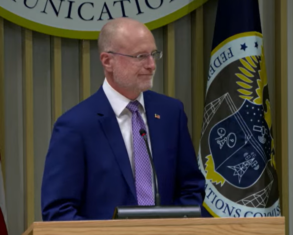
With rumors swirling across Washington on Tuesday that FCC Chairman Brendan Carr was teeing up an Order for consideration at the Commission’s August Open Meeting addressing the nation’s media ownership rules, insiders surmised that the proposal would include some sort of modernization of AM/FM radio station ownership as well as UHF/VHF television station ownership.
That’s not the case, as the Commission’s leader went to Brietbart to share that the August 6 vote will focus solely on a move to repeal the FCC’s 39% national television multiple ownership rule.
Specifically, the FCC will vote to replace the national cap with a granular, case-by-case review.
While the Commission did not move to adjust the percentage to perhaps 69% or even 100%, the announcement from the Commission excited investors within minutes of the announcement. As of 3:30pm Eastern, Nexstar Media Group shares were priced at $182.24, up 3.8% after rocketing to nearly $191 per share in late morning trading.
The E.W. Scripps Co.’s stock price was up to $3.07 after earlier climbing to $3.17; Sinclair Inc. shares were up by 3.6% to $14.30, while Gray Media stock was priced at $4.05, up by 6.2%.
Among the first industry leaders to applaud the proposed Order is NAB President/CEO Curtis LeGeyt. He thanked Carr and the Commission for moving forward with consideration of the order. “This reflects the understanding that decades-old ownership restrictions that apply only to broadcasters — and none of our competitors — are out of step with today’s media marketplace. Eliminating the
As the FCC sees it, the Order “will empower” the Commission to approve deals “that promote the public interest while allowing the agency to reject any deals that do not meet that standard.”
With ABC Owned Stations licenses in an early renewal period over what Chairman Carr has called “invidious” DEI claims, the Commission’s public interest standard has received the highest form of scrutiny in a generation.
“This action will foster a competitive media market, enhance localism, and promote investment in trusted sources of news and information,” the Commission said.
In his official Blog as FCC Chairman, released Wednesday afternoon, Carr added, “Previously, the cap operated as a blanket prohibition on any deal that would combine stations in excess of the FCC’s 39% limit—regardless of whether it was a good deal or a bad one for the country. Our new approach would allow the FCC to approve deals that exceed the 39% cap, but only if doing so would promote the public interest.
“This action is key to supporting local journalism. While the FCC adopted the cap to protect local broadcasters, it now operates to hold them back. Their competitors, including those in digital media, are free to compete in 100% of the relevant markets. But this outdated FCC rule prevents local broadcasters from competing on anything resembling a level playing field—denying them the scale to invest in local news.
“The FCC has tried clinging to rules like the cap before and the results speak for themselves,” he concluded. ” For decades, the FCC kept rules in place that prevented investment in local newspapers. Flash forward to today, thousands of newspapers have shuttered and up to 80% of local journalism jobs have vanished. The FCC should give local broadcasters and the talented journalists that work there a fighting chance.”
The draft order will be made available to the public tomorrow, the FCC added.
FLEXING AUTHORITY
For those who argue that it is the job of Congress, not the FCC, to amend or remove the 39% national television ownership cap, the Carr Commission feels otherwise — as do the NAB and the nation’s largest licensees of UHF and VHF stations.
Thus, the Commission has exercised “its authority” to modify the FCC rule for the first time in over 20 years—aligning it with “current market realities.”
In its current formulation, the national cap generally has operated as a blanket prohibition on transactions that would result in the merged entity achieving a national audience reach greater than 39% of television households. “As applied, the rule generally has presumed that it would not be in the public interest to allow a particular deal in excess of this bright line limit,” the Carr Commission said.
Shifting from a relatively inflexible, ex ante regulation to an individualized, case-by-case assessment “will help ensure that the Commission carries out its statutory mandates in an appropriate manner without having to show special circumstances that would justify a waiver of a rule that no longer serves the public interest,” the Commission added.
Further, in line with the Carr Commission’s public interest focus, it believes strict ownership limits on local broadcasters that prevent them from competing with other players in the modern marketplace are not in the public interest. “While competitors are free to reach 100% of their relevant market segments, this FCC rule has generally limited broadcasters to competing for just 39% of theirs,” the Commission said.
Explaining the reasoning for a case-by-case approach, the Commission said its interests in localism, viewpoint diversity, and competition — to the extent they are implicated in a case — can be fully analyzed and vindicated in the context of a specific transaction.
“There may be transactions that would have exceeded the limits of the 39% national cap that do not promote the public interest and those will be denied,” the Republican majority on the Commission continued. “On the other hand, there may be transactions that would have exceeded the cap that do promote the public interest and could gain Commission approval.”
Under the proposed new rules, any transaction that would have been barred under a strict application of the current rule will be subject to the Commission’s regular review process to determine whether approval would serve the public interest.
In addition, the proposed rules demonstrate, the Commission concludes, that this action “is within the Commission’s statutory authority to repeal the rule, as multiple agency Chairs—both Republican and Democrat alike—have consistently stated. While Congress has at times directed the Commission to change our rules, it has never withdrawn our authority under the Communications Act to regulate or change ownership limits.”
These rules were last updated before Netflix streamed a single movie, before the first iPhone, and before Instagram existed, and they continue to single out local broadcasters based on a competitive landscape that disappeared with the VCR.” — Nexstar Media Group
A WELCOME AND LONG-OVERDUE STEP
 For the nation’s No. 1 owner of broadcast television stations, news of the Order vote from Chairman Carr was cheered.
In a statement, a Nexstar spokesperson said, “It’s been over two years since Chairman Carr astutely observed, ‘We are at a break glass moment for America’s broadcasters.’ The FCC’s decision to review the national television ownership cap is a welcome and long-overdue step toward bringing broadcast regulation into the modern media marketplace. These rules were last updated before Netflix streamed a single movie, before the first iPhone, and before Instagram existed, and they continue to single out local broadcasters based on a competitive landscape that disappeared with the VCR. No one would suggest limiting the reach of YouTube, Amazon, or CNN, yet local broadcasters are still forced to compete under rules written for a different century. Modernizing these outdated regulations will help ensure broadcasters can continue investing in local journalism and providing the free, trusted news and information that communities across America rely on every day.”
 As Sinclair President/CEO Chris Ripley sees it, “It should not be controversial to suggest that changed facts should lead to changed rules. We commend Chairman Carr for considering action to modernize the FCC’s rules setting the national ownership cap — and for his continued leadership in looking at ways to preserve local news by taking proactive steps to empower local broadcasters. Given the undeniable change and disruption to the media ecosystem, updating these rules to reflect the current landscape is common sense.”
Meanwhile, one television station owner who spoke with RBR+TVBR asked if this could impact the Ninth Circuit’s review of Nexstar’s merger with TEGNA, which a group of state Attorneys General and DirecTV seek to stop, or a California federal district court’s pending look at whether the combination of the companies presents an antitrust violation. It is believed that the lawsuit will not be impacted by a change in the ownership rules made after the transaction closed; if anything, the FCC would be further empowered to move ahead with a full Commission vote on the deal, as it has stated, by year’s end, passing it on a 2-1 vote on the grounds that the new rules only strengthen the Media Bureau’s granting of rule waivers allowing the transaction to pass muster with the FCC.