FCC Plan To ‘Modernize’ Broadcast Ownership Rules Is On

0

WASHINGTON, D.C. —  The FCC has advanced a Notice of Proposed Rulemaking that would advance the Commission’s quadrennial regulatory review of its broadcast ownership rules and seek public comment on whether — given the current state of the media marketplace — it should retain, modify, or eliminate any of these rules.


Now comes a public comment period, one that will likely see a flood of filings advocating for needed regulatory relief and warnings from others that any thawing of local ownership caps is dangerous and unnecessary.

The vote came after a brief protest from attendees who shouted, “Fire Carr the censorship czar!” before being escorted from the meeting room.


The affirmative vote for MB Docket No. 22-459 puts into motion, three years late, the 2022 Quadrennial Regulatory Review.

This will allow the Commission to assess its broadcast ownership rules and other rules adopted pursuant to Section 202 of the Telecommunications Act of 1996.

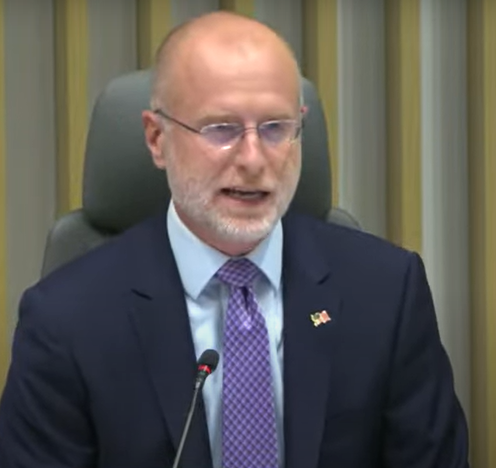
Commenting on what’s next for the FCC, Chairman Brendan Carr — who smiled stoically when a small but vocal group of protestors attempted to disrupt the September Open Meeting — took one of many opportunities to tout his “Build America Agenda.”

When he announced it, Carr emphasized the importance of “the Gretzky Test — keeping our eye on where the proverbial puck is going, not where it has been.” For Carr, “Nowhere is that more important than with our media regulations. So as we kick off this latest Quadrennial Review, the FCC must do so with an eye towards the future.”

After all, he continued, “the old regulatory silos have been breaking down for quite some time, so the Commission must move forward with a keen understanding of today’s converged markets — and that’s exactly what we’re doing with today’s item.”

Carr also believes it is fair to say that “the Gretzky Test,” referencing hockey great Wayne Gretzky, is why Congress first required the FCC to conduct Quadrennial Reviews in 1996. “They wanted us to consistently reassess market conditions to ensure our media ownership rules were keeping pace with the times,” Carr explained. “In recent years, numerous online audio and video streaming services have emerged, fundamentally changing how broadcast radio and television compete in the media marketplace. Our broadcast ownership rules should reflect these changes. In fact, the FCC is required by law to review certain broadcast ownership rules every four years to determine whether the rules remain ‘necessary in the public interest as the result of competition,’ which has traditionally meant advancing competition, localism, and viewpoint diversity.”

But, Carr lamented, “The FCC has not always done so. Indeed, just this year the Eighth Circuit determined that the FCC acted arbitrarily and capriciously when it adopted the last Quadrennial Review order. In doing so, the court emphasized the deregulatory nature of the Quadrennial Review provisions that Congress added to the statute.”

Ultimately, the court vacated the FCC’s decision to retain the “top-four” rule, which prohibits a single entity from owning or controlling two of the top four television stations in a local market. “We are guided by the court’s decision here,” Carr said, as he concluded the Commission intends to take “a fresh approach to competition by examining the broader media marketplace, rather than treating broadcast radio and television as isolated markets.”

The primary goal of the Carr Commission? “To promote investment in local broadcasters who provide trusted news and information vital to the communities they serve,” Carr said, noting that the NPRM will also consider whether public safety, national security, and other public interest goals should be part of this review process. “If we determine that any rule no longer serves the public interest, we will fulfill our statutory duty to modify or eliminate those rules,” Carr pledged.

A LENGTHY STATEMENT OF SUPPORT

The lone Democrat on the FCC voiced support for efforts that would seek comment on the “modernization” of the Commission’s broadcast ownership rules and looks forward to “productive engagement with stakeholders” while she remains focused on retaining rules necessary to serve the public interest.

Those words from Anna M. Gómez came at the end of a long statement from the Commissioner, which began with her lamenting “one of the most alarming attacks on the First Amendment in recent memory.”  She referenced calls to prosecute an ABC News reporter for coverage that had been assailed by some as “hate speech” while skewering the Republican majority at the Commission for threatening to go after ABC for comments made by Jimmy Kimmel on his late-night program about the suspected assassin of conservative political activist Charlie Kirk. The suggested action against ABC for Jimmy Kimmel Live! broadcasts that saw the host misclassify the suspect’s political leanings and influence, in Gómez’s view, serve as “a pretext to punish speech it disliked. That led to a new low of corporate capitulation that put the foundation of the First Amendment in danger.”

Anna M. Gómez

For Gómez, “This was no simple business decision. It was an act of clear government intimidation. And while the FCC does not have the authority, the ability, or the constitutional right to police lawful content or to punish broadcasters for speech the government dislikes, even the threat of revoking a license is no small matter. It poses an existential risk to a broadcaster, which cannot exist without its license.”

For Gómez, the brewing tussle between the Carr Commission and the ABC Television Network “left local stations trapped in the middle as these massive companies impose their will and their values upon local communities. This precise example neatly encapsulates the danger of allowing vast and unfettered media consolidation. This could drastically alter the media ecosystem and the number of voices that are a part of it.”

That’s why the NPRM that would open the 2022 Quadrennial Review is timely, as Gómez thinks “it is the right moment to give an overview of what is expected, how these actions are related, why it matters, and what is at stake.”

‘ONLY CONGRESS CAN RAISE THE CAP’

While Gómez is on board for the start of the 2022 Quadrennial Review process, limits on points of view when it comes to local news is a concern that lifting the two-station rule would acerbate, even as the NAB and broadcast television station owners argue that eliminating the regulation is necessary due to the economics involved with preserving a diversity of voices.

She referred to one consumer in Eugene, Ore., who lamented that four of the five local stations that broadcast local news “are owned by a single entity.” But, that’s not entirely true. In the market, CBS affiliate KVAL-TV is owned by Sinclair Inc., which provides services to dual NBC/The CW Network affiliate KMTR-TV through an agreement with Roberts Media. Cox Media Group-owned KLSR-TV, the FOX affiliate, airs KVAL-produced newscasts at 7pm and 10pm each weeknight. Otherwise, KEZI-TV, the ABC affiliate, is owned by Allen Media Group and maintains its own newsroom.

Nevertheless, this Oregon television viewer raised concerns to Gómez that these stations, which engage in shared services agreements permissible under FCC rules, “all share the same crew, reporters, on-air personnel and stories for the local news programing. This means that although there are five stations with local news programs on air each day there [are] really only two choices … [and] that limits the points of view available when it comes to local news stories.”

How the FCC moves forward will likely place a minimal focus on this concern, based on its desire to consider “the broader media marketplace” that includes unregulated “Big Tech” that has siphoned ad dollars and consumer attention from legacy linear media.

But, Gómez made it clear that the FCC itself has no jurisdiction in adjusting the ownership cap. “Given the prior Congressional action, I believe that only Congress can raise the cap,” she said. “From a policy perspective, as explained in the item today, our regulatory structure is in large part based on a balance of power between national networks with incentives to serve national interests and local broadcasters with incentives to serve their local communities. A significant question to be addressed is how would ownership of a group of local broadcasters that together reach the majority or all of the nation change the incentives of that station group? In the past two weeks the public has raised serious concerns that large station groups made programming decisions to serve their national corporate interests, not their communities of license. What is the impact of letting them get even bigger?”

Lastly, Gómez addressed the desire of the NAB and TV station ownership groups to have a sunset date for ATSC 1.0 broadcast signals, requiring a wholesale shift to ATSC 3.0 by a specific date and ending the current voluntary transition put in place by the Rosenworcel Commission under the Biden Administration. “This may well be a great use of spectrum but we should certainly consider the policy implications of allowing this before it happens,” Gómez said.

In addition, the Commission will seek comment on the Dual Network Rule, which effectively prohibits a merger between or among the Big Four broadcast networks.  The NPRM asks whether these networks remain so unique, particularly with respect to video programming and national advertising, as to justify applying these rules only to them.