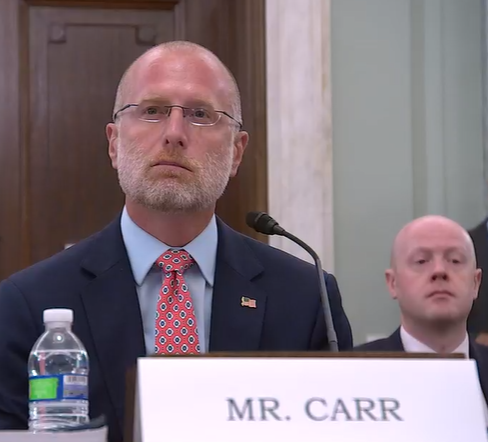
The top Republican vote-maker at the FCC says he will take an open mind as the FCC reviews the record in response to a Notice of Apparent Liability for Forfeiture alleging Nexstar Media Group and Mission Broadcasting ran afoul of the National Ownership Cap and engaged in a de facto transfer of control putting Nexstar in control of WPIX-11 in New York.
In particular, he’s concerned about facts that apparently emerged after the relevant FCC approvals tied to WPIX seen in 2019 and 2020.
At the same time, FCC Chairwoman Jessica Rosenworcel offered a statement that was brief but blunt as to what the Commission is claiming.

With the issuance late Thursday (3/21) of the Notice of Apparent Liability for Forfeiture, in which a $1.2 million-plus proposed fine is being handed to Nexstar while Mission would be on the hook for half that amount, Rosenworcel said, “Under the Communications Act, as amended by Congress in the Consolidated Appropriations Act of 2004, the Federal Communications Commission is prohibited from allowing a company to own or control broadcast stations that in total reach more than 39% of the national television audience. The record here reflects a situation where a company exceeds this threshold. Unless and until Congress changes this law, it is the responsibility of this agency to enforce it.”
It is therefore easily deducible that Rosenworcel fully supports the facts as stated in the NALF.
For Brendan Carr, the senior Republican FCC Commissioner, he notes that in 2019 and 2020 Nexstar and Mission provided the FCC “with express and detailed information about their relationship.”
In particular, he says, the parties disclosed to the FCC that Nexstar would provide all of the programming for WPIX, that Nexstar would collect all of the revenue from the station (including retransmission consent revenues), and that Nexstar had entered into an option to purchase WPIX, among other specifics. “After reviewing those disclosures, the FCC approved the relevant transactions, finding that it would serve the public interest.”
Flash forward to today, and Carr notes that in the NAL the FCC cites to those previously disclosed and reviewed features of the Nexstar-WPIX relationship “as indicia that Nexstar
may be exercising too much control over WPIX.”
Here’s where Carr may now question the arrangement. “To be sure, the NAL cites additional features of the relationship, as well as facts that apparently emerged after the relevant FCC approvals,” he states. “Those FCC allegations will require careful review.”
Yet, Carr contends that it is concerning to him that the FCC cites as evidence of control those features of the relationship that the FCC previously signed off on.
“We need to be careful that we do not undermine reasonable reliance on prior FCC decisions,” Carr says.