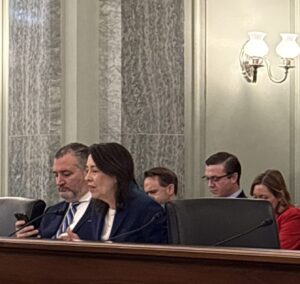
WASHINGTON, D.C. — Two of the most powerful Members of the U.S. Senate have written to FCC Chairman Brendan Carr seeking answers to Commission inconsistency when it comes to resolving significant transactions at the staff level.
It presents a significant rift between Carr and Ted Cruz, perhaps the most recognizable Republican leader on Capitol Hill. And, it could throw another wrench into Nexstar Media Group‘s completed merger with TEGNA.

In a formal four-page letter to the FCC Chairman, Cruz and Senate Commerce Committee Ranking Member Maria Cantwell (D-Wash.) wish to better understand the Commission’s actions regarding the $6.2 billion combination of TEGNA with Nexstar.
If it were from a Senate Commerce Committee led by Cantwell or perhaps another Democrat, some would likely brush it off as another example of political theatre. In this case, however, Cruz and Cantwell have teamed up to examine why the full Commission didn’t vote on the deal, leaving it to Media Bureau Chief Erin Boone to approve, with waivers allowing Nexstar to exceed ownership limits codified by Congress in 2004.
“This decision raises serious concerns about the Commission’s use of delegated authority in matters involving significant legal, policy, and economic consequences,” the Senators wrote in a letter sent Monday to the FCC Chairman. “The transaction is unprecedented in scale … A transaction of this magnitude alone warranted consideration and a vote by the full Commission.”
“A transaction of this magnitude alone warranted consideration and a vote by the full Commission.” — Senators Ted Cruz and Maria Cantwell
With Cantwell and Cruz reminding Carr that Congress entrusted the FCC with substantial authority under the Communications Act, including the mandate to act in the “public interest,” this allows the Commission to delegate certain responsibilities to its bureaus, “but such delegations are constrained by statute and regulation.”
Specifically, the Senators note that a bureau may not act on matters that present new or novel legal, factual, or policy questions unresolved by existing precedent.
Enter Exhibit No. 1, the Nexstar-TEGNA merger.
“This merger required the resolution of significant and unresolved legal questions,” Carr and Cantwell state. “Most notably, the order granted an expansive waiver of the 39% national audience reach cap—a statutory limit set by Congress—despite ongoing debate about the Commission’s authority to modify or circumvent that cap. In addition, the order approved extensive waivers of local ownership rules, including authorization of three major full-power stations in a single market in numerous cases. These are not routine applications of settled policy; they are substantial departures from existing rules.”
The Senators continue, “The size of the transaction and the scope of the waivers presented are precisely the type of novel and consequential issues that Commission precedent, as well as basic principles of administrative accountability to the American people, require to be decided by the full Commission.”
Equally troubling for Cruz and Cantwell is “the procedural consequence of this choice.” Because bureau-level decisions are not final orders, they tell Carr in the letter, “parties must first seek Commission review before accessing the courts.”
In a transaction of this scale, where integration proceeds quickly and unwinding becomes impractical, delay in judicial review can insulate the decision from meaningful challenge, the Senators add. “That outcome is difficult to reconcile with the Commission’s obligation to ensure transparency and accountability in major actions.”
A CHAIRMAN’S CONTRADICTORY STANCE

Chairman Carr has stated in the past that significant transactions should not be resolved at the staff level.
This flip-flop of opinion is at the heart of Cruz and Cantwell’s query. In June 2023, in a renomination hearing allowing Carr to extend his time on the Commission, he committed to “not block a large transaction without a Commission vote,” emphasizing that such decisions “must reflect the will of the Commission.”
This fact was shared in the letter from Cruz and Cantwell to Carr, as was the FCC Media Bureau’s April 2024 denial of the sale of WADL-TV in Detroit to Mission Broadcasting from Adell Broadcasting Corp. In the matter regarding WADL, Carr said the Bureau does not have the authority to block the deal.
Two years later, Carr is singing a different tune, and that has Cruz and Cantwell perplexed. “The Nexstar–TEGNA order presents the same kinds of questions. Yet here, the Commission proceeded in the opposite direction,” they state.
In fact, they add, “If a transaction of this scale, involving statutory caps and waivers across dozens of markets, can be resolved at the bureau level, it is unclear what types of decisions still require Commission-level review.”
That’s a big concern for the two Senators, as Boone’s approval of the Nexstar-TEGNA deal would establish precedent in the future, getting clearance without a full Commission vote. Such a concern goes beyond partisan politics, and as such Carr was presented with an Easter basket comprised of four questions he must answer to the Senators by April 13.
Here are the questions Brendan Carr has been asked to answer to Senators Maria Cantwell and Ted Cruz:
-
At the Commerce Committee’s hearing last month reviewing the Commission’s media ownership rules in light of this proposed transaction, Chairman Cruz reiterated that “a full Commission vote is required for certain matters, particularly those involving significant legal or policy consequences. Designating a multi-billion-dollar transaction such as the Standard General-TEGNA transaction for an ALJ hearing is precisely the type of serious decision for which commissioners must take responsibility.” Given the scope of the transaction, the novel legal issues involved, and the waivers required, why was the transaction resolved by delegated authority rather than by the full Commission? Please identify and describe the precedents you used to authorize the use of bureau-level delegated authority to approve the Nexstar-TEGNA transaction, including any precedents addressing the waiver of the 39% national audience reach cap and the local duopoly waivers.
-
You recently characterized the Nexstar-Tegna approval order as an “initial [staff] decision,” with the possibility of a full Commission vote following an application for review. Please clarify the process and expected timing for full Commission consideration. Further, what role would a Commission vote serve at this stage, given that the transaction has already been approved on delegated authority, and how would such a vote ensure meaningful Commission-level deliberation on a transaction of this magnitude?
-
In your dissent to the Biden FCC’s approval of the Audacy transaction, you stated that “[i]t is hornbook law that staff-level decisions (whether they complied with federal law or not) do not set precedent for the Commission.” Did this consideration factor into your decision to delegate review of the Nexstar-Tegna transaction to the Media Bureau?
-
Given the size and complexity of the legal issues surrounding the waivers granted in the Nexstar-Tegna order, what limiting principle will govern the use of delegated authority in transactions going forward?