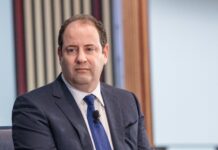
The Chairman of the FCC has reiterated his belief that the FCC has an obligation to enforce a public interest standard for broadcasters who have been given the right to use a “very valuable public resource” — spectrum — and will continue to do so under a Congressional statute it is obligated to follow.

Responding to a question in a post-December Open Meeting press conference with a small group of journalists, Brendan Carr commented on words shared at the December 17 Senate Commerce Committee’s oversight hearing of the FCC. There, Carr mentioned that the public airwaves could potentially be auctioned off if buyers wish to avoid adhering to the public interest standard.
The statement was not new, as Carr had stated this before. For Bloomberg News reporter Kelcee Griffis, the question was how this differs from what already happens when there is “a popular station that goes to an auction when there is more than one interested buyer.”
Griffis did not provide an example of the hypothetical scenario, which is largely seen only in court-ordered Chapter 7 bankruptcy liquidation cases.
She then asked ahead of a response from Carr about a social media post from President Trump on Wednesday that suggested he’d like to see the airwaves used in a better way, paraphrasing the Commander-in-Chief. The comments included Trump’s suggestion that broadcast TV networks pay significant fees for the use of the airwaves; network owned-and-operated stations comprise a small number of the total stations held by FCC licensees. Could Carr explain what Trump was inferring, and if had anything to do with the aforementioned auction proposal?
He replied, “Broadcasters originally got their spectrum from the government for free. It’s a very valuable public resource. Part of the bargain that took place here was that broadcasters are supposed to operate in the public interest — not just the narrow interests that anyone would operate on if they had their own podcast or soap box. I think we want to make sure that the American people are getting the value out of those airwaves.”
The spectrum auction idea, Carr continued, allows those who are uncomfortable with the public interest standard — “the statute that Congress passed” — to potentially pay more to avoid the “obligation” broadcasters hold. “But until there are reforms or changes along those lines, our job is to enforce the Communications Act and that’s exactly what we’re going to do.”
In terms of a spectrum auction offering a premium path around the public interest standard, Carr shared that it is something “that presumably would require legislation from Congress” but believes all ideas are on the table. “Fundamentally, I think we’re trying to reorient the FCC’s approach to the broadcast sector,” he said, adding that he thinks that over the years the agency stepped back from enforcing the public interest standard. In Carr’s view, “I don’t think that was a good thing.”
If they don’t like it? “There are many, many ways of distributing programming these days that don’t have a public interest standard,” Carr said. That includes YouTube, which reached an agreement revealed Wednesday that it will be the exclusive home of the Oscars from 2029 through 2033. As such, should YouTube choose to, it can eliminate any censors that ABC would be obliged to use.
With the Oscars announcement perhaps the biggest OTT era programming shift to date as professional sports leagues ink deals with Netflix and Amazon Sports, a future in which broadcast television networks are dissolved is an existential threat. And, with little discussion of applying broadcast license obligations on digital media, how a UHF or VHF station serves their respective communities will undoubtedly evolve from today in the coming years.
Alas, Carr is intent on following statutes by the book, and broadcast TV will not be getting a free pass under his leadership.
“If you want to be on this one, unique thing — the broadcast airwaves — we’re going to hold them accountable to that,” Carr said.
The post-December Open Meeting press conference also saw FCC Chairman Brendan Carr note that the Commission is looking into possible underwriting violations at NPR and PBS member stations and that it will not eliminate its “news distortion” policy, in place for decades.