By Brian Galante
Special to RBR+TVBR
When IBC 2026 begins on September 11 in Amsterdam, U.S.-based ENCO will introduce latest innovations for its Qimera Virtual Production system, demonstrating how advanced virtual production technology can help crews create more compelling content while making more efficient use of people, studio space and technical resources.
Visitors to Stand 7.A34 can step onto ENCO’s green screen and experience Qimera’s virtual production environment firsthand throughout the show. Visitors will also learn how Qimera now supports three production modes from one server: traditional virtual studio work with green screen keying, live AR graphics and – new for IBC – LED-based extended reality.
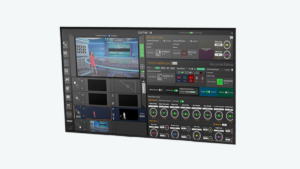
Qimera is a real-time 3D compositing platform that enables broadcasters and live content creators to produce immersive virtual environments, augmented reality graphics and dynamic live productions from a single system. Its flexible production model allows broadcasters to create multiple programs from one studio, instantly change virtual sets and reduce the time, space and physical infrastructure traditionally required to create distinctive broadcast environments.
At IBC, ENCO will place a special emphasis on Talent Tracking, Qimera’s unique technology and a key competitive differentiator for the platform. Unlike conventional approaches that track talent on a two-dimensional plane, Qimera tracks the presenter’s full body in 3D. The added spatial intelligence allows shadows and reflections to remain accurately aligned as talent moves through a virtual environment, creating a more convincing relationship between the presenter and surrounding virtual elements.
The difference is especially visible in dynamic live productions such as news, weather and sports, where presenters regularly move around a set and interact with graphics. Accurate 3D positioning helps eliminate distracting visual artifacts such as detached shadows and reflections that can make talent appear to float within a virtual scene.
Talent Tracking also opens new creative and operational possibilities. Because Qimera understands the movement and position of the presenter, body movements and gestures can be used to trigger virtual production elements. A weather presenter, for example, can recall a map or chart through a gesture, giving on-air talent greater ability to interact naturally with the surrounding virtual world.
The Qimera advances arriving at IBC reflect a broader shift in virtual production. As visual realism has matured, broadcasters are increasingly looking at the technology not simply to create impressive pictures, but as a practical means of improving everyday production efficiency.
Qimera allows broadcasters to transform the same physical studio from a news set to a sports program, interview environment or other production in moments, without rebuilding scenery or moving physical infrastructure. Robotic and PTZ camera control through the VISCA protocol extends that efficiency by bringing camera positioning directly into the Qimera environment, reducing dependence on separate control systems and enabling personnel to focus on other creative and technical responsibilities.
ENCO has also unlocked LED-based extended reality production in addition to Qimera’s existing virtual studio and AR toolset. Customers can add the LED-wall driver within Qimera’s software as an additional license without replacing hardware or learning a new interface.
Qimera’s latest visual enhancements pair native Unreal Engine 5.6 support with NVIDIA DLSS 4.5 integration. The combination improves GPU utilization and delivers an approximately 15 percent improvement in graphics performance, producing sharper, cleaner virtual environments while allowing broadcasters to extract more performance from existing hardware resources. Enhanced anti-aliasing, lighting and rendering further improve the realism of virtual scenes.
ENCO is also extending Qimera more deeply into established broadcast workflows. MOS connectivity allows newsroom systems such as ENPS to trigger graphics, scenes and media directly within Qimera, helping producers incorporate virtual production into familiar live rundowns rather than operating it as an isolated production system. New browser-based control capabilities add another layer of flexibility, allowing authorized users to access and update Qimera productions remotely. Together, the MOS and web capabilities reduce operational complexity and give broadcasters more options for distributing production responsibilities across their teams and facilities.
Qimera’s broader feature set includes integrated chroma keying, tracked and trackless production modes, a built-in production switcher, real-time charts and data visualization, screen mapping and an expanding library of editable 3D assets for news, sports and entertainment. Its native Unreal Engine architecture combines these capabilities through an intuitive interface developed specifically for day-to-day television production.
“Virtual production is increasingly becoming a primary production tool rather than a secondary capability,” said Frommert. “The ability to create a completely different environment at the click of a mouse changes the economics and creative possibilities of a studio. Qimera brings those advantages together with the automation, integration and ease of use broadcasters need to make virtual production part of their everyday workflow.”