In a significant move that signals a likely lobbying victory for the NAB, the full FCC on Friday released a Second Further Notice of Proposed Rulemaking adopted on November 4 that would allow digital multicast NEXTGEN TV channels to effectively be licensed in the same manner as their host station.
The matter is open for Comments and Reply Comments, with a schedule forthcoming based on the FNPRM’s publication in the Federal Register.
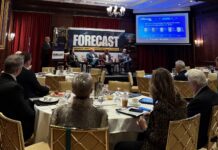
As Gordon Smith exits his role at year’s end as CEO of the National Association of Broadcasters and Curtis LeGeyt prepares to take the helm, what is the state of the broadcast industry from the Beltway view? Steve Newberry, who worked closely with both executives during his own tenure at the NAB, sits down with them in an exclusive Forecast 2022 chat covering legal, regulatory, and legislative initiatives under the leadership of the NAB that have impacted the broadcast industry over the past 12 years, how they will shape and define its future, and what challenges and opportunities lie on the horizon.
DON’T HESITATE ANY LONGER. ATTEND FORECAST 2022 BY REGISTERING NOW.
The 35-page FNPRM is chock full of D.C. “WonkSpeak” and legal language. Specifically, the proposal is a response to a NAB petition.
“We propose to allow Next Gen TV stations to include within their license certain of their non-primary video programming streams (multicast streams) that are aired in a different service on ‘host’ stations during a transitional period, using the same licensing framework, and to a large extent the same regulatory regime, established for the simulcast of primary
video programming streams on ‘host’ station facilities,” the proposal reads.
If that’s hard to comprehend, let us translate to everyday English what the proposal would do.
A licensee would be able to get a license, if you will, giving them easier abilities to sign a deal with another “host” station to carry their multicast channels. This would encompass both ATSC 1.0 and ATSC 3.0 services.
At present, FCC rules fail to address the licensing of multicast streams, even with regard to the host that is airing a station’s primary stream. The Media Bureau implemented an interim process that sees a Next Gen TV broadcaster which has converted or is seeking to convert its facility to ATSC 3.0 seek special temporary authority (STA) to air 1.0 multicast streams on a host station.
“Just as under the current rules for primary guest streams, these STAs permit a guest multicast stream to be treated as if it originated from the Next Gen TV broadcaster’s facility, as opposed to the host station’s facility, for purposes of the Commission’s rules and the Communications Act,” the FCC notes.
The STAs granted to date are valid for six months but may be renewed.
Using a case-by-case process has, in the Commission’s view, become “resource-intensive” for both the FCC and for broadcasters. “[U]nder this approach it is difficult for both Commission staff and potential viewers to track where streams are being hosted,” the Commission adds.
Enter the NAB, which in November 2020 filed a Petition for Declaratory Ruling and Petition for Rulemaking to allow a Next Gen TV broadcaster to license its simulcast multicast stream(s) either together with its primary stream on the primary simulcast host or on
different simulcast host(s), among other requests streamlining ATSC 1.0 and ATSC 3.0 service regulation.